


🟦 Introduction
Prayer belongs to the most important foundations of the life of faith, and yet many people find it difficult to pray consistently and consciously. Often, prayer is used intensely only during times of crisis, while in everyday life it easily fades into the background. This lesson shows through various biblical examples that prayer is far more than speaking requests aloud. It is a personal encounter with God that includes trust, honesty, surrender, and perseverance. Jesus Himself taught His disciples how to pray and showed them that prayer grows out of a living relationship with the Father. This lesson invites us not only to understand prayer theoretically, but to integrate it practically and intentionally into daily life.
🌱
🌱 GROWING IN A RELATIONSHIP WITH GOD
🕊️ Lesson 7: Practical Prayer
📘 7.1 Elijah—Praying in Crisis
God meets us even in moments of fear and exhaustion
📖 1. Introduction – After the great victory comes the collapse
Sometimes we think that after a spiritual success, strength, joy, and stability should automatically follow.
But that is exactly what we do not see in Elijah.
Right after the great victory on Mount Carmel, he falls into fear, exhaustion, and deep despair.
👉 This story shows:
Even strong people of faith can become inwardly exhausted.
📜 2. The biblical foundation – Elijah’s flight and God’s response
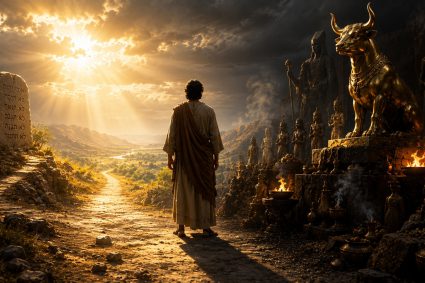
In 1 Kings 18 we witness a powerful moment:
God visibly answers with fire from heaven.
But immediately afterward, Jezebel threatens Elijah with death.
In 1 Kings 19, Elijah flees into the wilderness. There he even asks to die.
His emotional condition stands in strong contrast to the previous victory.
🌍 3. Connection to today
Many people today experience similar tensions:
- spiritual highs
- sudden exhaustion
- inner emptiness
- fear and overwhelm
We often expect ourselves to always have strong faith.
But Elijah shows:
👉 Crises of faith do not automatically make a person unfaithful or worthless.
💡 4. Central message of the lesson
👉 God meets us not only in strong moments of faith, but also in weakness, exhaustion, and inner crises.
His presence does not depend on our emotional stability.
✝️ 5. Theological focus
At the center of this lesson is the question of how God deals with human weakness.
Elijah had just experienced one of Israel’s greatest spiritual victories. Yet it becomes clear that outward success does not automatically make a person inwardly strong. Physical exhaustion, fear, and loneliness also affect spiritual life.
Remarkable is God’s response. God does not meet Elijah with accusations or harshness. He does not first criticize him for his weak faith, but instead cares for his basic needs:
- rest
- food
- water
- protection
This reveals an important spiritual principle:
👉 God cares for the whole person—not only for their “spiritual performance.”
Another central aspect is the nature of God’s revelation. On Mount Carmel, God revealed Himself through fire and power. In 1 Kings 19, however, He reveals Himself in a “gentle whisper.”
This means:
God’s work is not always spectacular. Often He meets people quietly, patiently, and personally.
Elijah’s false perspective also becomes visible. He believes he is the only one left. But God shows him that He is still at work and has preserved others.
👉 Theologically decisive:
God’s nearness does not depend on whether a person is strong or weak. Especially in times of crisis, God reveals His patience, care, and faithfulness most clearly.
📖 6. Explained Bible passages
1 Kings 19:1–18 describes Elijah’s deep inner crisis.
Outwardly, little had changed:
Jezebel still ruled, and the danger remained real.
But inwardly Elijah suddenly loses perspective. Fear becomes stronger than trust.
His wish to die shows deep exhaustion and hopelessness.
Especially important is the way God deals with him:
- God does not force Elijah to act immediately
- God does not begin with arguments
- God first provides for him practically
The food and water give him new strength for the long journey.
The 40 days and nights also remind us of other important biblical times of preparation and encounters with God (Moses, Jesus).
At Horeb, Elijah finally experiences God’s presence:
- not in the storm
- not in the earthquake
- not in the fire
- but in the gentle voice
This shows:
👉 God’s voice is often perceived in silence—not in the noise of fear or busyness.
Isaiah 55:8–9 complements this thought. God’s ways and thoughts are higher than our expectations. Elijah probably expected an immediate, visible change in the situation. But God works differently.
👉 In summary:
This story shows that God does not abandon people when they are exhausted or discouraged. He meets them patiently and leads them step by step back into fellowship with Him.
🔧 7. Everyday application
This lesson becomes practical through concrete steps:
- speak honestly with God in times of crisis
- take physical and emotional limits seriously
- seek times of silence
- do not look only for spectacular answers from God
- trust God even when feelings fluctuate
❓ 8. Reflection question
Where am I currently inwardly exhausted—and am I still listening to God’s gentle voice?
🌟 9. Final thought
Elijah was not finished because God had abandoned him.
He was exhausted.
And precisely there, God met him.
Because:
👉 God’s strength is often revealed most clearly in our weakness.