
🟦 Introduction
Lesson two takes us to one of the most sacred and profound places in the Bible: the burning bush. There, Moses encounters the living God—not in thunder or splendor, but in a simple, yet mysteriously burning bush. This revelation changes everything: it marks the beginning of God’s active intervention for the redemption of Israel. Moses, who feels weak and unworthy, is chosen—called, commissioned, and accompanied by the great “I Am.” This lesson powerfully shows how God, with patience, wisdom, and power, shapes ordinary people to accomplish extraordinary things through them. It invites us to listen for God’s voice—even when it whispers in the wilderness.

⛪ Lesson 2: The Burning Bush
📘 2.1 The Burning Bush
✨ God Meets Moses: The Burning Bush as a Turning Point of Calling
………………………………………………………………….
🟦 Introduction
In a world full of distractions, noise, and constant hurry, many people struggle to hear God’s voice—let alone pay attention to it. Yet Moses encountered God not in a royal palace or a magnificent temple, but alone—in the quiet of the wilderness, while tending sheep. This seemingly ordinary life became holy ground when God spoke to him through a burning bush.
Why did God appear to Moses in a burning bush, in the midst of sand and stones? Because God often speaks to us right where we least expect it—not in spectacular moments, but in stillness, in everyday life, in hidden places. And why did it take 80 years of preparation before Moses was called to his life’s mission? Because calling takes time. And because God cares not only about the “what” but also the “when.”
………………………………………………………………….
📖 Bible Study: Exodus 3:1–6
🔍 1. Historical-Spiritual Context
Moses is now 80 years old (see Acts 7:30). He has been living for decades in Midian, far from the Egyptian court, in complete isolation. From a prince, he became a simple shepherd—yet this is the exact place God chose for his preparation. As we often see in Scripture: God works in hidden places. The solitude of the desert serves the formation of the heart. Moses may have thought his time was over—but God’s time was just beginning.
➡️ Principle: God uses waiting as preparation for working.
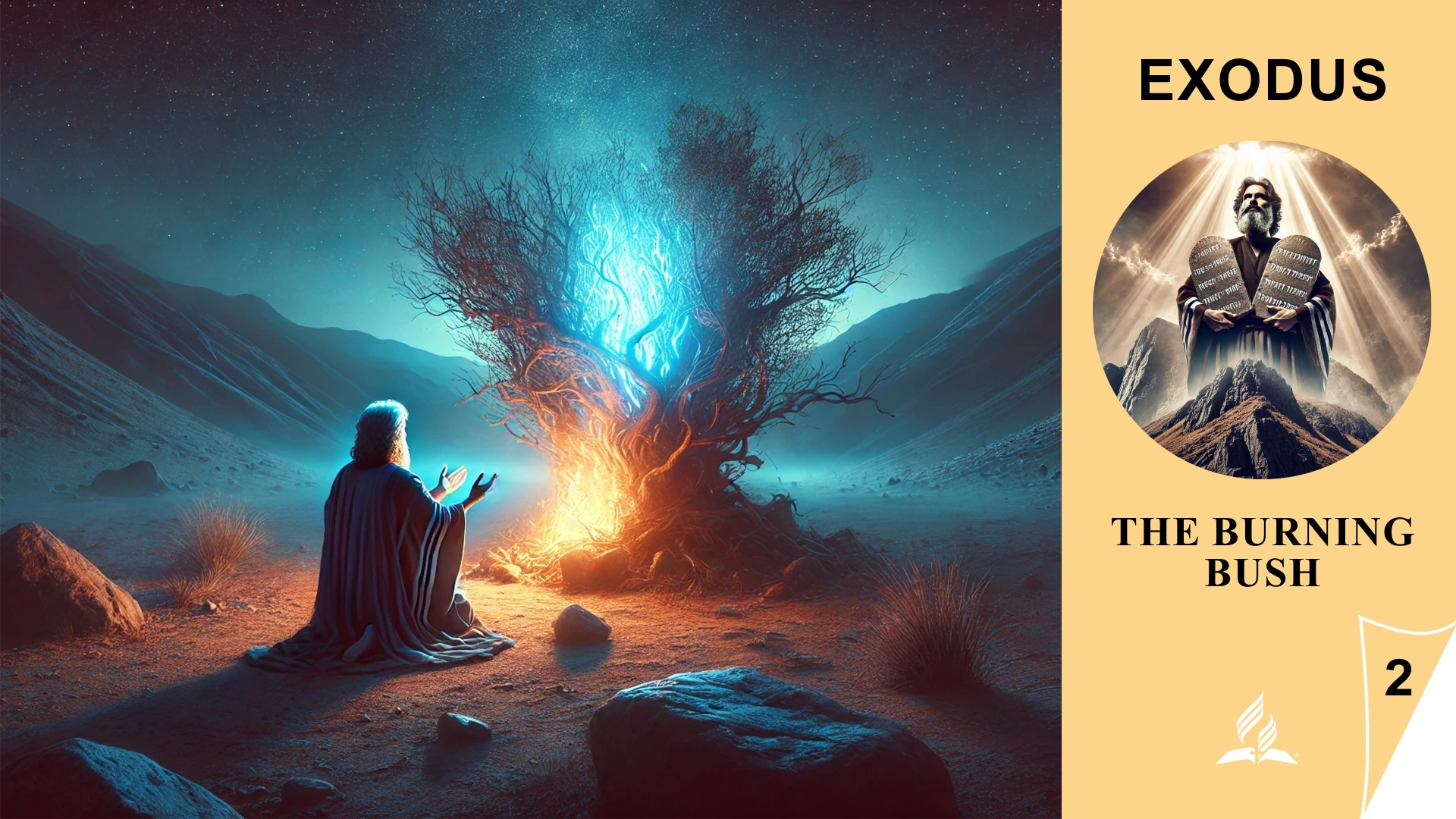
🔥 2. The Burning Bush – A Divine Symbol (Verses 2–3)
“There the angel of the LORD appeared to him in flames of fire from within a bush.” (Exodus 3:2)
What did Moses see? A bush that burned—but was not consumed. This is more than a miracle. It is a sign.
The bush symbolizes fallen humanity—weak, vulnerable, insignificant. But the fire that does not consume it is the holy presence of God, which does not destroy but sanctifies. God reveals Himself in the ordinary—yet in a supernatural way.
“God took something common and filled it with His glory.”
(see also 2 Corinthians 4:7: “We have this treasure in jars of clay…”)
👣 3. Removing Shoes – Holiness Begins with Reverence (Verse 5)
“Take off your sandals, for the place where you are standing is holy ground.” (Exodus 3:5)
In that culture, taking off one’s shoes symbolized reverence, humility, and the acknowledgment that one was on “holy ground.” God invites Moses to draw near—but not carelessly. It’s a balance between closeness and reverence.
➡️ Principle: God’s presence is real—but never casual.
Application:
When was the last time you took off your “shoes”—your pride, your plans, or your routines—to truly stand before God?
How often do we treat God’s presence with familiarity instead of reverence?
🧬 4. The God of the Fathers – Faithfulness Across Generations (Verse 6)
“I am the God of your father, the God of Abraham, the God of Isaac and the God of Jacob.”
God identifies Himself not by title, but by relationship. He is the God of history, of generations, of promise. And now Moses stands at the center of that plan. With this statement, God links Moses’ calling to the divine plan of salvation—he becomes part of the red thread of redemption.
➡️ Principle: God’s call is always connected to His eternal plan.
🧎♂️ 5. Moses’ Response – Fear and Reverence
“Then Moses hid his face, because he was afraid to look at God.” (Verse 6)
This response is not born of terror, but of deep reverence. Moses realizes he stands before the Holy One. His past, his failure, his doubts fade—and he understands: God is still choosing to meet with him.
➡️ Principle: True calling begins with the recognition of one’s unworthiness—and God’s acceptance.
📘 Theological Parallels
Isaiah 6:5 – Isaiah also realizes his sin in the presence of God.
Acts 9 – Saul meets Christ—with fear and transformation.
Hebrews 12:29 – “Our God is a consuming fire.”
Fire symbolizes purity, presence, holiness—but also calling and refinement.
………………………………………………………………….
📖 Answers to the Questions
📌 Question 1: What is the significance of the Lord introducing Himself to Moses as “the God of Abraham, Isaac, and Jacob”?
🟨 Detailed Answer:
God does not reveal Himself with a new name or as some foreign power, but as the God of the patriarchs—a God of history and faithfulness. This self-identification has deep theological meaning:
Connection to the Promise:
God reminds Moses (and thus Israel) that He is a covenant God—the same who promised Abraham land, descendants, and blessing (see Gen 12:1–3). By naming the patriarchs, God declares, “I have not changed. My promises still stand.”
God is not an anonymous force, but a God of relationship:
By identifying as “the God of Abraham, Isaac, and Jacob,” God shows that He is personal, near, and faithful. He hasn’t just made history—He walks alongside it.
Encouragement for Moses:
Moses knew the stories of the patriarchs—their doubts, failures, and struggles. That God still claims them means: Even if you feel weak, I can still use you.
God’s identity is constant:
In a constantly changing world, it is comforting to know that God is the same—yesterday, today, and forever (Hebrews 13:8). He is faithful across generations.
👉 Spiritual Principle:
God does not call us into the unknown but into a history of faithfulness—He acts in continuity with His eternal plan.
📌 Question 2: Moses needed 80 years before God considered him ready. What can this truth teach us about patience?
🟨 Detailed Answer:
This fact challenges our modern mindset. In a world of hurry, instant success, and self-optimization, Moses waits eight decades—then begins his true ministry. What can we learn?
God has His own timing:
Moses may have thought his chance was gone. But God often forms character in long, quiet years. His “waiting seasons” are not wasted—they are preparation.
Patience is spiritual trust:
To be patient is to esteem God’s timing and ways above our own. Moses had to learn: Deliverance does not come by might or anger (like when he killed the Egyptian), but by God’s calling.
Character before task:
In Midian, Moses learned not just shepherding, but humility, silence, and trust. Only when he no longer trusted in his own strength was he ready for God’s.
God does not forget us in the hidden places:
You may feel overlooked. But God is working in you, even when no one sees. Callings often ripen in secret.
👉 Spiritual Principle:
Patience is the soil in which calling grows. What you learn today in silence may lead to deliverance for many tomorrow.
………………………………………………………………….
✨ Spiritual Principles
-
God’s calling often comes to those who feel unqualified.
-
Holy moments often arise in everyday places.
-
God speaks not only through words but through signs—and often through quiet wonders.
-
Obedience begins with reverence—even in small gestures like removing our shoes.
-
God’s timeline is not our timeline—but it’s always right.
…………………………………………………………………
🧩 Application for Daily Life
-
Pause: When was the last time you “removed the shoes” of your routine and stood intentionally in God’s presence?
-
Don’t feel too old or too late—God writes life stories beyond calendars.
-
Watch for the “burning bush” in your everyday life—where God might be speaking in humble ways.
-
Declare God’s promises over your life—especially when you feel weak or forgotten.
………………………………………………………………….
✅ Conclusion
God meets us—often unexpectedly, often in everyday life, always with holiness. The burning bush was not just Moses’ call to purpose—it is ours, too. God still speaks today. The question is: Are we listening?
………………………………………………………………….
💭 Thought of the Day
“God doesn’t call the qualified—He qualifies the called.”
………………………………………………………………….
✍️ Illustration – “Fire in the Silence”
Chapter 1: Withdrawal
Jonas Berger was once a celebrated name in Berlin’s start-up scene. At 28, he sold his first app. By 30, he was featured in international magazines, surrounded by flashlights and buzzwords. And at 34—he was gone. Just gone. One last headline: “Tech Star Disappears – Jonas Berger Sells Everything and Vanishes into Nowhere.”
Indeed, Jonas sold everything. The loft, the office, the Tesla—even his watch. It wasn’t his life anymore. The burnout came like a storm, but it wasn’t the only reason. A deep, gnawing emptiness haunted him. He felt like he had never truly lived.
An old friend—a quiet but devout man—gifted him a remote farmhouse in northern Norway. “Stay as long as you like,” he had said. Jonas accepted, silently, tired. There, where winters are endlessly dark and summers endlessly bright, he found silence. He carved wood, cooked soup, jotted notes in a weathered notebook. He didn’t speak much. Not even to God. But sometimes, when the wind rustled the pines, he almost heard a whisper. It wasn’t yet faith. It was longing.
Chapter 2: The Bush
It was a late autumn evening. The sun had set early, and Jonas went for a walk in the valley behind the house. Fog lay heavy among the trees, and frost hardened the ground.
Suddenly, he saw something. At first, he thought it was a campfire—perhaps a lost hiker. But as he drew closer, he saw: a bush. A small, thorny juniper—and it was burning. Yet the branches weren’t consumed. No smoke. Just light. And then—silence. No voice, no words—but a dignity, a holiness that made Jonas hold his breath.
Without understanding, he took off his shoes. He didn’t know why. It just felt right.
Then, deep within, he sensed something—not fear. Not panic. But presence. As if someone who had always known him was finally speaking.
He heard no voice—but thoughts not his own:
“I have seen your life. Your struggles. Your escape. I am the God of your fathers. I am the I Am. And I am sending you.”
“Where?” Jonas whispered.
“To those in the dark. To the weary. You will not go alone.”
Tears ran down his face. He fell to his knees, barefoot in the frost, the bush’s light reflecting in his eyes.
Chapter 3: The Calling
In the weeks that followed, everything changed. Jonas began writing again—but not code, rather thoughts, prayers, questions. He read the Bible—not as history, but as dialogue. In Moses, he found a brother—a runaway called by fire.
A year later, he opened a small café in Tromsø—but not just any café. It was a space for conversation, silence, and prayer. No cross on the wall, no religious slogans—but those who came sensed: Something—or someone—was speaking.
Jonas rarely talked about what had happened. Only once, when a young man lingered late and said, “I don’t believe in God, but I hope He believes in me.” Jonas smiled, looked out at the dark fjord, and replied:
“I once saw a bush burning—in the snow. No smoke. No lighter. And I knew: I am seen. God doesn’t just call pastors and prophets. Sometimes He calls failed programmers—barefoot in the night.”