



⛪ Lesson 12: Precursors
📘 12.6 Summary
✨ Forerunners of the End – God’s Faithfulness in Trial
…………………………………………………………………
🟦 Introduction – The Past Lights the Way
In a world constantly shifting, orientation is not easy. What was valid yesterday is now debated. Amidst uncertainty and tension, chapter 12 of our study series offers a penetrating look at the broad arc of history—from Babylon to the present day.
What if the Bible is not a collection of religious myths, but a compass?
What if its prophecies are not vague predictions, but precise signposts?
The past lessons have taken us on a journey through prophecy, courage, persecution, and decision-making. Now, in this summary, we see: it was all preparation. The final chapter of this world’s story is approaching—and every one of us is a participant.
………………………………………………………………….
📖 Bible Study – A Prophetic Line from Babylon to the Final Decision
🔹 Daniel 2 – God’s Plan Through History
The image in Daniel 2 is more than a dream—it is a divine timeline. Each metal represents a world empire. What begins with a head of gold (Babylon) ends with feet of iron and clay (modern-day Europe). No kingdom lasts forever—except one: God’s eternal kingdom.
Key verse: “The God of heaven will set up a kingdom that will never be destroyed.” (Daniel 2:44)
🔹 Daniel 3 – Faith Under Fire
Nebuchadnezzar’s three friends don’t simply stand firm—they defy the spirit of the age. They choose faithfulness over compromise, even if it means the fiery furnace.
Key verse: “Even if He does not deliver us—we will not bow down.” (Daniel 3:18)
🔹 Revelation 13 – The Image Raised Again
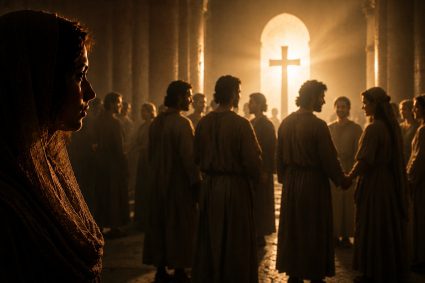
A second power rises, enforcing worship of an image. It’s about identity and authority. Again, a small group stands against the masses—not in rebellion, but in faithfulness.
🔹 Acts 12 – Early Persecution, Divine Guidance
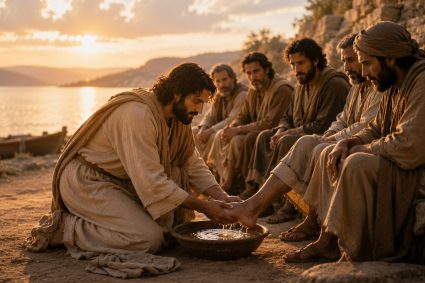
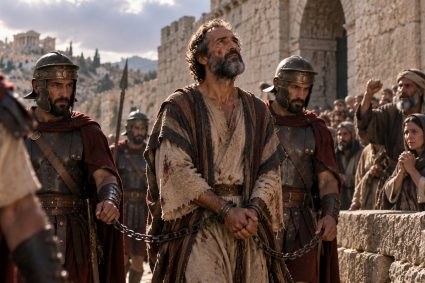
James dies. Peter is freed. Two paths—one God. Persecution was never far away. But faithfulness carried believers through prison, even death.
🔹 Revelation 14 – The Mark of the Beast
In the end, it’s about worship—not only inwardly, but through visible action. The Sabbath becomes a sign—not of legalism, but of loyalty to the Creator.
The mark of the beast? The visible proof of surrender to human authority.
………………………………………………………………….
✨ Spiritual Principles
-
God guides history—not chance.
Daniel 2 shows the world follows a divine plan. -
Faithfulness is not a feeling—it’s a decision.
Daniel 3 reveals that true worship stands firm, even in fire. -
Scripture interprets itself.
Historicism isn’t outdated—it’s the Bible’s prophetic key. -
Persecution is reality—not the exception.
Acts 12 shows that God’s people often grow under pressure. -
The final conflict is spiritual—not political.
Revelation 13 and 14 ask: Who is truly our Lord?
………………………………………………………………….
🧩 Application for Daily Life
-
Trust the biblical timeline: News and chaos shouldn’t frighten you—but remind you: God already said this would happen.
-
Prepare spiritually: The mark of the beast won’t appear suddenly. It begins in daily life—with either compromise or faithfulness.
-
Honor the Sabbath consciously: Not as a ritual, but as a holy sign of your connection to the Creator.
-
Stand tall when others bow: The courage to be faithful in small things prepares you for great trials.
………………………………………………………………….
✅ Conclusion
The lesson “Precursors” has shown us: The past speaks to the future. Every story—whether from Babylon, Rome, or the early church—is an echo for the last days.
The decisive moment is not coming—it has already begun. Today, your character is being shaped. Today, you show who you belong to.
The three men in Babylon stood firm.
Peter trusted—even in chains.
Daniel saw the end coming—and remained faithful.
Now it’s your turn.
………………………………………………………………….
💭 Thought of the Day
“God is not looking for heroes—but for people who are willing to be faithful in small things.
Those who stand upright today will not fall tomorrow.”
………………………………………………………………….
✍️ Illustration – “The Decision”
Germany, 2032.
Jakob was a history teacher. He loved ancient texts, the chronology of empires—and especially Daniel 2. But now he was tired. Something had changed.
For months, pressure had been mounting. The government had introduced a “Day of Unity”—a mandatory rest day to strengthen social cohesion. It sounded good—but the day was Sunday. Not by accident. Those few who observed the biblical Sabbath were now under suspicion of being “non-compliant.”
Jakob felt it. His colleagues asked why he always left early on Fridays, why he was never reachable on Saturdays. Then came the letter:
“Mr. Goldstein, we ask that you also provide instruction on Saturdays in the future. Exemptions are not provided for in the new educational framework.”
Jakob sat at his desk. The clock ticked. On his screen, two buttons glowed: “I agree” or “I decline.”
He thought of the three men in Babylon. Of Peter in prison. Of Jesus—who said,
“Whoever acknowledges Me before men…”
He took a deep breath.
Clicked “Decline.”
On Monday, he was suspended.
By Wednesday, he received threats.
On Friday, a student wrote:
“Thank you for not lying. Today I read the Bible for the first time.”
On Sabbath, Jakob sat under a tree. No paycheck. No recognition.
Just the wind. And a quiet, deep certainty:
He had not bowed.