




🌿 Traces of Creation – Discoveries from Nature
🦋 Series 2: Transformation and Order – What Insects Teach Us
🪶 Episode 4 – Wings Thinner Than Paper
🏗️ Stability in Lightweight Design
🌬️ Introduction: Flying with Almost Nothing
When we think about flying, we think of strength, speed, and stability. Airplanes are made of metal, composite materials, and technology. Insects, on the other hand, fly with wings that are thinner than paper, seemingly fragile and barely visible. And yet they carry the body safely through the air, enable precise maneuvers, and often function for weeks or even months. How can something so light be so reliable?
🪢 1. Thin Does Not Mean Weak
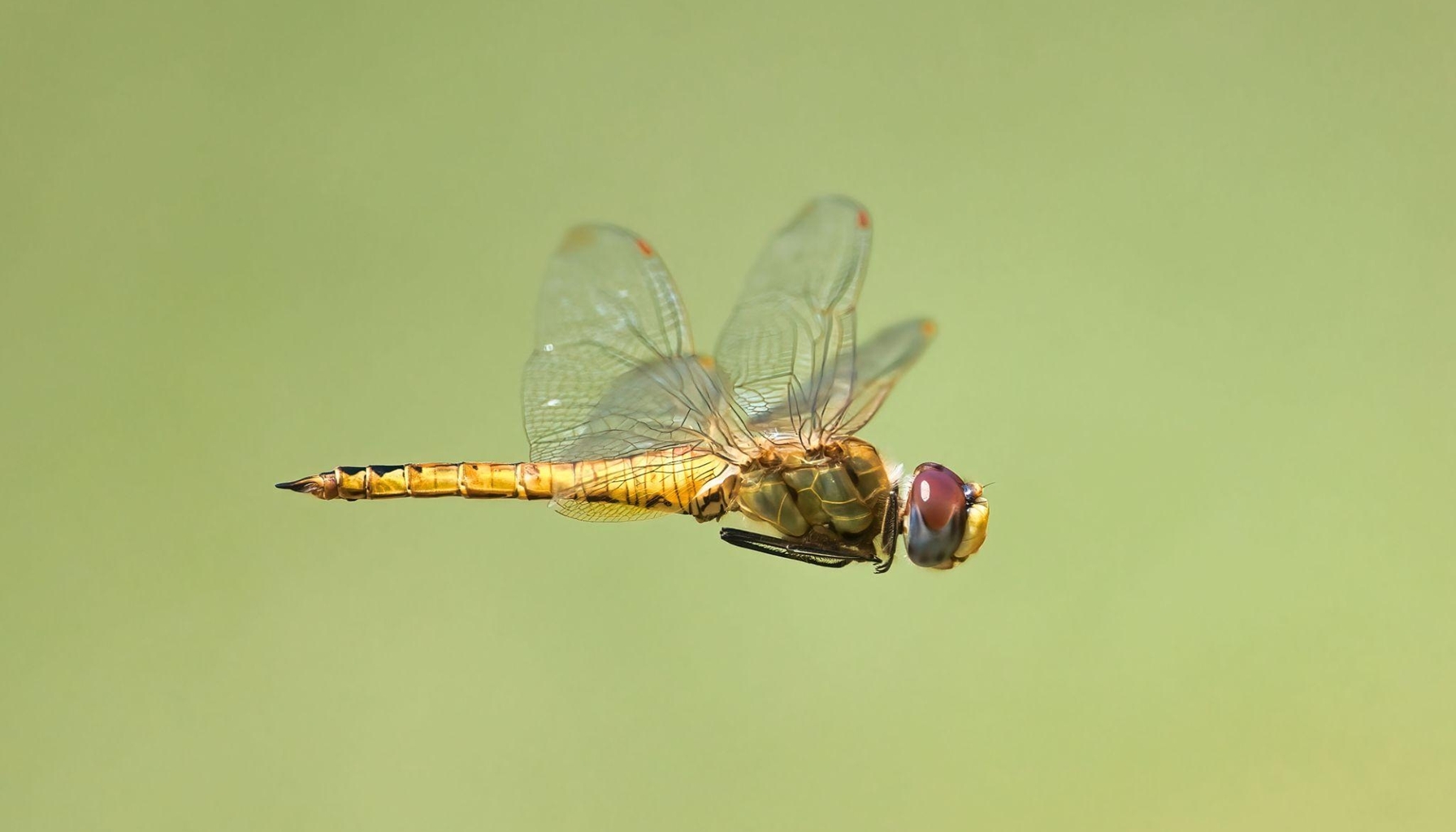
The first impression is misleading. An insect wing is extremely thin, but it is not homogeneous. It consists of: 🔹 a flexible membrane 🔹 a network of veins 🔹 clearly defined reinforcement zones These veins are not random lines. They form a supporting framework that distributes loads in a targeted way. The wing is stable where stability is needed – and flexible where movement is required.
🧷 2. Flexibility as a Safety Factor
A rigid wing would break under stress. A wing that is too soft would not generate lift. Insect wings combine both: 🔹 they give way 🔹 and return to their original shape This elasticity: 🔹 absorbs shocks 🔹 reduces material fatigue 🔹 increases lifespan Flexibility is not a disadvantage, but part of stability.
🔄 3. Flight Through Deformation
Unlike airplane wings, insect wings generate lift not only through shape, but also through active deformation. During the wingbeat: 🔹 the wing twists slightly 🔹 changes its angle 🔹 adapts to the airflow This adaptation happens automatically, through material properties and movement patterns. The wing “works with” the air, rather than resisting it.
⚖️ 4. Minimal Material, Maximum Effect
Insect wings are made of minimal material. This saves weight – and weight is crucial for flight. But less material usually means less safety. Not here. The combination of: 🔹 targeted reinforcement 🔹 flexible membrane 🔹 precise movement enables maximum performance with minimal effort. In engineering, this is called lightweight design – a principle we still try to imitate today.
🦗 5. Different Wings for Different Tasks
Not all insect wings are the same. Dragonflies have: 🔹 two pairs of wings 🔹 independent control 🔹 high maneuverability Beetles have: 🔹 hard protective wing covers 🔹 flight wings protected underneath Butterflies: 🔹 large wing surfaces 🔹 fine scales 🔹 smooth gliding flight Each form is precisely adapted to its way of life. Nothing is arbitrary.
🚀 6. Ready from the First Flight
As with other systems, the same applies here: The wing must function immediately. An insect has no opportunity to learn to fly in order to develop usable wings later. The first flight: 🔹 determines food 🔹 determines escape 🔹 determines reproduction An unreliable wing would not be an evolutionary advantage, but a death sentence.
❌ 7. Why Intermediate Solutions Are Not Enough
A half wing: 🔹 does not carry 🔹 does not steer 🔹 does not protect A wing with the wrong balance between stiffness and flexibility fails. This shows: Function only arises through precise coordination. Lightweight design does not happen by chance. It requires exact planning – whether in engineering or in biology.
📊 8. A Rational View of Efficiency
Engineers know: The lighter a system is, the more precisely it must be calculated. Errors cannot be compensated by mass. Insect wings show exactly this: 🔹 highest efficiency 🔹 with minimal tolerance Not as proof, but as a sober observation of functioning order.
✝️ 9. The Christian Perspective: Strength in Measure
The Christian view of creation emphasizes that strength does not arise from excess, but from appropriateness. Insect wings are: 🔹 not oversized 🔹 not wasteful 🔹 not unnecessarily complex They are exactly what is needed. This precision is not accidental, but an expression of order.
💡 10. What Insect Wings Teach Us
They teach us: 🔹 lightness can be load-bearing 🔹 flexibility increases stability 🔹 efficiency requires precision Perhaps they also remind us that strength does not always have to be loud or massive.
🌌 Final Thought
An insect rises with wings that we can hardly perceive. And yet they carry it reliably through a world full of air movement and danger. Whoever takes this silent engineering seriously discovers even in a paper-thin wing traces of Creation.
