






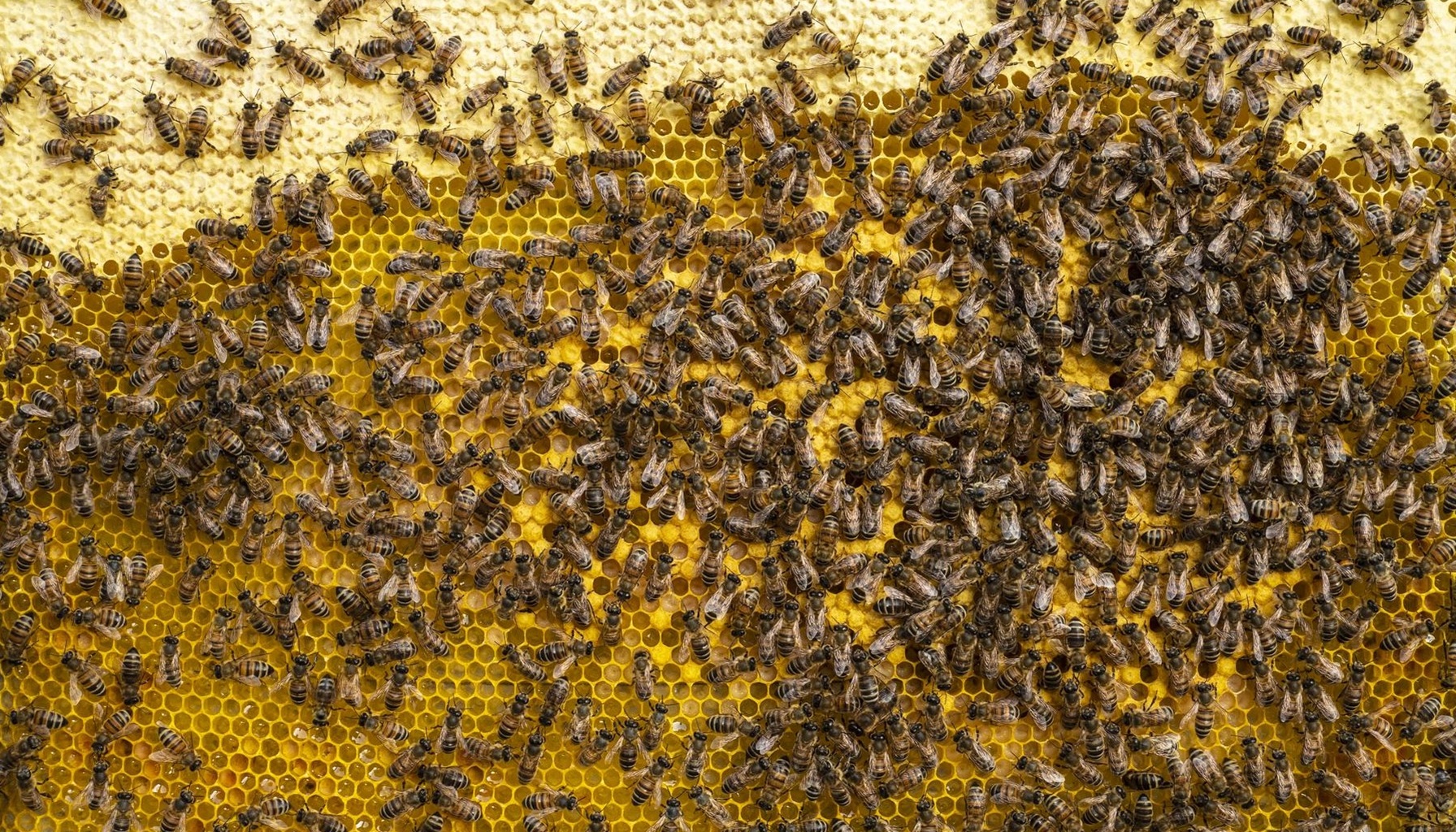
🌿 Traces of Creation – Discoveries from Nature
🦋 Series 2: Transformation and Order – What Insects Teach Us
🐜 Episode 5 – Division of Labor Without a Boss
🏛️ Order in the Insect State
🌐 Introduction: Order Without a Command Center
Where many work together, we expect leadership.
Plans, instructions, control.
In human societies, it is assumed:
Without direction, chaos arises.
And yet, in nature there exist communities with thousands, sometimes millions of individuals,
that act in a coordinated way, use resources efficiently,
and respond flexibly to changes—
without a boss, without a center, without an overall view.
Ant colonies, bee hives, and termite colonies are such communities.
What we observe in them is not improvisation,
but order in a remarkable way.
🧩 1. Division of Labor from the Beginning
In insect societies, division of labor is not a later addition,
but a fundamental principle.
Different individuals take on:
🔹 Foraging
🔹 Brood care
🔹 Nest construction
🔹 Defense
🔹 Climate regulation
These roles do not arise through application or decision.
They are biologically determined.
A worker does not become a queen.
A guard ant does not become a forager.
The order of the state begins in the individual.
🧭 2. No Overview – Yet Coordination
No insect in the colony knows:
🔹 the total number of members
🔹 the state of all supplies
🔹 the complete structure of the nest
And yet, the whole system works.
Coordination arises locally:
🔹 through smells
🔹 through contact
🔹 through simple signals
Each individual reacts to its immediate environment.
The whole emerges from many small actions
governed by rules.
Here, order arises from the bottom up,
not through central control.
📡 3. Communication Without Language
Insect societies do not communicate with words.
And yet, their communication is precise.
Ants use:
🔹 Pheromones
🔹 Intensity and direction of scent trails
Bees use:
🔹 Dances
🔹 Body contact
🔹 Scent signals
These signals are:
🔹 clear
🔹 situation-dependent
🔹 reliable
A false signal would have immediate consequences.
Therefore, accuracy is not optional,
but essential.
🔄 4. Flexibility Without Planning
Especially remarkable is the adaptability of such societies.
If a food source becomes scarce:
🔹 foragers change their routes
🔹 new tasks are taken on
If part of the nest fails:
🔹 it is rebuilt
🔹 repaired
🔹 reorganized
All of this happens without meetings,
without formal decisions,
without long-term planning.
Flexibility does not arise from overview,
but from robust rules.
🚫 5. Why Individualism Does Not Work Here
An insect society functions not despite,
but because of limited individuality.
Individual animals do not act independently in the human sense.
They follow clear patterns.
This may sound restrictive,
but it is the key to the stability of the whole.
If each individual made “creative” decisions,
the colony would not be viable.
Here, order does not arise from freedom,
but from reliability.
⚡ 6. Effective from the First Day
This order must also function immediately.
A young ant:
🔹 must fulfill its role
🔹 without training
🔹 without a trial-and-error phase
A bee colony cannot afford
that some of its workers
are “still learning.”
Therefore, these systems are designed to function from the start.
📊 7. A Rational View of Collective Order
In technology, people speak of:
🔹 Swarm intelligence
🔹 Decentralized systems
🔹 Self-organizing networks
Such systems are:
🔹 difficult to design
🔹 prone to errors
🔹 complex to coordinate
That they function stably in nature
commands respect.
Not as proof of a particular viewpoint,
but as an indication of extraordinary order.
✝️ 8. The Christian Perspective: Many Members – One Body
The Bible often describes community as the interaction of many members,
each fulfilling different roles.
Not all are the same,
but all are necessary.
Insect societies reflect this principle in a natural way:
Diversity serves the whole.
Order arises through complementarity.
Not as an equivalence,
but as an illustrative image.
💡 9. What Insect Societies Teach Us
They teach us:
🔹 Order does not always require hierarchy
🔹 Reliability is more important than individualism
🔹 Community can function without an overall view
Perhaps they also remind us
that responsibility does not always mean
controlling everything.
🌌 Final Thought
An ant colony does not plan.
A bee colony does not debate.
And yet, they act together,
purposefully
and successfully.
Whoever takes this quiet cooperation seriously
discovers in it
an order
that is not commanded—
but active.
Here too, we find
traces of Creation.
