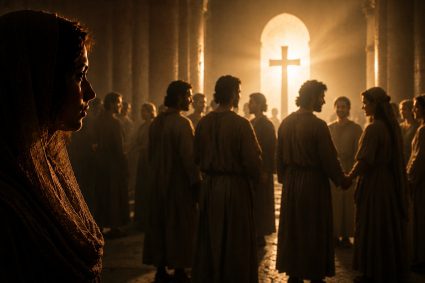
7.4 God Among His People God at the Center—from the Wilderness to Eternity
…………………………………………………………………
🟦 Introduction
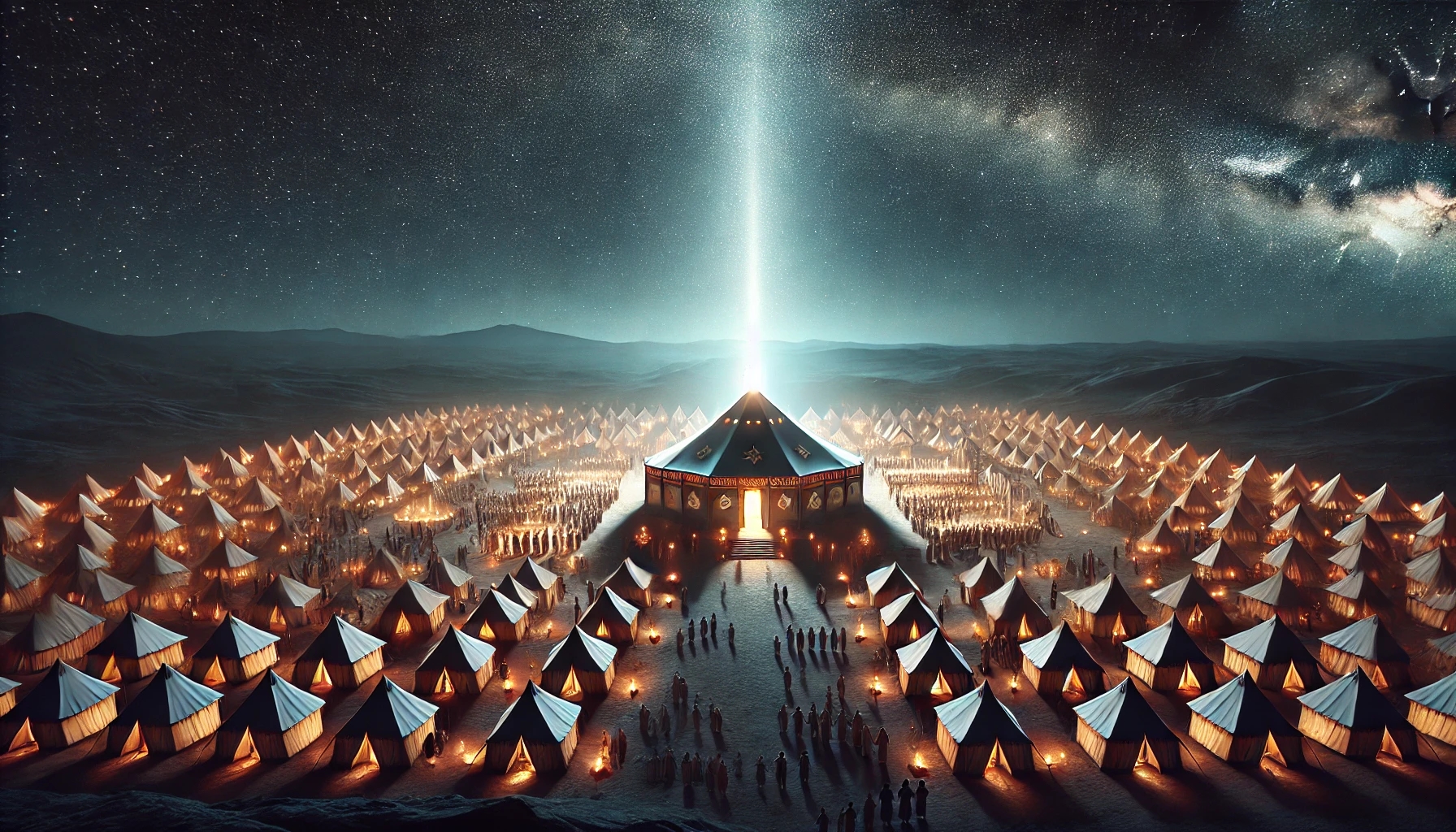
God’s desire was never to remain distant. From the very beginning, His goal was to dwell among His people—not above them, not outside them, but in their very midst. The Tabernacle was the first visible sign of this nearness: a meeting place set up in the middle of the Israelite camp, surrounded by the twelve tribes—ordered, each under its banner, with a clear center: God’s presence.
This ancient camp arrangement reflects more than mere organization. It reveals God’s wish to live in relationship with us, at the center, not relegated to the margins. And though we no longer have a Tabernacle today, God still calls people in the twenty-first century back into His center.
………………………………………………………………….
📖 Bible Study
In Numbers 2, God gives precise instructions for the arrangement of Israel’s camp. Each tribe had its appointed place. On each side of the Tabernacle stood a leading tribe, whose banner indicated the direction:
East:Judah (Num. 2:3) – representing kingship.
South:Reuben (Num. 2:10) – representing the firstborn.
West:Ephraim (Num. 2:18) – symbolizing fruitfulness and blessing.
North:Dan (Num. 2:25) – representing judgment and vigilance.
Rabbinic tradition assigns each tribe a symbol on its banner—lion, man, ox, eagle—the same four living creatures Ezekiel and John later saw around God’s throne. This connection between the earthly camp and the heavenly order is deeply symbolic: what begins on earth is fulfilled in heaven.
In Revelation 21, John sees the New Jerusalem—a city with four sides and three gates on each side, named after the tribes of Israel. And again, at its center is not a tent, but the living God Himself: “For the Lord God Almighty and the Lamb are its temple” (Rev. 21:22).
Questions & Answers
📌 Which were the four leading tribes in Numbers 2?
East: Judah (v. 3)
South: Reuben (v. 10)
West: Ephraim (v. 18)
North: Dan (v. 25)
These four each led three other tribes and symbolized four facets of divine order: royal rule, humanity, fertility, and judgment—the same aspects seen in the heavenly throne visions.
📌 How can we draw near to God’s presence today?
Center our lives consciously on Him.
Engage in prayer, worship, and Scripture reading.
Be part of a living community.
Place Jesus at the center—He is the Lamb in the midst.
………………………………………………………………….
✨ Spiritual Principles
God is a God of order—He dwells where He is given space.
God desires to live in our midst, not merely observe from afar.
Outer order reflects an inner reality: the human heart organizes itself around a central focus.
Christ fulfills the Tabernacle—through Him we have direct access to God’s presence.
………………………………………………………………….
🧩 Application for Daily Life
Design your daily routine around God’s presence. Schedule regular times for prayer and silence—just as the tribes camped around the Tabernacle.
Carry your banner:What do you stand for? How can others see that God is at your center?
Introduce spiritual order into your life—not as legalism, but as spaces that invite God’s nearness.
Join a spiritual community—like the tribes of Israel, you were never meant to journey alone.
………………………………………………………………….
✅ Conclusion
Israel’s camp layout was more than a practical arrangement—it was a spiritual invitation. God wants not only to save us but to live in our tent. The four banner bearers—Judah, Reuben, Ephraim, and Dan—point to God’s universal reign, fulfilled in Christ. Even though we are not desert wanderers, we are on a journey—and we need orientation, His presence, and holiness.
………………………………………………………………….
💭 Thought of the Day
If God once dwelt in tents among His people to draw near, how much more does He desire to dwell in your heart today—making you His temple through His Spirit?
………………………………………………………………….
🎨 Illustration – “The Place in the Center”
Miriam was an interior designer. She created spaces, arranging furniture, colors, and light. She understood the importance of a focal point—the element that gives a room meaning and structure: a table, a fireplace, a window.
Yet her own life lacked that very center. Her days were filled with projects, meetings, and lonely evenings on Netflix. Everything looked good—but inside, she was empty.
One evening, working on a design for a nursing home intended to be a place of gathering, Miriam remembered a childhood story from Sunday school: the Tabernacle in the center of the Israelite camp. She googled “Tabernacle” and landed on Numbers 2.
She read about the four leading tribes, their banners, and the holy center. Then she found Revelation 21, where there is no tent but God Himself in the city’s heart. Something stirred within her.
She realized: her apartment had a center; her projects had structure—but her heart was like a camp without a center. Everything revolved around success, recognition, aesthetics—but not around God.
That night, amid fabric swatches and blueprints, Miriam did something she hadn’t done in years: she closed her eyes and spoke to God, “Be my center.”
She began to declutter her heart—not perfectly, but sincerely. From that moment on, her heart wasn’t just a place for designing homes—it became a place for encountering God. Just like in the wilderness, just like in the heavenly city.
And every room she designed thereafter followed a new guiding principle: “What is in the center?