
⛪ Lesson 2: The Burning Bush
📘 2.2 The Angel of the Lord
✨ The Angel of the Lord – Jesus as the Divine Messenger of Deliverance
………………………………………………………………….
🟦 Introduction
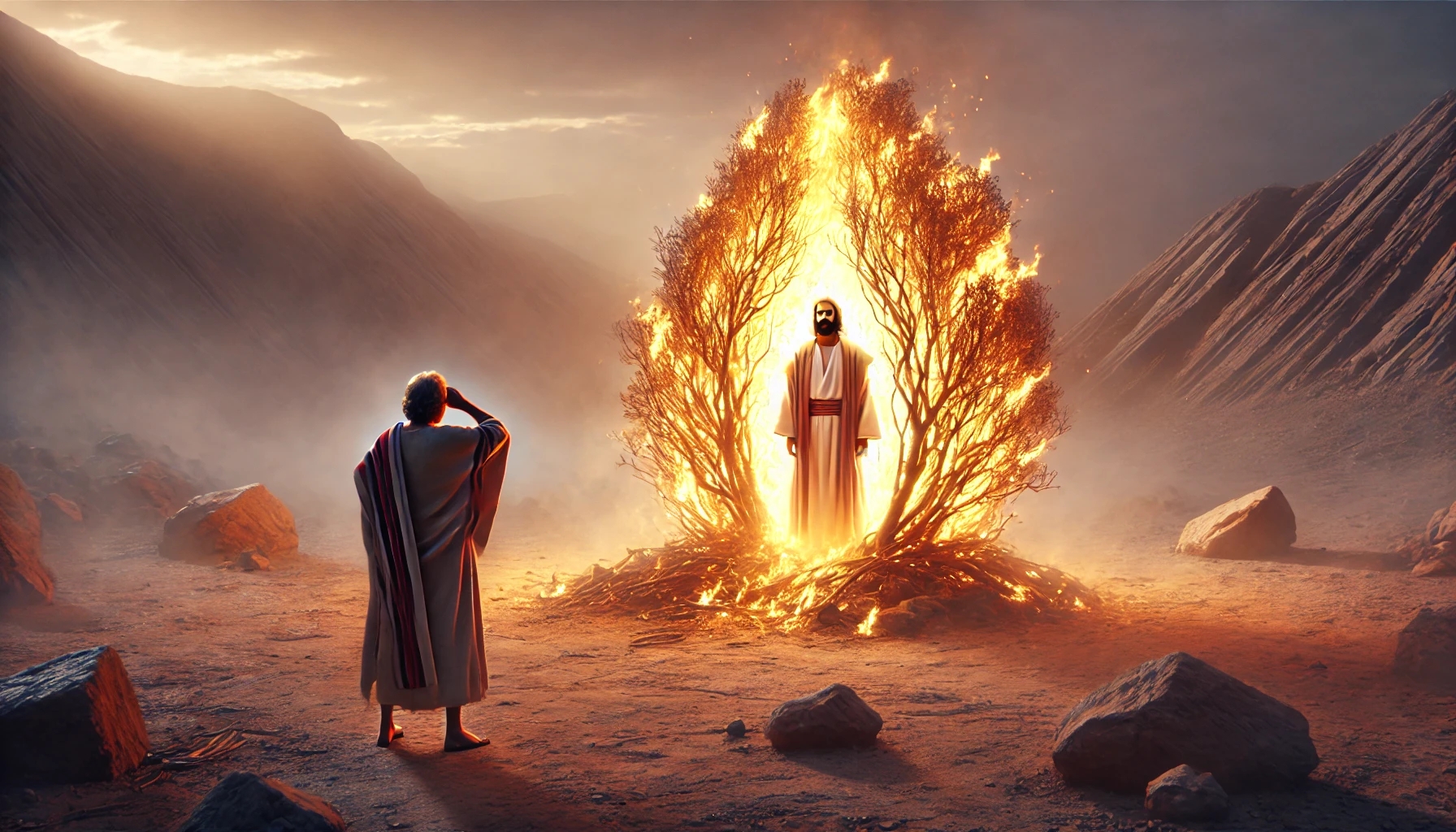
Moses, once a prince of Egypt, has lived as a simple shepherd in exile for 40 years. His dreams have faded, his influence is gone. But it is here, in the wilderness—in loneliness and obscurity—that God meets him. Not spectacularly in a palace, but in a burning bush that is not consumed.
This chapter marks a turning point—not only in Moses’ life, but in the history of salvation.
………………………………………………………………….
📖 Bible Study: Exodus 3:2–12 – The Call from the Burning Bush
📘 1. The Angel of the Lord Appears (Verses 2–4)
“The Angel of the Lord appeared to him in a flame of fire out of the midst of a bush.” (v. 2)
– The Angel of the Lord here is a visible revelation of God, showing Himself to Moses in a tangible way.
– God speaks “from the bush” (v. 4), making it clear this angel is divine.
– The burning bush is a powerful symbol: it burns but is not consumed—just like Israel in Egypt suffers but is not destroyed.
📘 2. God’s Holiness and Nearness (Verses 5–6)
– God calls Moses by name—twice. This shows deep intimacy and calling (see Abraham, Samuel).
– Moses is told to take off his shoes: God’s presence makes the place holy.
– Though God draws near, He remains holy—reverence and humility are necessary.
📘 3. God’s Compassion and Plan (Verses 7–9)
“I have surely seen the affliction of My people… I have heard their cry… I know their sufferings.” (v. 7)
– God is not only holy, but also compassionate.
– His actions are based on His covenant with Abraham, Isaac, and Jacob (v. 6, 15).
– God plans to deliver Israel—not out of duty, but out of love and faithfulness.
📘 4. The Call of Moses (Verses 10–12)
“Come, I will send you to Pharaoh…” (v. 10)
– God’s plan involves a human servant—Moses.
– But Moses feels overwhelmed and gives his first of many excuses: “Who am I?”
– God’s answer isn’t “You are able” but “I will be with you.” The calling is based not on Moses’ abilities but on God’s presence.
………………………………………………………………….
📖 Answers to the Questions
📌 Question 1: Read Exodus 3:7–12. How did God explain to Moses why He wanted to intervene on behalf of the Israelites enslaved in Egypt?
Answer:
God responds to the groaning and cries of His oppressed people. He describes their suffering in vivid terms: He has seen, heard, and known their pain. He calls them “My people”—a sign of covenant loyalty, even before the giving of the law at Sinai. His motivation is compassion, not just justice. God shows that He deeply identifies with the pain of His children—His intervention flows from a heart full of mercy.
📌 Question 2: Why are humility and a sense of unworthiness so important for anyone who wants to follow the Lord and serve Him?
Answer:
Moses asks, “Who am I?”—not out of false humility, but genuine self-doubt. This attitude is essential for spiritual leadership:
– Humility protects from pride.
– It makes space for God’s power to work.
– It keeps us from trying to control or manipulate God.
Those who know their own weakness can fully rely on God’s strength. Moses becomes a model for every servant who lives in obedience, not confidence in self.
………………………………………………………………….
✨ Spiritual Principles
– God’s presence may come unexpectedly and quietly—but it changes everything.
– True service begins with a call—and often with fear.
– God’s calling is based not on our qualifications, but on His purpose.
– God sees, hears, and feels—He is not a distant observer.
– Humility is not weakness—it’s the key to divine authority.
………………………………………………………………….
🧩 Application for Daily Life
– Do you hear God’s voice in everyday life? Maybe He’s not calling from a bush, but through people, circumstances, or thoughts.
– Are you willing, like Moses, to lay down your insecurities—so He can walk with you?
– Where are people crying out today—and how might God want to send you to bring hope?
………………………………………………………………….
✅ Conclusion
Exodus 3 is not just the story of a call, but the beginning of God’s deliverance plan. Moses learns that his story is not over—it’s just beginning. And we learn: When God calls, we don’t answer with “I can’t,” but with “Here I am—send me.”
………………………………………………………………….
💭 Thought of the Day
“God doesn’t call the qualified—He qualifies the called.”
What is burning in your life today—not to destroy you, but to call you?
………………………………………………………………….
✍️ Illustration – “The Call at the Edge of the City”
The sun beat down over the rooftops of Frankfurt as Jonas took the escalator to the subway like every morning. Coffee cup in hand, eyes tiredly fixed on his phone, he was like everyone else: busy, distracted, caught in the rhythm of city life.
He was 42, divorced, no kids, working as a project manager in a building security firm. His life was functional, successful—yet empty. He had once served God, as a young man in a Christian youth group. He had even considered studying theology. But that was long ago. Now his faith was a quiet memory, buried somewhere between childhood sermons and a lingering hope that maybe there was still something more.
🟩 The Bush at the Subway Stop
That day, due to a signal failure, Jonas exited the train one stop early. Slightly annoyed, he walked the rest of the way.
As he passed under an old underpass, he saw something odd: A trash can was on fire. No smoke, no burning smell—just fire, calm and clear. And its contents were not being consumed.
“Great,” he muttered. But as he drew closer, he heard something. Not a voice in the air, but deep within. Not a thought—but a call. “Jonas.” He stopped. That wasn’t imagination. It echoed inside him like a voice straight to his soul.
“Take off your shoes—you are standing on holy ground.”
He laughed nervously, looked around. No one there. He stepped closer—and suddenly felt cold. Not from fear—but from an overwhelming presence. Something greater was there. Something that saw him. Knew him.
🟥 The Mission
“I have heard the cry of My people. I have seen their suffering. And I am sending you.”
The voice wasn’t loud—but unmistakable. In Jonas’s mind, images flashed:
– Refugees in camps, children in broken families, the overwhelmed, the lost, the broken.
– The addicts he passed every day near the station.
– The young woman in the grocery store who cried quietly yesterday.
“Why me?” Jonas whispered.
“Because you saw. And because you didn’t turn away.”
He felt his knees buckle. “I’m not worthy… I’m not even a real Christian anymore. I’m tired, afraid… I’m nobody.”
“I will be with you.”
🟦 The Struggle
The next few days felt like an inner earthquake. Jonas tried to ignore the moment—but couldn’t. Everything that had once seemed important—presentations, KPIs, deadlines—now felt ridiculous.
He spoke with an old friend, a pastor. The man listened quietly, then said:
“Maybe God is calling you not because you’re strong—but because you’ve become soft.”
🟨 The Decision
Two months later, Jonas quit his job. Not to become a monk, but to serve. He joined a social outreach project. At first, doing simple tasks—distributing food, listening. Then, helping refugees at government offices, translating forms.
Strangely, he met people with the same questions he once had. God gave him words—not grand sermons, but quiet sentences that opened hearts.
He became a man of prayer. Not a theologian, not a preacher—but a true intercessor. When he prayed, he often wept—not from weakness, but from compassion. And people noticed.
🟥 The Burning Everyday Life
The bush in the underpass was gone. The trash can had long been replaced. But the fire remained—inside him.
He lived simply. No fame, no applause. But in quiet moments, he felt God was with him. That His presence made even the dust of daily life holy.
✅ Conclusion
God still calls today. Not in temples, not in palaces—but often at the edges. Among those who don’t see themselves as worthy. But that’s where true calling begins.
A burning bush in the city. A voice in the noise. And a person who responds.
Not with confidence—but with willingness.