
Lesson 5.Passover | 5.2 Healing the Body | EXODUS | LIVING FAITH

⛪ Lesson 5: Passover
📘 5.2 Healing the Body
✨ The Meal of Remembrance and Hope
………………………………………………………………….
🟦 Introduction
You might think that before their escape from Egypt, God would have given the Israelites detailed escape plans—routes, logistics, safety instructions. But instead, He gives something completely different: instructions for worship. He doesn’t first direct their eyes to what they must do, but to who He is—and what He will do for them.
Through the Passover, God places an eternal remembrance of His saving grace into the heart of His people. This celebration is not just a ritual but a response to God’s faithfulness. Even today, God calls us: “Do not forget what I have done for you—for that will give you strength for what is to come.”
………………………………………………………………….
📖 Bible Study: Exodus 12:1–20
🔹 1. Historical Background: Deliverance begins with worship
In Exodus 12, we are on the eve of the greatest miracle in Old Testament history: the exodus of Israel from Egypt.
The ten plagues are reaching their climax—and God announces the coming judgment: the death of all firstborns in Egypt. But before this event takes place, God draws Israel’s attention to something very unexpected: a feast.
Deliverance does not begin with a military campaign, not with rebellion or escape, but with a meal, a ritual, an act of worship. This shows us: Redemption begins with trust—not activism. And this trust is strengthened through concrete, divine instructions.
🔹 2. A New Calendar: God gives a new understanding of time (verses 1–2)
“This month shall be for you the beginning of months; it shall be the first month of the year for you.”
Before the people are even freed, God gives them a new calendar. This signals: “Your time no longer belongs to Egypt—it belongs to Me.” The people are no longer to live by the rhythms of oppression, but by God’s rhythm.
➡️ Spiritual Principle: Redemption changes our perspective on time, meaning, and identity.
🔹 3. The Selection and Preparation of the Lamb (verses 3–10)
-
One-year-old, male, without blemish—the lamb must be perfect.
-
It must be observed in the home for four days (from the 10th to the 14th day).
-
It is eaten in community—no one is to be left alone.
-
Nothing is to be left over—redemption is complete.
The lamb is more than a sacrifice—it is a substitute. The blood saves the firstborn; the flesh nourishes the family. It symbolically represents the body and blood of Jesus, the true Passover Lamb (cf. 1 Cor. 5:7; John 1:29).
➡️ Typology:
The Passover lamb points to Christ:
-
Without blemish → Sinless (Hebrews 4:15)
-
Slaughtered for many → Atoning death (Isaiah 53:7)
-
Blood saves → Redemption through Christ’s blood (1 Peter 1:18–19)
🔹 4. The Blood on the Doorposts (verses 7, 13)
“The blood shall be a sign for you on the houses where you are… When I see the blood, I will pass over you.”
This act is a step of faith. The blood on the door is a visible sign that the family believes God’s promise. There is no protection through ethnicity, heritage, or works—only through the blood.
➡️ Passover is not magic. Without faith, even the best sacrifice is useless.
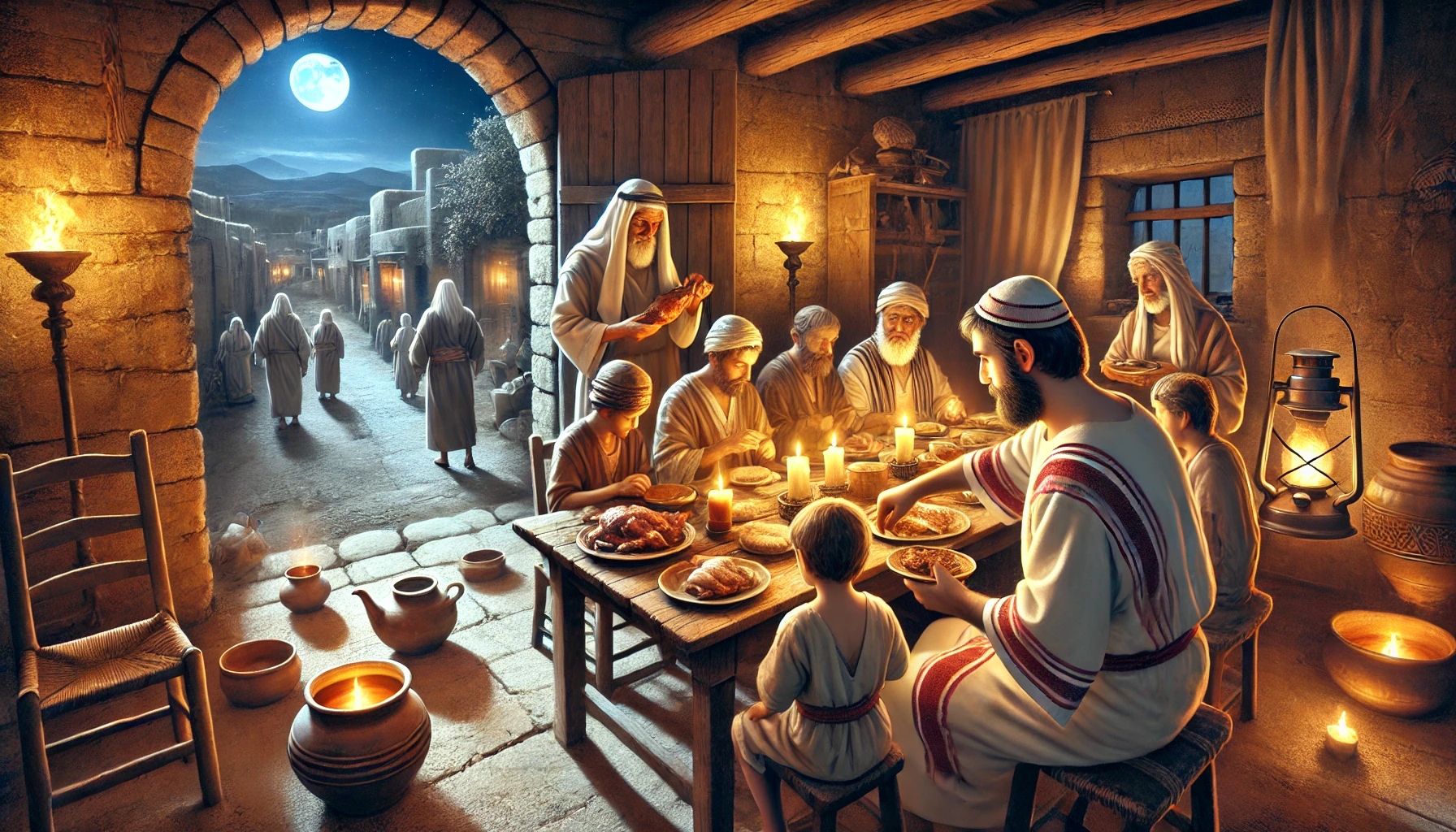
🔹 5. The Posture During the Meal: With belts, shoes, and staffs (verse 11)
“Eat it in haste, with your loins girded, sandals on your feet…”
The Israelites are to be ready to leave. Passover is not a leisurely family gathering, but a sign of readiness. It connects past (slavery), present (deliverance), and future (freedom).
➡️ Christians too are pilgrims—we eat the “Lamb of God” while ready to go, to follow, to obey.
🔹 6. Universal Threat, Specific Salvation (verses 12–13)
“I will go through Egypt and strike down every firstborn…”
God’s judgment affects everyone. It does not distinguish between Egyptians and Israelites—except through the blood. The only difference is the sign of salvation. This shows:
-
God is just – He judges.
-
God is merciful – He spares through the blood.
➡️ Death is not avoided by ancestry, but through faith and obedience.
🔹 7. The Feast of Unleavened Bread (verses 14–20)
The week following Passover begins the Feast of Unleavened Bread. Yeast often symbolizes sin, pride, and corruption in the Bible. The Israelites are to remove all yeast—a purification, both outward and inward.
➡️ Those who are redeemed must leave the “old” behind—not only be outwardly free, but inwardly renewed.
➡️ Paul writes in 1 Cor. 5:7–8: “Therefore let us keep the feast, not with the old leaven… but with unleavened bread of sincerity and truth.”
🔹 8. Remembrance as God’s Strategy (verse 14)
“This day shall be for you a memorial day… a lasting ordinance… from generation to generation.”
God knows humans are forgetful. So He gives the Passover as a remembrance—a recurring testimony to His work.
➡️ Rituals and feasts are anchors of faith. They embed theology into everyday life, family, and identity.
📖 What We Learn from Exodus 12:1–20
| Theme | Meaning |
|---|---|
| New Calendar | God initiates a new beginning—our life starts with redemption |
| The Lamb | Symbol of Christ—spotless, sacrificed, saving |
| Blood on the Door | Sign of faith—salvation through trust |
| Communal Meal | No solo faith—we celebrate redemption together |
| Bitter Herbs | Reminder of suffering—redemption involves pain |
| Unleavened Bread | Purity—leave the old life behind |
| Readiness | Faith expects change—shoes on, belt tightened |
| Recurring Feast | Memory strengthens faith and identity |
🕊️ What This Means for Us Today
-
Our “Passover” is Jesus Christ—we are saved by His blood.
-
Our redemption is not earned, but received through faith and trust in His finished sacrifice.
-
The Lord’s Supper is our spiritual memorial—not just a reflection, but a reaffirmation.
-
Each of us is called to live ready to move—not settled in the old, but alert to God’s path.
………………………………………………………………….
📖 Answers to the Questions
📌 Question 1: Read Exodus 12:1–20. What instructions does God give Moses and Aaron before the Israelites leave Egypt?
The situation is dramatic: Nine plagues have passed, Egypt is shaken, the tenth plague—death of the firstborn—is imminent. You might expect logistical instructions: What to pack? Which route to take? How to organize?
But God does something else: He doesn’t speak first about the escape, but about how to worship.
He turns the people’s gaze away from fear—toward His saving grace.
Key instruction: Celebrate the Passover—the festival of deliverance.
It includes concrete actions and deep symbolism:
-
A lamb is to be slaughtered—perfect, one-year-old, male.
Symbol of purity, innocence, substitution. A pointer to Christ—the Lamb of God (John 1:29). -
The lamb must be completely eaten—nothing left behind.
Complete participation in the sacrifice—a full experience of redemption. -
The blood is to be applied to the doorposts.
A sign of faith—not magic, but trust in God’s promise to “pass over” (Exodus 12:13). -
The meal includes bitter herbs and unleavened bread.
Bitterness recalls slavery; unleavened bread reflects haste and spiritual purity. -
Eat in haste—with shoes, staff, and readiness to go.
A spiritual posture of obedience and movement. -
The feast is to be celebrated eternally—for all generations—as a remembrance of God’s saving act.
Lesson:
God doesn’t just rescue—He invites His people to consciously and communally participate in His redemption.
Preparation for the exodus was really preparation of the heart—not the luggage.
📌 Question 2: Read Exodus 12:13–14. What did God want to do for the Israelites during the last plague? What does it symbolize?
God wanted to spare the Israelites. He wanted to protect them from the judgment coming over Egypt. But this protection was not automatic—it was tied to a sign: the blood of the lamb.
“When I see the blood, I will pass over you…” (Exodus 12:13)
The Hebrew word for Passover (Pesach) comes from pasach—to pass over or to spare. The name itself is a message: God passed by the houses marked by blood.
-
Not the name “Israel,”
-
Not heritage,
-
Not tradition—
Only trust in God’s word and obedience to His sign.
It symbolizes:
-
Substitution: The lamb dies instead of the firstborn—a clear preview of Christ’s work on the cross (Isaiah 53:7; 1 Cor. 5:7).
-
Faith: Applying the blood was an outward expression of trust. Salvation came not from feelings, but from acts of faith.
-
Distinction: God doesn’t distinguish by nationality but by obedience in faith.
On that night, it wasn’t “Israel” that was protected—but those who applied the blood. -
Remembrance: God commanded this to be celebrated annually, so future generations would never forget:
“I am the Lord who brought you out.”
The Passover is more than a ritual. It is the first great proclamation of salvation in the Old Testament—a gospel in pictures.
📌 Question 3: Why is it important to remember the good that God has done for you in the past and to trust that He will do good in the future?
Our spiritual life is deeply shaped by remembrance. The Bible repeatedly urges:
“Forget not all His benefits.” (Psalm 103:2)
Why?
Because remembrance strengthens faith.
When we face present challenges, uncertainty, or fear, looking back helps us say:
“God helped me then—why wouldn’t He do it again?”
Passover was created for that purpose: an eternal remembrance. Every generation should know:
“God was faithful to our ancestors—and He is our Redeemer too.”
Remembrance is important because:
-
It connects past and present.
We believe in a God who acts in history, not just a concept. -
It brings hope for the future.
Those who’ve seen God heal, provide, or guide, gain courage for new challenges. -
It cultivates gratitude.
Gratitude shifts focus from lack to abundance in Christ. -
It guards against forgetfulness and pride.
Israel suffered most when they forgot God’s deeds (see Deut. 8:11–14). -
It motivates testimony.
Those who’ve seen God’s faithfulness will share it—with children, friends, coworkers.
In the New Testament, the same applies to the Lord’s Supper:
“Do this in remembrance of Me.” (Luke 22:19)
God knows how quickly we forget—but memory preserves faith.
So: Keep a “spiritual journal.” Pray with gratitude for what God has done. And trust:
The One who was faithful yesterday will be faithful tomorrow.
………………………………………………………………….
✨ Spiritual Principles
-
God saves by grace—but obedience is the path to blessing.
-
Rituals carry spiritual power when lived by faith.
-
Remembrance of God’s acts strengthens future faith.
-
Redemption comes through substitution—then by a lamb, now through Christ.
-
God begins with worship—not fear.
…………………………………………………………………
🧩 Application for Daily Life
-
Consciously celebrate your “Passover moments”—times when God protected, preserved, or delivered you.
-
Tell your children, spouse, and friends about God’s faithfulness—memory is transmission.
-
Wear or display “faith markers”: a verse, a prayer ritual, a song that reminds you.
-
Don’t rely on plans—rely on the blood of the Lamb.
-
Approach Communion not as routine, but as personal encounter with the Savior.
………………………………………………………………….
✅ Conclusion
God begins the exodus with a feast—this is more than remembrance. It’s divine strategy:
Those who celebrate remember. Those who remember believe. And those who believe are saved.
………………………………………………………………….
💭 Thought of the Day
“Memory is the bridge on which hope walks into the future.”
………………………………………………………………….
✍️ Illustration – “The Red Ribbon”
A modern Passover story about faith, remembrance, and rescue
Chapter 1 – The Sound of War
Mariella stood at the window of her apartment on the eighth floor. The sun had set, but the city remained bright—not from lights, but from flames. It was the fifth day of fighting in her city.
She lived in Novo Zara, a large city in Eastern Europe that had, until recently, been a rising economic hub. Now it had become a front line. The bridges were blown up, food was rationed, sirens wailed every night.
Mariella was 34 years old, a primary school teacher, a single mother of two children—Daniel (10) and Sofia (6). Since the schools had been evacuated, she had been locked in her apartment with the children. No electricity. No internet. Only the radio still worked.
“Tonight, another airstrike is expected,” the broadcaster said. “Remain calm. Stay away from windows. Pray, if you can.”
She did. Every night.
Chapter 2 – The Man with the Ribbon
One day, there was a knock at the door. Cautiously, Mariella opened it a crack—it was Mr. Sava, the old man from the ground floor. He used to do janitorial work, but had been retired for years. Most people thought he was odd—but Mariella liked him. He always wore an old coat, talked about the Bible, and called himself a “watchman.”
“Mariella,” he said, “you must tie a red ribbon to your door tonight.”
She frowned. “A ribbon? Why?”
“It’s like in Egypt,” he said solemnly. “Death is moving through the city. But the LORD sees the sign—and He will pass over.”
She looked at him, puzzled. “What do you mean?”
He pulled an old New Testament out of his coat pocket. It was opened to Exodus 12.
“I know you don’t understand everything, child. But I sense tonight will be especially bad. Just do it.”
He handed her a strip of red cloth. It was coarse, like an old curtain.
Mariella took it without arguing. In this city, everything seemed possible. And impossible.
Chapter 3 – The Red Door
Later that evening, she spoke with Daniel.
“Mama, is this like magic?”
“No,” she whispered. “It’s a sign. Of faith.”
She tied the ribbon to the door handle. Double-knotted. Then she knelt with her children.
“God, if You walk through the city tonight—please pass over us.”
Sofia fell asleep with the Bible under her pillow. Daniel held her hand until he, too, drifted off.
Outside it was quiet. Then loud. Then quiet again.
And eventually… night came.
Chapter 4 – The Call in the Morning
The next morning, a loud knock woke her. Two soldiers stood at the door. One pointed to the ribbon.
“Why did you do that?”
Mariella turned pale. “It was just… just a sign. For God.”
The other soldier, younger, looked at her for a long time. Then he said:
“This is the only apartment in this block that wasn’t hit.”
Mariella swallowed hard. Her heart pounded.
“How many…?”
“All the other apartments on the upper floors were damaged. Yours—not even a cracked window.”
She gave thanks—not to them, but to God.
Later, when she stepped into the hallway, she saw: Mr. Sava’s door also had a red ribbon. And three other doors as well.
Chapter 5 – The Story Lives On
Weeks later, the city was liberated. The weapons fell silent. Mariella kept a diary. She remembered every detail. On Passover night—as she would later call it—it wasn’t just the blood of the lamb over her, but the hand of God.
She began telling her children about Moses. About Egypt. About the lamb. And about Jesus.
“But why is Jesus our lamb?” Sofia asked.
Mariella answered: “Because His blood was shed for us—so death doesn’t have the final say.”
Every 14th of the month, they tied a red ribbon to their door—not out of superstition, but in remembrance:
God sees the sign.
God passes over.
God saves.
🎯 Core Message of the Story:
Just like the first Passover in Egypt, today it is still about faith in the darkness. The red ribbon was not a magical object—but a symbol of trust, like the blood on the doorposts.
In a world full of fear, uncertainty, and war, God’s promise remains:
“When I see the blood, I will pass over you.” (Exodus 12:13)
And sometimes, all it takes is a piece of cloth, a prayer, a posture of the heart—
so that life remains where death rages.

More Stories