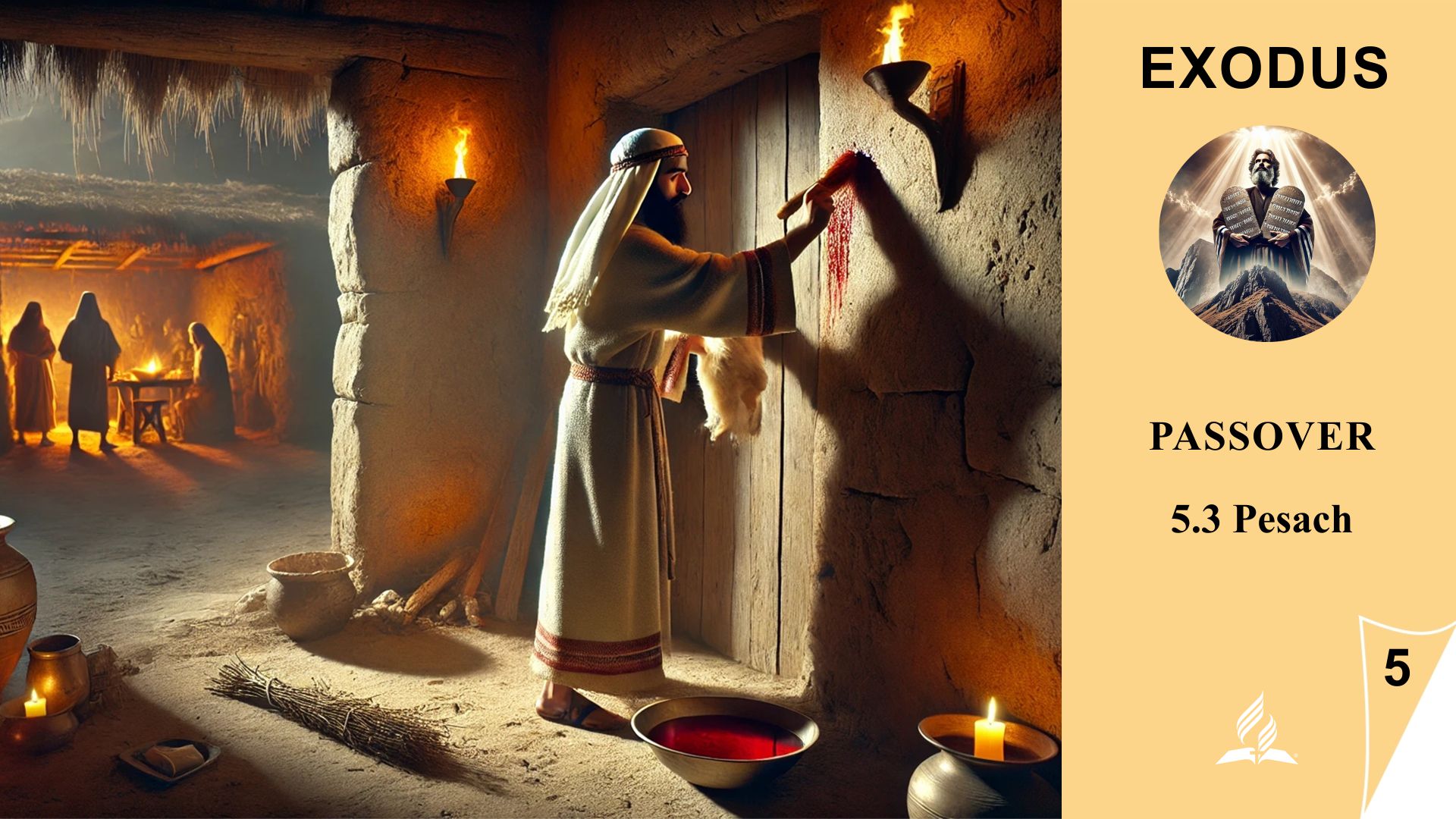
Lesson 5.Passover | 5.3 Pesach | EXODUS | LIVING FAITH
⛪ Lesson 5: Passover
📘 5.3 Pesach
✨ Sign of the Blood, Sign of Redemption
………………………………………………………………….
🟦 Introduction
Why blood? This is a question many people ask when they read the biblical sacrificial laws or hear of Jesus as the “Lamb of God.” For us, blood often symbolizes pain, death, or violence. But in the Bible, it is the deepest sign of life—and of salvation.
At the center of the Passover feast is blood. It was the visible sign of faith and at the same time God’s answer to judgment. The Israelites weren’t spared because they were better than the Egyptians—but because they believed God’s word and applied the blood to their doorposts.
This lesson leads us into the heart of the Gospel: Only through the sacrifice of another—the pure, spotless lamb—can a person be saved. And this lamb is Christ.
………………………………………………………………….
📖 Bible Study: Exodus 12:17–23
🔹 1. Context: A Sacred Moment Before Judgment
Verses 17–23 appear in one of the most dramatic parts of the Bible: the final night before Israel’s departure from slavery. God, through Moses, had repeatedly announced that the death of the firstborns was imminent—God’s judgment over Egypt, the symbol of an oppressive world power.
Yet in the middle of this somber announcement, God shifts the focus away from judgment toward salvation—and toward the sign that guarantees that salvation: the blood of a lamb.
These verses form the theological heart of the Passover—and a prophetic picture of the Gospel of Jesus Christ.
🔹 2. Verse-by-Verse Explanation
📌 Verse 17: “Celebrate the Festival of Unleavened Bread, because it was on this very day that I brought your divisions out of Egypt.”
God gives Israel a memorial festival—not after salvation, but while it is happening.
Passover and the Feast of Unleavened Bread are not merely commemorations but part of the saving event itself. Remembrance is part of redemption.
Here, God begins shaping Israel’s identity as a people of memory and gratitude.
📌 Verses 18–20: “For seven days you are to eat bread made without yeast…”
In this context, yeast (leaven) symbolizes the old way—sin, pride, corruption, decay.
Removing the leaven is not just a household task—it is a spiritual act of sanctification: detachment from the old, readiness for the new.
Paul echoes this in 1 Corinthians 5:6–8: “Get rid of the old yeast… celebrate the festival with the unleavened bread of sincerity and truth.”
🔎 Application: God’s deliverance is not only external (from Egypt), but also internal—He wants to remove “leaven-thinking” from us.
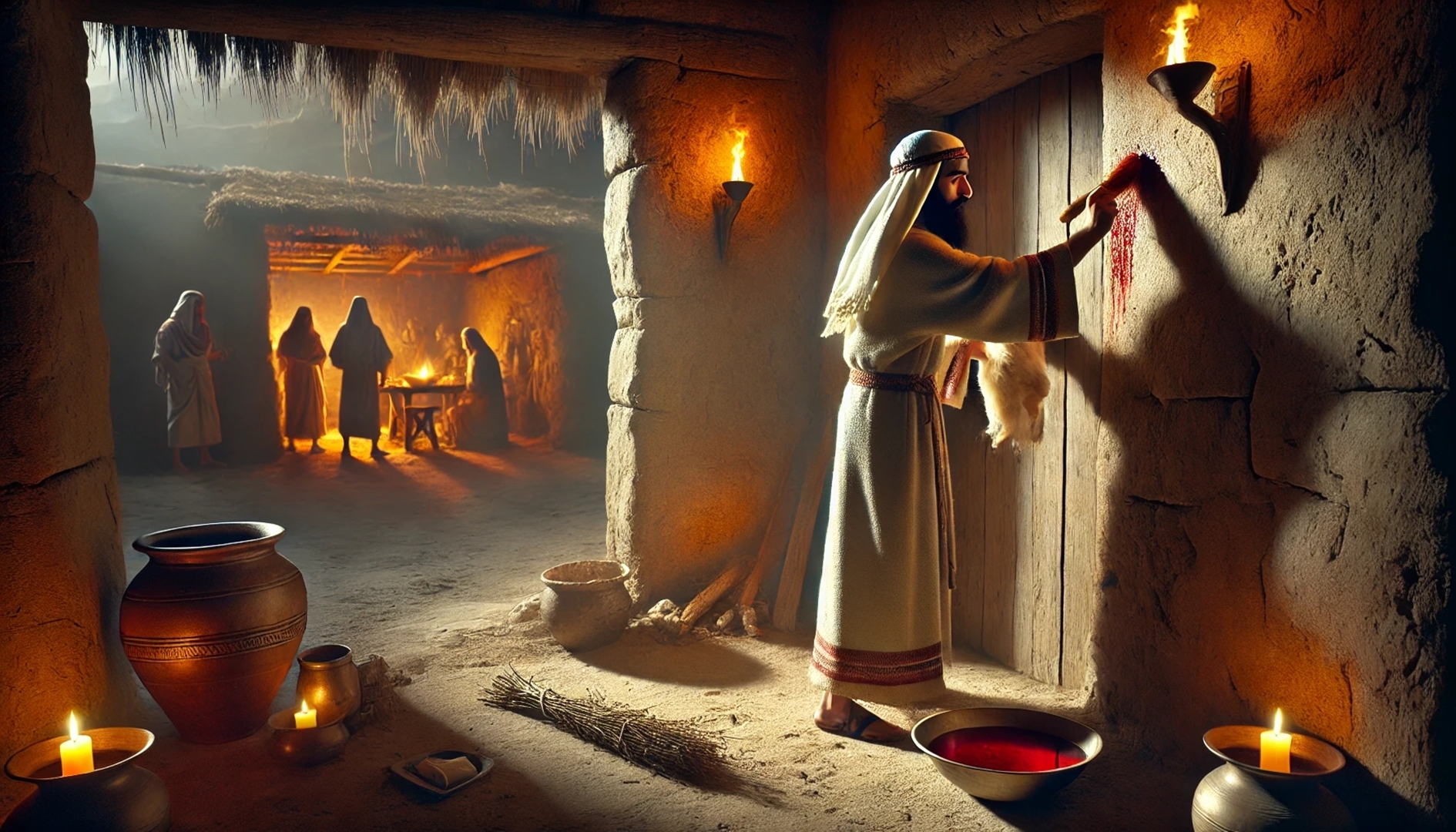
📌 Verses 21–22: “Go at once and select the animals for your families and slaughter the Passover lamb. Take a bunch of hyssop, dip it into the blood…”
God gives concrete instructions—not abstract piety, but clear acts of faith.
The lamb must be sacrificed. A life for a life.
The blood is visibly applied to the doorframe—with a bunch of hyssop, a bitter herb associated in the Bible with purification (e.g., Psalm 51:7: “Cleanse me with hyssop…”)
🔎 Symbolism:
-
Lamb: Purity, innocence, substitution (cf. Isaiah 53:7)
-
Blood: Protection, life, atonement
-
Doorposts: The threshold—transition from death to life
-
House: The community of believers sheltered under the blood
📌 Verse 23: “The LORD will pass through to strike Egypt… But when He sees the blood on the top and sides of the doorframe, He will pass over that doorway…”
The judgment applies to all—Israelites and Egyptians—unless they are under the blood.
It is God Himself who passes through—not a “death angel,” but the LORD. It is His judgment—but He spares where there is faith.
The word pass over (Hebrew: pasach) is the origin of Pesach → Passover.
✨ The blood does not change God—but marks the place of faith. God passes over because death has already occurred—upon the lamb.
🔹 3. Theological Depth: Why Blood?
-
Blood = Life (Leviticus 17:11): The life of a being is in the blood. When blood is shed, life is given.
-
Atonement requires blood (Hebrews 9:22): “Without the shedding of blood, there is no forgiveness.”
-
Substitution: The lamb dies in place of the person—a core principle of divine grace.
➕ Typology: Passover is a foreshadowing of the cross:
| Passover Element | Fulfilled in Christ |
|---|---|
| The Lamb | Jesus, “Lamb of God” (John 1:29) |
| The Blood | His death on the cross |
| The Doorposts | Public confession of faith |
| The Salvation | “Whoever believes… shall not perish” (John 3:16) |
🔹 4. Spiritual Meaning of the Passover Blood Today
No animal needs to be sacrificed today, because Christ has made the final offering (Hebrews 10:10). But faith in the blood remains central. It is not the symbol that saves—but what the symbol points to: Jesus’ sacrifice on the cross.
Whoever trusts in the blood of Christ is under divine protection—not just from external threats but from eternal death.
The “application” of blood today is our confession of faith—our personal decision to claim Jesus’ death for ourselves.
🔹 5. Historical and Practical Aspect: The Birth of Israel’s Identity
Passover is not only theologically important—it also establishes Israel’s national identity as a covenant people. United under the blood, united in the meal, united in their exodus.
-
Family Meal: Everyone should take part. No one is alone. Faith is passed on—from parents to children.
-
Eternal Remembrance: God wants this event to be remembered every year—because faith grows through remembrance.
🕯️ Christianity continues this through the Lord’s Supper: “Do this in remembrance of Me” (Luke 22:19).
📚 Summary: What Exodus 12:17–23 Teaches Us
| Element | Meaning |
|---|---|
| Unleavened Bread | Sanctification, separation from the old |
| Lamb | Substitution, purity, image of Christ |
| Blood | Protection, atonement, life |
| Hyssop | Purification, repentance |
| Doorposts | Confession, boundary between death and life |
| Household | Unity in faith, transmission of promise |
| Remembrance | Faith grows through conscious memory |
| God’s Judgment | Serious, yet merciful |
🔚 Conclusion of the Extended Bible Study
Exodus 12:17–23 is more than a ritual regulation—it is the Gospel in symbols. The red thread of redemption running through all of Scripture becomes visible here:
-
Guilt is real—and has consequences.
-
But God provides a way out—through the blood of an innocent substitute.
-
Those who humbly place themselves under this protection are secure—now and forever.
The Passover blood was not only effective in Egypt—it points to the cross at Calvary, where the true Lamb of God shed His blood for us.
The most important question for us today is not: “Why blood?”
But: “Am I under the blood of Christ?”
………………………………………………………………….
📖 Answers to the Questions
📌 Question 1: Read Exodus 12:17–23. What role does blood play in celebrating this new festival?
Blood plays a central, life-determining role in the celebration of Passover. It is more than a ritual element—it is the decisive marker between life and death, between judgment and grace, between Egypt and the people of God.
God Himself says in Exodus 12:13:
“The blood will be a sign for you… When I see the blood, I will pass over you.”
This is revolutionary:
Not origin, nationality, or ancestry—but the visible sign of blood on the doorposts determines life or death.
🩸 Why is the blood so important?
-
Blood represents life (Leviticus 17:11):
“The life of the flesh is in the blood… I have given it to you to make atonement.”
Blood symbolizes life given for another life. -
Blood means substitution:
The lamb dies so the firstborn does not.
→ The heart of the Gospel: Innocent blood covers human guilt. -
Blood is a sign of faith:
Applying the blood to the door was a public act of trust.
The family was saying: “We believe God’s word. We obey, even if it seems illogical or risky.”
→ It was not just the lamb that saved—but the faith, made visible through the blood. -
Blood is a shield in judgment:
That same night, countless firstborns died in Egypt—but not one death occurred where the blood was present.
→ The difference wasn’t moral status—but the presence of the blood.
Typologically, the blood points to Jesus:
-
John the Baptist called Jesus: “The Lamb of God who takes away the sin of the world.” (John 1:29)
-
Paul wrote: “Christ, our Passover Lamb, has been sacrificed.” (1 Cor 5:7)
-
Peter added: “…redeemed with the precious blood of Christ, a lamb without blemish or defect.” (1 Peter 1:18–19)
➡️ Conclusion:
The Passover is not just about remembering the escape from Egypt—but about the Gospel in symbolic form.
The blood says: “Another dies in my place.” And God sees that blood—and spares.
📌 Question 2: To atone for sin, the blood of Jesus—God’s own blood—was required. What does this show us about the seriousness of sin?
This question goes to the very heart of the Gospel—and of our view of God and humanity. In a world where sin is often trivialized, the Bible reveals:
Sin is deadly. And it is so profound that only God’s own life could atone for it.
➡️ The price of forgiveness is not a gentle “It’s okay”—but the blood of Jesus.
Not the blood of an animal. Not a prayer. Not a good deed. But the death of God’s holy Son on the cross.
💡 What do we learn from this?
-
Sin is not harmless—it is deadly:
“The wages of sin is death.” (Romans 6:23)
Not just physical death, but eternal separation from God.→ If there had been another way to save humanity, God would have avoided the cross.
→ The cross proves sin is no minor issue. -
Sin destroys relationship—with God and others:
In Eden, one act of disobedience expelled humanity from God’s presence.
→ Every sin is, at its core, rebellion against God’s rule. -
Only a perfect sacrifice could atone:
Old Testament sacrifices had to be spotless—but they could not save permanently.
“It is impossible for the blood of bulls and goats to take away sins.” (Hebrews 10:4)That’s why Jesus came—sinless, but willing to bear our punishment.
-
Jesus’ crucifixion shows how seriously God takes sin:
God could have judged humanity outright.
But instead, He chose self-sacrifice: The Son of God dies—for the sinner.The cross is the ultimate proof of both God’s justice and His love:
“…so that He would be just and the justifier of the one who has faith in Jesus.” (Romans 3:25–26)
➡️ God does not downplay sin—but He forgives because He paid the price Himself.
💔 Sin is so grave, only God’s blood could cover it.
💖 You are so loved, God was willing to shed it.
………………………………………………………………….
✨ Spiritual Principles
-
Salvation comes only through the blood—not works, heritage, or knowledge.
-
Faith becomes visible through obedience—like applying the blood to the doorposts.
-
Sin is serious—it costs life. But grace is greater—it gives life.
-
Christ is our true Passover Lamb—His blood protects us from eternal judgment.
-
Rituals can heal—when combined with heart, faith, and remembrance.
…………………………………………………………………
🧩 Application for Daily Life
-
Be honest about your sin—and take refuge under Christ’s blood.
-
Talk to your children about the meaning of the Lord’s Supper—it is our Passover.
-
Don’t allow “yeast” in your life: jealousy, pride, unforgiveness—clean house.
-
Believe God’s grace is bigger than your past—and celebrate that!
-
When you take Communion, do it with this awareness: You live because He died.
………………………………………………………………….
✅ Conclusion
Passover is not an ancient ritual—it is a living testimony. It calls out to us:
Trust the blood! Take refuge under the sign of grace. And move forward—free from guilt, ready to live in God’s presence.
………………………………………………………………….
💭 Thought of the Day
“It is not our effort that saves us from destruction—but the blood of Another.”
………………………………………………………………….
✍️ Illustration – “The Red Thread”
A story about guilt, protection, and an old coat
Setting: Manila, Philippines – Present Day
Prologue – The Siren’s Echo
Outside, the typhoon raged. The shutters rattled like the rhythm of fear. Above the rooftops of the slums, sirens wailed. People fled into emergency shelters—not for the first time. But this time was different. Authorities warned: “This will not be an ordinary storm.”
Mariah, 17, pulled her little brother Joel tightly against her. Their mother had abandoned the family, their father had passed away. Mariah was what the neighbors called “the strong one”—because she held everything together. But now, even she was shaking.
Chapter 1 – The Old Garment
In one of the boxes they had grabbed while fleeing, Mariah found her father’s red coat—worn and frayed, but still warm. Her father had always worn it when praying after work.
Mariah remembered his words:
“If you’re ever afraid, hide under the red. It’s like God’s blood—it covers what you don’t understand.”
Back then, she had laughed. Now, she cried.
Chapter 2 – The Flood
That night, the river burst its banks. The emergency shelter was flooded. People screamed, children clung to mattresses, doors—anything that could float.
Mariah frantically searched for Joel. When she found him, he was standing on a rooftop shouting, “The wind tore the roofs off!”
She pulled him close, wrapped him in the red coat, and held him tightly.
Chapter 3 – The Sign
The next morning, everything was destroyed—except for their tiny home. Mud, debris, shattered lives everywhere. But a rescue team found them safe and unharmed. When they freed them from the coat, one of the helpers asked:
“How is it that the tree didn’t fall on your house?”
Another said: “There’s something about this place… something protective.”
Later, Mariah hung the coat on the front door. Not out of superstition—but as a reminder. Of grace. Of protection. Of a blood that was not merely symbolic—but truly saves.
Epilogue – A New Generation
Years later, Joel became the pastor of a small church. Above the entrance hung the red coat—in a frame. Below it were the words:
“When I see the blood, I will pass over you.” – Exodus 12:13
🎯 Core Message of the Story:
Just like the blood on the doorposts of the Israelites during the night of judgment, today the blood of Christ is our protection.
We survive not because we are strong, but because someone stronger died in our place.
Passover teaches:
What covers you, saves you.
And Christ is enough.

More Stories