
🌱LIVING FAITH | 13.Choose This Day! | 13.3 Free to Serve | 🗺️ LESSONS OF FAITH FROM JOSHUA

🗺️ THE BOOK OF JOSHUA
⛪ Lesson 13: Choose This Day!
📘 13.3 Free to Serve
✨ God does not want forced servants — He calls for free and wholehearted devotion
🟦 Introduction
The renewal of the covenant in Joshua 24 is not a ritual. It is a holy moment of truth. Joshua does not call Israel to blind loyalty, but to an honest decision. In a time of outward peace, he reminds them: serving God is not a game. It is a serious, free, and life-changing choice.
Even today, God does not challenge us through coercion, but through truth:
Whom do you want to serve – and why?
………….. 🗺️ …………..
📖 Bible Study
Theme: Free choice, serious responsibility
📌 HISTORICAL CONTEXT
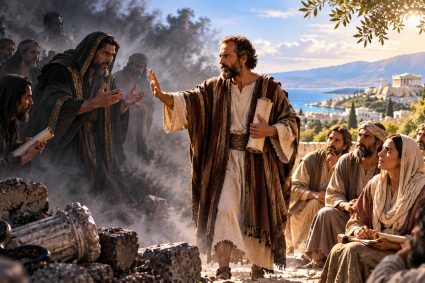
At the end of his life, Joshua gathers the people once more at Shechem—the place where Abraham built his first altar (Genesis 12:6–7) and where Jacob buried all foreign gods under the terebinth tree (Genesis 35:4). Now, after the conquest of the land, the people stand before a new decision:
Will they truly remain faithful to the God of their fathers?
Joshua 24 is the solemn renewal of the covenant—comparable to a combination of renewing wedding vows, founding a nation, and taking a sacred oath.
────────────────────────
📚 VERSES FOR DEEPER REFLECTION
────────────────────────
🔹 Joshua 24:16–18 – The people’s spontaneous response
“Far be it from us to forsake the LORD and serve other gods!” (v. 16)
This statement is remarkable because the people explicitly confess:
• God has led them (not only their ancestors)
• God has protected them
• God has brought them into the promised land
In a way, they retell the story of salvation. It seems as though they have understood.
But:
In Israel’s history, it often becomes clear that an emotional confession does not always lead to lasting faithfulness
(compare Exodus 19:8; 24:3–7; Judges 2:7, 10–13).
────────────────────────
🔹 Joshua 24:19 – Joshua’s sobering response
“You are not able to serve the LORD…”
At first glance, this sounds discouraging. But it is a pastoral warning.
Joshua clarifies three important theological truths:
-
God is holy – He is not a “household god” or “tribal god,” but the God of heaven.
-
God is jealous – meaning He tolerates no “divided loyalty” (see Exodus 20:5).
-
God does not forgive automatically – grace is not mechanical; it belongs to a covenant relationship.
Joshua confronts the people with the depth of their decision: whoever commits to God assumes responsibility.
────────────────────────
🔹 Joshua 24:20–21 – Warning against relapse
“If you forsake the LORD… He will turn and do you harm…” (v. 20)
Here, reference is made to the covenant structure of the Old Testament:
• Blessing for faithfulness (see Deuteronomy 28:1–14)
• Curse for unfaithfulness (see Deuteronomy 28:15–68)
The people must not underestimate the holiness of God. Joshua’s goal is not intimidation, but maturity: only a conscious decision will endure.
────────────────────────
🔍 BIBLICAL CONNECTIONS & THEOLOGICAL DEPTH
────────────────────────
📎 1. The meaning of the verb “to choose” – bachar
The Hebrew word bachar (“to choose”) is used deliberately here—just as it is in God’s choosing of Israel
(Deuteronomy 7:6; 10:15).
Meaning:
Just as God freely chose Israel, He invites Israel to freely choose Him—without coercion, but with consequences.
➡️ Biblical parallels:
• Deuteronomy 30:19: “I have set before you life and death, blessing and curse. Therefore choose life!”
• 1 Kings 18:21: Elijah: “How long will you waver between two opinions?”
• John 6:67–68: Jesus asks the disciples, “Do you also want to go away?” Peter answers, “Lord, to whom shall we go?”
• Revelation 3:20: “Behold, I stand at the door and knock…”
────────────────────────
📎 2. The impossibility of serving God by one’s own strength
Joshua’s statement is not theologically wrong, but pastorally profound. No one can serve God “righteously” by their own strength. The New Testament also emphasizes this:
• Romans 3:10: “There is none righteous…”
• John 15:5: “Apart from Me you can do nothing.”
• Philippians 2:13: “For it is God who works in you, both to will and to act…”
Therefore, true discipleship is not self-achievement, but spiritually possible through relationship with the living God.
────────────────────────
🧠 SUMMARY
Joshua shows us a spiritually responsible theology:
• God calls – but does not force
• Humans respond – and bear responsibility
• Grace is given – but not cheap
• Decision is free – but serious
………….. 🗺️ …………..
🗣️ Answers to the Questions
🟢 Question 1: How did the Israelites respond to Joshua’s call? Why was Joshua’s response so sharp?
Answer:
The Israelites respond enthusiastically:
“We will serve the LORD!” (v. 18)
But Joshua sees deeper. He knows that religious words come easily—especially in collective enthusiasm. Yet God’s covenant requires heart and consequence.
Therefore he warns them:
• God is holy – not a God to be adapted
• God is jealous – He does not share His people with idols
• God is just – He takes promises seriously
Joshua’s sharpness is spiritual love. He does not want the people to fall back into superficial religiosity.
………….. 🗺️ …………..
💎 Spiritual Principles
• True discipleship flows from free decision, not religious group pressure
• A “yes” to God is not merely emotional—it is a responsibility
• Serving God is a spiritual covenant, not a religious duty
• The covenant with God lives through relationship, not commands alone
………….. 🗺️ …………..
🛠️ Application in Daily Life
• Ask yourself honestly: Was my “yes” to God influenced from the outside—or was it my free decision?
• Renew your devotion regularly, not only at conferences or baptisms
• Train your ability to decide: Even today, God places us before choices every day
• Recognize this: God takes you seriously—so take His invitation seriously as well
………….. 🗺️ …………..
✅ Conclusion
God does not want slaves—He wants children who freely love Him.
Joshua’s message is:
“You are free—so serve out of freedom, not out of fear.”
Today, God also calls you:
“If you choose, then choose with heart, with understanding—and with devotion.”
………….. 🗺️ …………..
💭 Thought of the Day
“God forces no one—but He calls everyone to an honest decision.”
………….. 🗺️ …………..
✍️ Illustration
“The Decision in the Third Pew”
A story from the 21st century about freedom, truth, and service
🧩 Chapter 1 – The Last Song
Leonie sits in the third pew, as she does every Sabbath. The congregation sings. But inside her, there is silence.
She knows the message. She attended Sabbath School, the youth group, the baptism classes. And yet she feels:
I have never really chosen.
🧩 Chapter 2 – The Question No One Asks
After the service, no one talks about Joshua 24. It was about “serving in freedom.” Everyone rushes to lunch.
Leonie remains seated. The sermon verse echoes:
“Choose this day whom you will serve.”
She asks herself:
Have I ever really chosen—or have I just gone along with the crowd?
🧩 Chapter 3 – The Break
Leonie begins to pray. But something is missing. It feels mechanical.
In a conversation with her mentor, she says:
“I can’t serve God from a genuine heart. Somehow… it’s not honest.”
The answer is calm:
“Then start with honesty. God prefers your real silence to your false prayer.”
🧩 Chapter 4 – The Choice
One week later. Sabbath. The sermon ends—this time no music, just silence.
The preacher repeats:
“God does not want your routine. He wants your decision.”
Leonie slowly stands up. Her legs tremble. She walks forward—not because others do, but because for the first time she truly wants to.
🧩 Chapter 5 – Freedom
One year later. Leonie leads a small group. Not perfect—but honest.
She often speaks about the day she chose for the first time in the third pew:
“I thought freedom meant independence. But real freedom begins when you say yes to God.”
………….. 🗺️ …………..
🧠 Final Thoughts
God forces no one. But He asks everyone the question:
“Do you want to serve Me—truly, from a free heart?”
Leonie has learned:
The freedom to say “no” is what makes our “yes” so precious.
God invites you—not into bondage, but into a covenant of freedom and love.

More Stories