📖 1. Introduction – A real-life situation
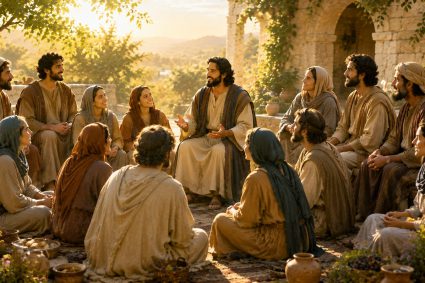
Imagine a group of people who actually belong together—perhaps a church, a team, or even a family. Outwardly everything looks fine, but internally there are tensions. Different opinions, backgrounds, or expectations lead to distance between people. They do talk to each other, but not really to one another.
Such a situation is nothing new. We experience it today—and it already existed in Paul’s time.
📜 2. The biblical story – Paul and his co-workers
In Colossians 4:10–11, Paul mentions several people: Mark, Aristarchus, and Justus. All three are Jewish believers and close co-workers in ministry. Later, he also mentions non-Jewish co-workers such as Epaphras, Luke, and Demas.
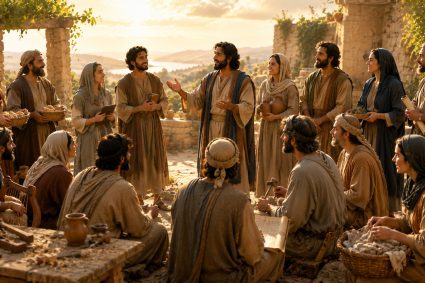
What stands out here is this: these people had different backgrounds, cultures, and perhaps even different perspectives—and yet they worked together toward the same goal.
Paul goes even further: he intentionally builds relationships. For example, he mentions Mark, who had once caused problems, and now recommends him as trustworthy. In doing so, he builds bridges and promotes reconciliation.
🌍 3. Connection to today
Today we live in a highly connected world 🌐. Yet many churches still experience tensions:
differences in opinion, generational gaps, or cultural diversity can lead to conflict.
So the challenge is not new—it has simply taken a different form.
💡 4. Central message of the lesson
Unity does not happen automatically. It must be intentionally lived out and nurtured.
Paul shows: unity does not mean sameness, but a shared purpose despite differences.
✝️ 5. Theological focus
The unity of believers is not a human project, but a spiritual principle.
In the Bible, the church is described as the “body of Christ” (see 1 Corinthians 12). This means:
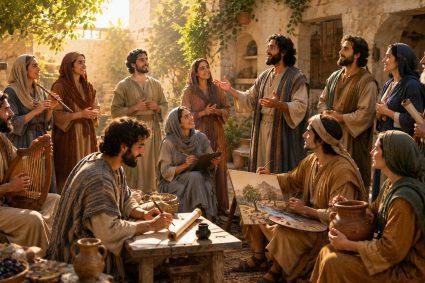
- Everyone is different
- Everyone has a unique role
- But all belong together
That Jews and Gentiles served together was revolutionary at the time. It shows that the gospel overcomes boundaries and unites people who would otherwise be separated.
👉 Unity is therefore a sign of God’s work.
📖 6. Bible texts explained
In Colossians 4:10–11, Paul mentions specific names and describes their cooperation. These greetings are more than politeness—they show that real fellowship is being lived out.
An important background text is Ephesians 4:3:
“…make every effort to keep the unity of the Spirit through the bond of peace.”
This makes it clear: unity is something that must be actively preserved.
In 1 Corinthians 12:12–13, the church is described as one body in which many members belong together—regardless of origin or difference.
This means: diversity is not a problem, but part of God’s plan.
Also, John 17:21 shows Jesus’ desire:
“…that all of them may be one.”
Unity is therefore not optional, but central to the Christian witness.
👉 Taken together, these texts show:
Unity is intended, spiritually grounded, and essential for the credibility of the church.
🔧 7. Practical application
Now the question becomes personal:
How do I contribute to unity?
This can look very practical:
- I truly listen to others
- I respect different opinions
- I seek reconciliation instead of being right
- I speak in ways that build up rather than criticize
Unity does not begin with “others,” but with me.
❓ 8. Reflection question
Where are there tensions in my church—
and what can I concretely do to promote peace?
🌟 9. Final thought
Paul shows us: unity does not happen by itself, but it is possible.
When people with different backgrounds live together for Christ, something becomes visible that is greater than themselves.
👉 A united church is one of the strongest testimonies to the world. 🤝