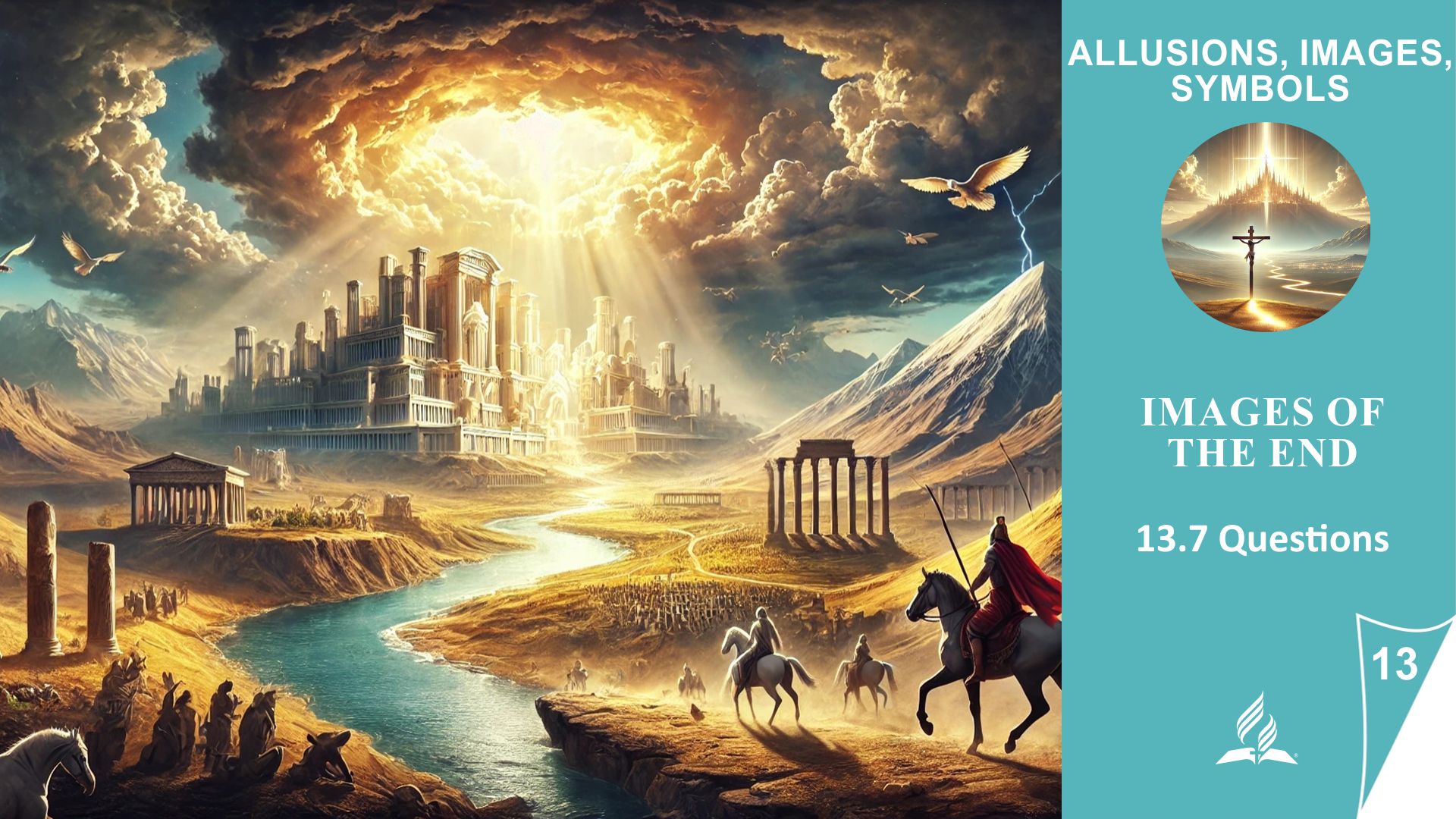

⛪ Lesson 13: IMAGES OF THE END
📘 13.7 Questions
………………………………………………………………….
🟦 Introduction
When we think about the great images of the end times, it’s not just symbols, timelines, or prophetic events that challenge us—it’s the questions Jesus asks. Questions that pierce the heart. He spoke of Nineveh, of Belshazzar, of the drying up of the Euphrates—not as distant stories, but as mirrors for His church today.
This lesson invites us into deep reflection: What does it mean to live in truth? How do we deal with spiritual heritage? And what truly keeps people—even in the church—from fully surrendering to Jesus?
………………………………………………………………….
📖 Answers to the Questions
📌 Question 1: Consider Jesus’ statement that it will be more tolerable for Nineveh in the judgment than for God’s people who have turned away from the truth (see Matthew 12:39–42). What can God’s church learn from this warning?
“The men of Nineveh will rise up in the judgment with this generation and condemn it; for they repented at the preaching of Jonah, and behold, a greater than Jonah is here!” – Matthew 12:41
Jesus’ words are striking. He compares repentant, pagan Nineveh to His own people—the religiously privileged. God’s people had more light, more revelation, more closeness to heaven. Yet they rejected it.
What can God’s church today learn from this?
The greatest danger for the church is not a lack of truth—but taking it for granted. When grace becomes routine, we lose our reverence. History teaches us: It’s not the amount of knowledge that saves us in judgment—but how we respond to it.
God’s warning to His church is: “Never lose your awe of grace. For to whom much is given, much will be required.”
📌 Question 2: Note Ellen White’s statement that with each successive kingdom “history repeated itself” (PK, p. 548). What similarities do you see among the kingdoms mentioned in prophecy? In what way did they follow the same prophetic pattern? And how does our modern world follow that same path?
“With every succeeding kingdom, history repeated itself.” – Ellen White, Prophets and Kings, p. 548
What connects the prophetic kingdoms?
Babylon, Medo-Persia, Greece, Rome—they all followed a pattern:
-
Pride over humility
-
Human power over divine authority
-
Fleeting splendor over eternal values
They often began with sincerity, even divine calling (e.g., Cyrus), but with success came self-glorification. And eventually: the fall.
What about today’s world?
We see the same dynamics:
-
Economy over truth
-
Control over character
-
Systems over meaning
The global order strives for unity—but without God. It’s a modern Tower of Babel—digitally connected, spiritually empty. Just like the kingdoms before, our world is heading toward a point where God will intervene.
📌 Question 3: Consider the idea that it is often not the mind or intellect that keeps people from faith—but the heart. How might this insight shape the way you witness to others?
This is a deeply spiritual truth: Many do not reject faith because of lack of knowledge—but because of inner resistance. The intellect is often willing, but the heart remains closed. Pride, fear, hurt, control—all block faith.
How does this change our witness?
-
Fewer arguments, more compassion
-
Fewer debates, more prayer
-
Not just “What do you know?”—but “How is your heart?”
To witness is not just to teach—it is to love.
………………………………………………………………….
✨ Spiritual Principles
-
Knowledge brings responsibility. The more truth we have, the deeper our accountability.
-
History is a mirror: Those who don’t learn from it will repeat it.
-
Evangelism begins not in the mind, but in the heart.
………………………………………………………………….
🧩 Application for Daily Life
-
Self-reflection: Do I still respond to God’s Word—or have I become spiritually numb?
-
Understanding the times: What parallels do I see between today’s systems and the kingdoms in prophecy?
-
Heart-based witness: Meet people not just with Bible verses, but with compassionate presence.
………………………………………………………………….
✅ Conclusion
This lesson calls us to more than knowledge—it calls us to repentance. Like Nineveh. It calls us to humility—as Jonah eventually learned. It warns against pride—as Belshazzar ignored. And it shows hope—through Cyrus and through Jesus.
For the goal is not judgment—but salvation.
………………………………………………………………….
💭 Thought of the Day
Some nations barely know the truth—and repent.
But God’s people know the truth well—and hesitate.
True faith is not about how much you know.
But how deeply you allow yourself to be transformed.
………………………………………………………………….
✍️ Illustration – The City of Mirrors
Chapter 1 – The Call in the City’s Heat
It was a hot late summer evening in Frankfurt. The city glowed—not just from the asphalt, but from the pace of life. Between investment banking, artificial intelligence, and political stability, everything seemed focused on progress.
Elisa Wolf, 33, was part of this system. A top-ranking lawyer, internationally active, eloquent, brilliant. Her specialty: constitutional law and religious freedom. Only one thing she had long left behind: the faith of her childhood.
One evening, after a live interview at the ARD studio on “The Future of Values in a Secular Society,” a quiet, older man approached her—white shirt, calm eyes.
“You speak well,” he said. “But do you believe what you say?”
“I speak about facts, not faith,” Elisa replied.
“Then you speak about shells,” he said, handing her a card. Only one word was written on it: Nineveh.
Chapter 2 – The Shadow of Nineveh
She couldn’t shake the card. That night, she dreamed: A golden city—bright, powerful—collapsed. Its towers made of data and law shattered. From the ruins rose one word: Mene, Mene, Tekel…
She found it again in the Bible—Daniel 5. King Belshazzar. The one who drank from holy vessels. The one who knew—but did not obey. Elisa was shaken: He was weighed and found wanting—because he had despised what was sacred.
She kept reading—and came across Matthew 12: “Nineveh will rise against this generation.”
She understood: Nineveh had less knowledge—but more humility. Israel had more light—but remained proud.
Suddenly, she felt exposed.
Was she like Belshazzar?
Had she known truth—and ignored it?
Was she like modern Israel—educated, religiously informed, but spiritually empty?
Chapter 3 – The City of Babel
At a conference center in Brussels, a panel of top lawyers, tech strategists, and ethicists met—theme: “Global Order in the 21st Century.”
Elisa was to speak on religious freedom—in a time when faith was increasingly viewed as a “disturbance.”
But as she read her speech, something in her shifted. Instead of her prepared words, she spoke spontaneously:
“The greatest danger to our freedom is not religion—but our arrogance in believing we can order what only God can sustain.”
A murmur went through the room. Then: silence. And then applause.
But Elisa knew: The applause was empty. Many heard—but none understood.
That night, she saw the city again. But this time, words burned across the sky:
“With every kingdom, history repeats itself.”
Chapter 4 – The Heart of the Matter
Back in Frankfurt, she spoke with her mother—a simple woman, still faithful, quiet, unnoticed.
“You have all the knowledge in the world,” her mother said. “But do you have peace?”
Elisa was silent.
“Faith doesn’t begin in the head. It begins where you finally become honest—before God. And before yourself.”
That night she went alone to a small Seventh-day Adventist church on the edge of the city. No big cross. No show. Just people, Bibles, silence. The sermon text: Isaiah 58.
“If you honor the Sabbath… you will find your joy in the Lord.”
She wept.
For the first time not from pain—
But from clarity.
Chapter 5 – The Answer
She began to keep the Sabbath—on the seventh day, as written. She canceled her Saturday contracts. Her firm didn’t understand. Her network turned away. But she found peace. New. Real.
She studied the prophecies of Daniel, Revelation 14. She realized: We’re not just living in a digital age—but in a time when Babylon is rising again.
-
Systems are being built—without God.
-
Kingdoms erected—against His Word.
-
Truth replaced—by “tolerance.”
But God will not remain silent forever.
And in the midst of it all, He calls:
“Come out of her, My people.” – Revelation 18:4