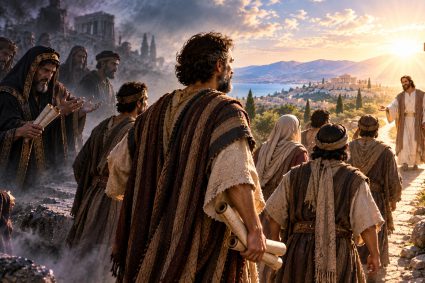
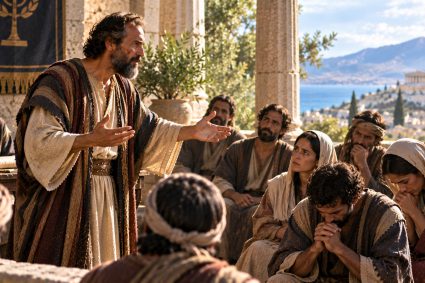
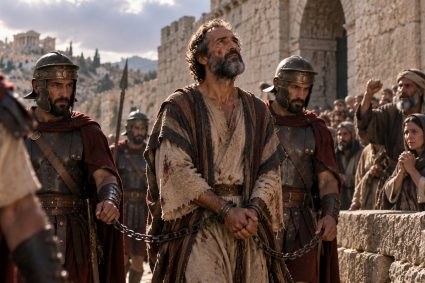
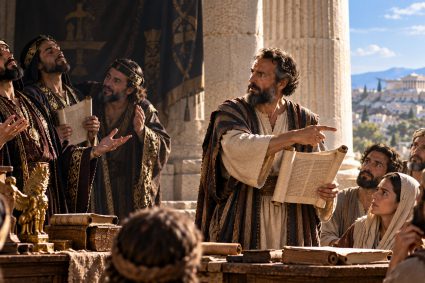
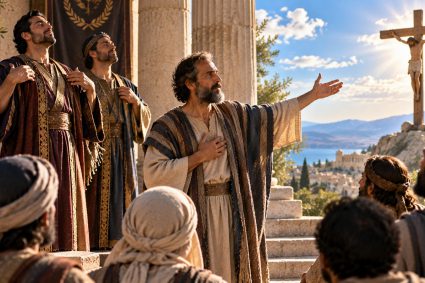
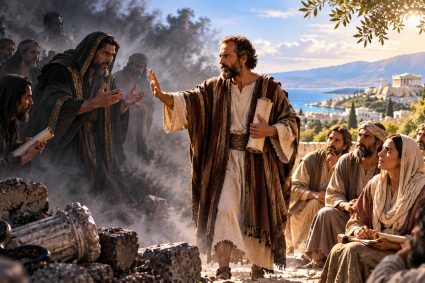
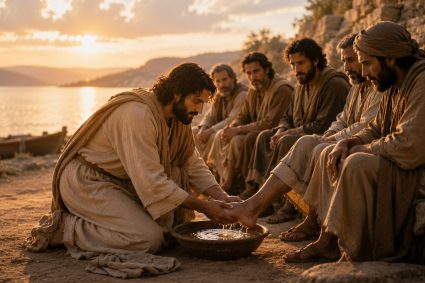
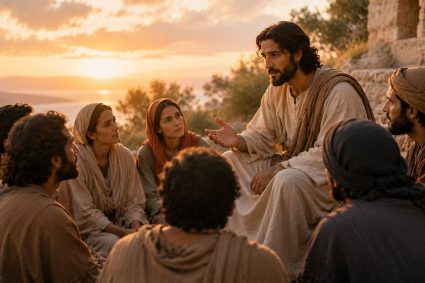
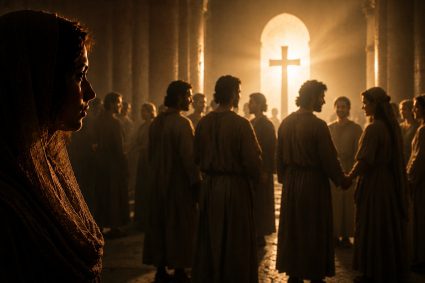
This is the key passage for understanding the “living sacrifice.”
• Living — not a dead ritual, but a daily life for God.
• Holy — set apart, dedicated to God.
• Pleasing — not out of duty, but out of love, through the Spirit.
True worship is not limited to church. It happens in everyday life when we give God everything — our thoughts, decisions, priorities, and relationships.
📌 1 Corinthians 11:1: “Follow my example, as I follow the example of Christ.”
Paul is not calling for blind obedience, but inviting us to imitate the life of Jesus — and his own life insofar as it reflects Christ. The living sacrifice is not a dark fate, but the way of Jesus, who gave Himself fully — out of love.
………………..✉️………………..
🗣️ Answers to the Questions
📌 Question 1: What is Paul saying in these verses?
Paul presents himself as an example of a devoted life. In Philippians 2:17 and 2 Timothy 4:6, he describes his life as a drink offering — a conscious gift, not a loss.
In Romans 12:1–2, he expands this to all believers. Not only priests or martyrs are called to sacrifice — every Christian is called to offer themselves as a living sacrifice. This happens not on a stone altar, but on the “altar of everyday life.”
The key lies in the renewal of the mind: we are not shaped by the world, but by God’s will. When this happens, devotion is no longer forced, but a logical response to God’s grace.
1 Corinthians 11:1 shows that this life is visible and imitable. It is not extreme — it is meant to be a model for others.
📌 Question 2: What does it mean if your life is a “living sacrifice”? What does your answer say about you?
To be a living sacrifice means to give everything to God — not just on Sabbath, not just in worship, but in daily life:
• my time
• my money
• my gifts
• my relationships
• my goals
• my leisure
• my thinking
The degree to which I am willing to surrender these areas shows how much room God really has in my life. If I only “sacrifice” what is easy for me, am I truly living as an offering — or as a consumer?
This question is uncomfortable — but necessary. It reveals whether my faith is convenient or consecrated.
………………..✉️………………..
💎 Spiritual Principles
-
True worship is a surrendered life.
-
Devotion is not loss — it is gain in Christ.
-
A “living sacrifice” lives consciously different — every day.
-
God asks not only for our words, but for our hearts and our daily lives.
-
Christian discipleship means taking up the cross daily — out of love.
………………..✉️………………..
🛠️ Application for Everyday Life
• Start your day with the question: “Lord, what do You want to do with me today?”
• Review your time investments: Where does my life truly serve God — and where only myself?
• Practice spiritual disciplines intentionally — as offerings: not out of duty, but as expressions of love.
• Teach children and family what devotion means: not through sermons, but through example.
• Use opportunities for evangelism actively: small groups, Bible studies, personal conversations — like the believers in Philippi or the Adventist pioneers.
………………..✉️………………..
✅ Conclusion
Paul’s message is challenging — but also glorious: A life surrendered to God is not empty, but fulfilled.
Sacrifice is not the end — it is the beginning of a meaningful, powerful life with lasting value.
In a world that lives for itself, Christians are called to live differently — fully.
………………..✉️………………..
💭 Thought for the Day
“God is not looking for half-hearts, but for whole lives.”
………………..✉️………………..
✍️ Illustration — The Quiet Heroine
When devotion goes unnoticed — except by heaven
Part 1 — In the shadow of visibility
Sabrina was not a famous speaker. No YouTube channel, no church offices. She worked as a nurse on rotating shifts and lived alone in a small apartment on the edge of the city. But every morning, before driving to the clinic, she prayed:
“Lord, take my life today. Use me however You want.”
During her 15-minute lunch breaks, she often read from her worn New Testament. Sometimes she spoke with coworkers about her faith. Not pushy — but honest.
Part 2 — The hidden ministry
In oncology, she regularly faced death. Her calm, compassionate, and dignified manner caught patients’ attention. Some asked for prayer. Others asked questions. Some accepted Bibles she bought with her own money.
At home she wrote letters to lonely church members, cared for elderly neighbors, gave faithfully, and supported missionaries overseas.
One day a coworker said to her:
“Sabrina, you are different. Not religious — but real.”
She smiled and said:
“Because Jesus is real.”
Part 3 — On the day of Christ
Sabrina died of cancer at 56. Her funeral was small. But when her Bible was opened, her family found notes, prayer lists, and names — hundreds of them. Every page was soaked with devotion.
Many people she had never consciously “evangelized” came to faith through her witness — a nurse, a patient, a coworker.
On the day of Christ, she may be amazed at what God made from what seemed like a small life.
………………..✉️………………..
📌 Final thoughts on the story
Not every sacrifice is visible. But every sacrifice made out of love for God is precious in His eyes.
A “living sacrifice” does not live for applause, but for Christ. Not for the stage, but for faithfulness.
God writes extraordinary stories with ordinary people — when they give themselves to Him completely.