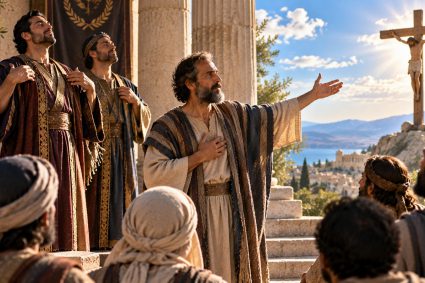
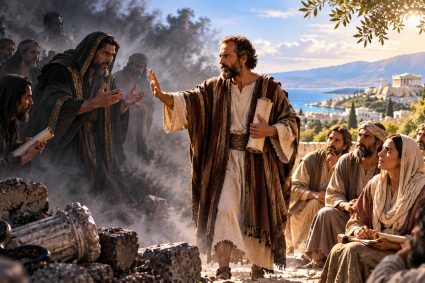
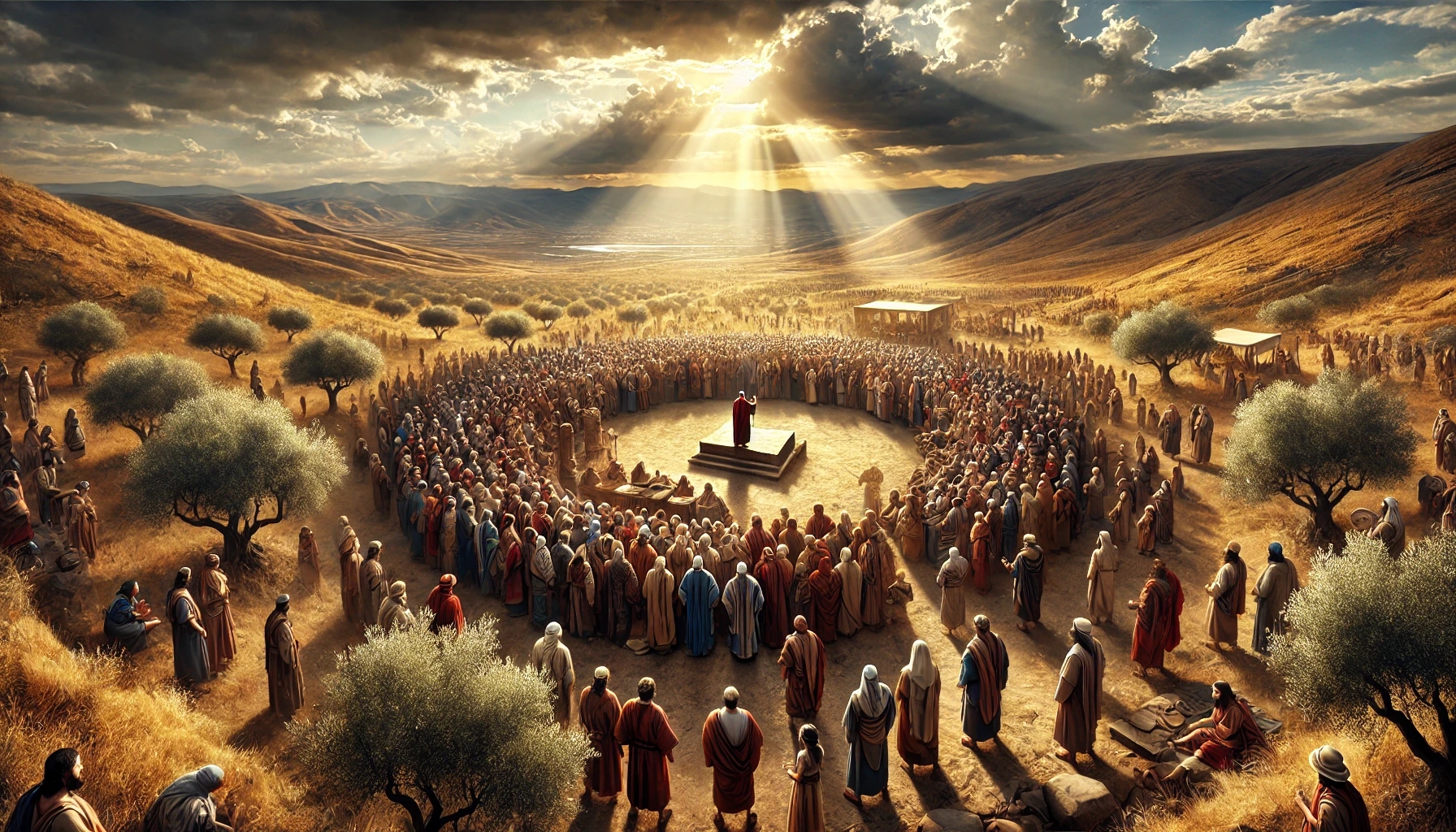
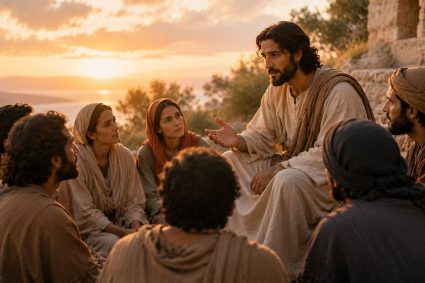
At the end of his life’s journey, shortly before his death, Joshua gathers all Israel in Shechem—the place where Abraham first entered the promised land and worshiped God. It is not only a historical location—it is a spiritual crossroads of remembrance, grace, and decision.
Joshua takes Israel on a journey into the past. “I took… I led… I gave…”—God Himself is the One acting in Israel’s story. And now, at the end, the question arises: How will the people respond to this story?
This lesson reminds us that we were there too. We stand in the spiritual heritage of those who experienced God. And every generation must decide anew: Will I follow the God of history today?
………….. 🗺️ …………..
📖 Bible Study
🔎 Joshua 24:1 — The Covenant at a Holy Place
Shechem is not a random location. Here:
-
God’s promise to Abraham was given (Genesis 12:6–7)
-
Jacob’s household was called to repentance (Genesis 35:2–4)
-
And now: Israel is called to covenant faithfulness.
Commentary:
Geography becomes theology: God has not only made history—He has filled places with meaning. The call to decide happens not in a vacuum, but on the ground of history.
🔎 Joshua 24:2–13 — God’s Review of His Faithfulness
God Himself speaks. And He tells not of Israel’s deeds, but of His own works:
-
“I took Abraham”
-
“I brought you out”
-
“I gave you the land”
Israel is a recipient, not the author. This is the theology of grace: What you are, you are because of God’s intervention.
Commentary:
It is as if God were saying:
“Before you speak about your decision, remember: without Me, you would not exist as a people.”
The repeated shift between “they” (ancestors) and “you” (the present generation) emphasizes:
Past experiences also belong to you. You are part of God’s story.
………….. 🗺️ …………..
🗣️ Answers to the Questions
🟢 Question 1: What is the main point of God’s speech in Joshua 24:2–13?
Answer:
The central message is: Everything you are, you are because of Me.
-
Israel did not come into the land by its own strength.
-
It was God who led, saved, provided, fought, and gave.
-
This past calls for a response: to give God the honor—with your whole life.
Summary:
God’s faithfulness in history is the foundation for our decision in the present.
🟢 Question 2: How can we as a church develop a stronger sense of collective responsibility?
Answer:
The Bible never thinks individualistically. Whole generations, families, and peoples are addressed again and again—not because everyone is guilty, but because everyone is connected.
Practical ways:
-
Use more “we” language instead of “I” language: “How are WE doing with God?”
-
Carry responsibility for one another (Galatians 6:2): “If one falls, we all suffer.”
-
Practice shared repentance and intercession—like Nehemiah, Ezra, or Daniel
-
Connect generations: the young listen to the older, and the older bless the young
Spiritually, church means community:
“We stand together before God—as one people.”
………….. 🗺️ …………..
✨ Spiritual Principles
-
God’s story with your life begins long before you.
-
Remembering is a spiritual act—it leads to gratitude and devotion.
-
Decisions for God are rooted in His actions, not in your feelings.
-
Shared faith is not the sum of individual piety, but a shared inheritance.
………….. 🗺️ …………..
🛠️ Everyday Application
-
Tell your family or youth group how God has led you—be part of the community’s memory of faith.
-
Avoid the temptation to see your faith as purely private—you are part of something bigger.
-
When you doubt, remember God’s deeds—in your life or in the lives of others.
-
Celebrate milestones (baptisms, answered prayers, testimonies) intentionally together—like Israel in Shechem.
………….. 🗺️ …………..
✅ Conclusion
Joshua’s message to Israel is also ours:
“You were there—because God’s story includes you.”
If you live today, breathe, believe—then you are part of His story. Your response is needed—not out of duty, but out of reverence. Choose today—not detached from the past, but rooted in God’s faithfulness.
………….. 🗺️ …………..
💭 Thought of the Day
“The past with God is the invitation to fully trust Him today.”
………….. 🗺️ …………..
✍️ Illustration
“The Oath of Shechem”
An awakening in the heart of a lost grandson
Chapter 1 – Return to Kalbarri
As Daniel passed the rusty town sign of Kalbarri, a small town on Australia’s west coast, he felt an inner resistance. He hadn’t been here for 17 years. Back then, at 14, he had moved away with his parents—away from the small Adventist church, away from faith, away from the village that reminded him too much of what he had lost.
Now, at 31, he was back—only because his grandfather had died. Albert Lasker, former church elder, a preacher on his motorcycle, the man who walked from house to house every Sabbath morning handing out invitations.
“Come to the covenant renewal,” it said on one of the old leaflets Daniel found by chance among the estate.
Chapter 2 – The Old Verse
That evening Daniel rummaged through his grandpa’s dusty house. Between books and notes, he discovered a framed parchment on the wall:
“Choose for yourselves this day whom you will serve… But as for me and my house, we will serve the LORD.”
– Joshua 24:15
His eyes lingered on it. Why had his grandfather quoted it again and again? As a child it had annoyed him. Now… it sounded like an echo catching in his heart.
Chapter 3 – Shechem in Australia
On Sabbath morning Daniel went for a walk—not to church, but to the old campsite by the river. That’s where his extended family used to spend Sabbaths, sing songs, and hold communion services.
That was where he had been baptized. At 12, without understanding much, but with one sincere desire: “I want to belong.”
Now he knelt there again. His grandfather’s Bible lay beside him. He opened it. And again: Joshua 24.
But this time he read more carefully. Not only verse 15, but verses 1–13—God’s review: “I took… I led… I gave…”
Daniel wept. He recognized himself in the story. He hadn’t believed God was with him. But now he saw: “He was the One who led me, even when I didn’t recognize it.”
Chapter 4 – Decision by the Fire
That evening, the small church in Kalbarri held a memorial service for Albert. The church was full: old friends, members, grandchildren, young people.
Daniel stayed quiet until the preacher—a young man from Perth—suddenly said:
“Just as Joshua gathered his people in Shechem, so we stand here today. You were not there in the wilderness, you were not at Jericho—but by faith you are part of the same story.”
Then he challenged the congregation:
“If you want to make a decision for God today—not out of duty, but out of reverence—then stand up. Show heaven: I’m in.”
Daniel stood. Not emotional—but steady. In that moment he understood:
Faith was not a nostalgic memory, but a living call into the present.
Chapter 5 – The Oath
After the service Daniel went for a walk with the preacher’s granddaughter—Rachel. She had studied theology in Perth and had volunteered to come back to keep the small church alive.
She showed him an old wooden board where church members of past decades had engraved their “oath.” Like in Shechem. Year after year.
He took his grandfather’s pocketknife, went to the board, and wrote:
“Daniel Lasker – 2025. I choose today.”
Rachel asked quietly, “What convinced you?”
He answered:
“I thought God was done with me. But today I realized: I’ve been part of His story the whole time.”
Chapter 6 – The New Heritage
A year later Daniel was a deacon. He led the youth group. He told his story—not as a hero, but as a witness of God’s faithfulness.
He learned that spiritual heritage does not mean living in the past, but carrying it forward—through your own decision.
And again and again he told the young people the same sentence his grandfather had said:
“Choose today—for you were there too.”
………….. 🗺️ …………..
🧠 Final Thoughts
This story reminds us:
God’s story has room for your name—if you are willing to choose today.