⛪ Lesson 3: Rough Start
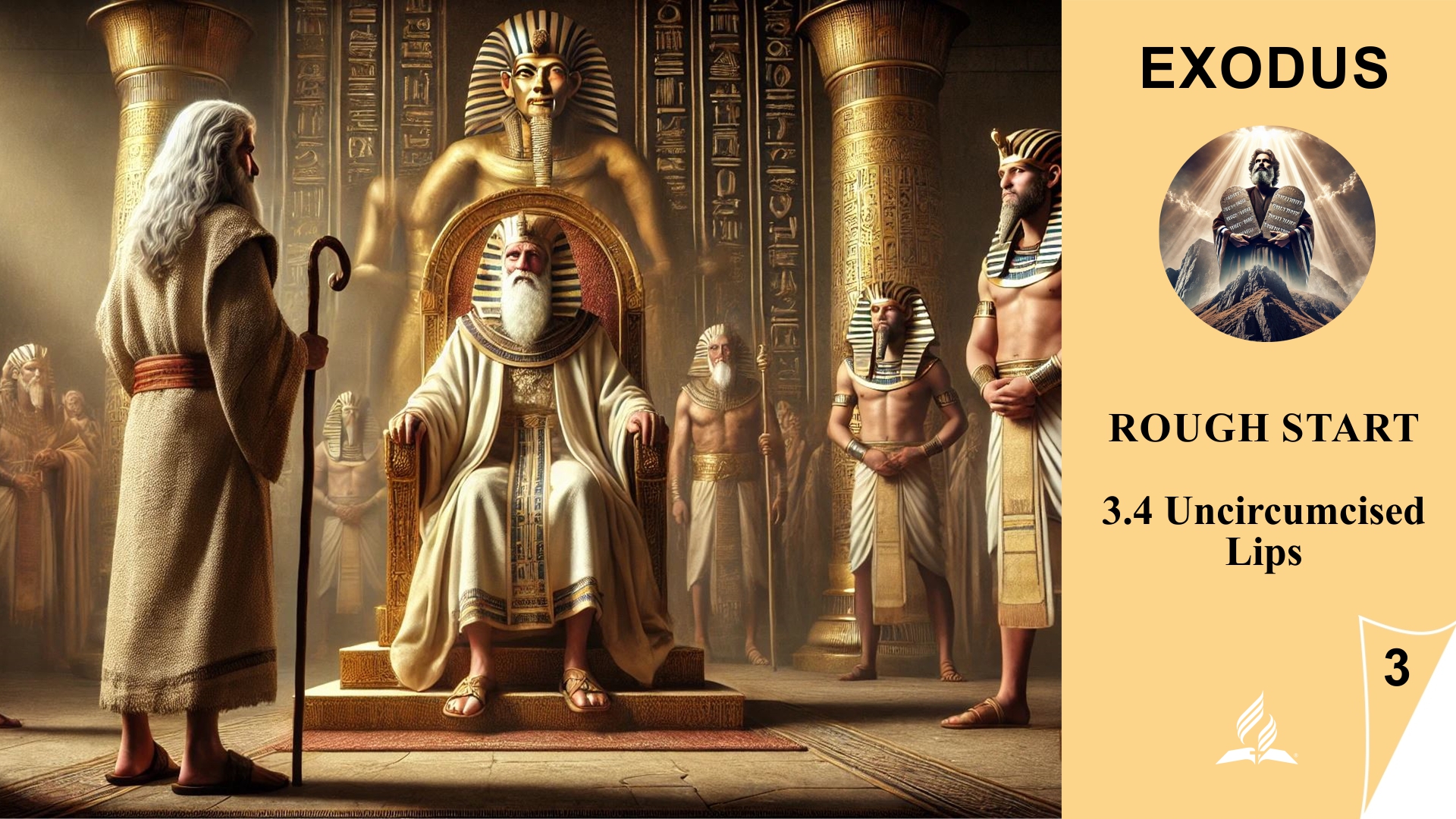
📘 3.4 Uncircumcised Lips
✨ When discouragement closes ears – God’s promise still stands
………………………………………………………………….
1.🟦 Introduction
Discouragement is a familiar companion in the life of a believer – especially when prayers go unanswered, hopes are shattered, or God’s promises seem unfulfilled. Moses had received a clear calling from God: to proclaim Israel’s deliverance from Egyptian slavery. And yet, his words were rejected – not only by Pharaoh, but also by his own people.
The people were too tired, too disappointed, too bitter to hold on to hope. And Moses himself – the prophet of God – called himself “uncircumcised in lips” (Exodus 6:12).
What should we do when we know God is faithful – but nothing around us looks like it?
………………………………………………………………….
2.📖 Bible Study – Exodus 6:9–13
Theme: When calling meets resistance – faithfulness in the valley of disappointment
🔍 1. Context: Moses at a low point
Moses had spoken with God at the burning bush, returned to Egypt, and confronted Pharaoh – and everything got worse. Instead of deliverance came more slave labor, more suffering, more frustration.
Now, in chapter 6, God speaks again to Moses – with powerful promises:
“I will redeem you… I will take you as my people… I will be your God” (vv. 6–7).
But the people’s reaction? Rejection.
📖 Verse 9: Hope meets disappointment
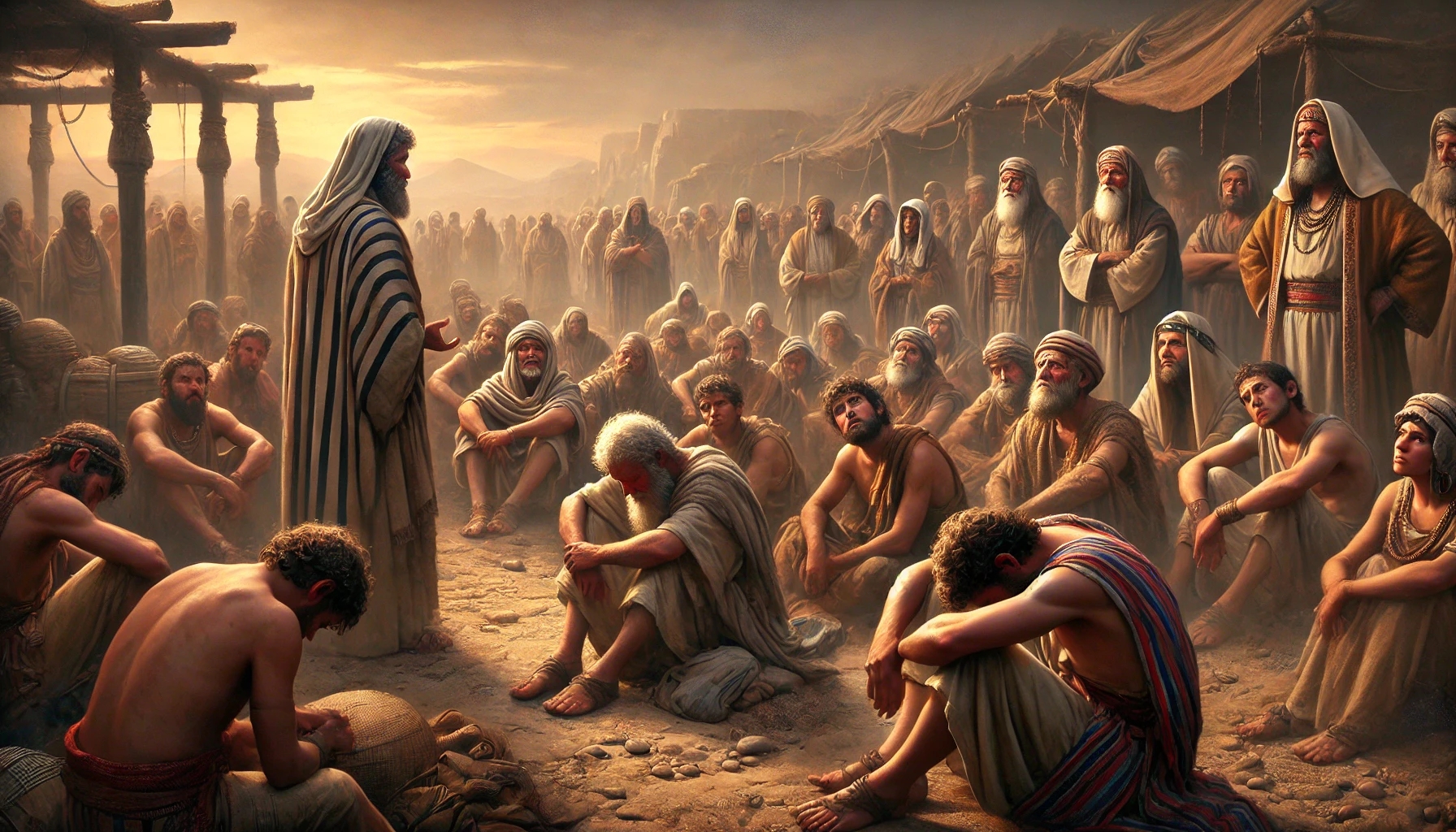
“But they did not listen to him because of their discouragement and harsh labor.”
The Israelites couldn’t believe Moses – not because his message was false, but because their suffering was too loud. Hopelessness can be so deep that even God’s promises fail to break through.
👉 Important Point:
Discouraged people are often not unbelievers – they are simply exhausted.
📖 Verses 10–11: God’s command remains
“Then the Lord said to Moses: ‘Go, tell Pharaoh…’”
God does not change His command – even when Moses feels like a failure. God speaks directly again. Calling is not defined by how people react, but by God’s will.
📖 Verse 12: Moses’ self-doubt
“‘If the Israelites will not listen to me, why would Pharaoh listen to me, since I speak with faltering lips?’”
Moses doubts himself – again, a pattern already seen in Exodus 4. He uses his supposed lack of eloquence as an excuse.
“Uncircumcised lips” means: unworthy, unclean, inadequate to speak. A feeling of unfitness – as if saying: “I’m not the right person.”
But here lies the contrast:
-
Moses looks at his inability,
-
God looks at His calling.
📖 Verse 13: God’s authority stands
“Now the Lord spoke to Moses and Aaron and gave them a command…”
God confirms His mission – not through discussion, but through command. He calls Moses and Aaron – not because they are perfect, but because He chose them.
🧠 Deepening & Parallels
📌 Job
Job lost everything – family, possessions, health. His friends were no help. And yet: he stayed connected to God – through struggle, silence, and suffering.
📌 Asaph (Psalm 73)
Asaph saw injustice around him – and nearly lost his faith. But he found stability in God’s presence:
“Yet I am always with you…” (v. 23)
📌 Jesus in Gethsemane
Even Jesus, in the garden of Gethsemane, felt abandoned, overwhelmed, and weak – yet He prayed:
“Not my will, but Yours be done.”
💡 Spiritual Principles from this passage
-
God’s promises are true – even when we don’t feel them.
-
Discouragement is not a sign of God’s absence.
-
Faithfulness is more important than immediate success.
-
Our weakness does not disqualify us – God works through it.
-
God’s calling remains – regardless of others’ reactions or our emotions.
✍ Application in Life
-
If you pray and nothing seems to happen – hold on.
-
If your words seem to fall flat – trust anyway.
-
If you feel unqualified – God can work through “uncircumcised lips.”
-
If disappointment numbs your hope – remember God’s promise:
“I will be your God, and you will be My people.”
✨ God doesn’t always answer with explanations – but with presence.
Exodus 6 shows:
God is not passive when His people suffer. And He does not wait for perfection to call someone.
His actions are guided by promise, patience, and grace.
3.📖 Answers to the Questions
📖 Question 1: What happened next, and what can we learn for times of discouragement?
Moses wasn’t rejected because he spoke poorly, but because the people were broken. Their long oppression had buried hope. We know the feeling: prayers go unanswered, dreams collapse, trust fades.
But God didn’t give up on Moses – and Moses didn’t give up on his people.
In times when people don’t hear us – or when even our own hearts hesitate – we must remember:
👉 God’s mission continues – even when no one responds.
Example: Job and Asaph
Both knew darkness, doubt, grief – and yet remained with God.
Asaph’s words in Psalm 73 say it best:
“Yet I am always with you…”
Faith is not blind – it’s loyal in the dark.
📖 Question 2: “I will take you as My people…” – What does this mean personally?
“I will take you as My people and I will be your God.”
– Exodus 6:7
This promise wasn’t only for Israel – it reflects the covenant relationship God offers every believer. Paul echoes this in 2 Corinthians 6:16:
“I will be their God, and they will be My people.”
Personally, this means:
-
I am not alone – God identifies with me.
-
God sees me as belonging, even when I feel unworthy.
-
This relationship should be lived out in trust, obedience, and closeness – even in uncertainty.
………………………………………………………………….
4.✨ Spiritual Principles
-
God’s faithfulness remains even when we doubt.
-
Faith means obedience – even without immediate results.
-
Our calling depends on God’s power, not our skill.
-
Disappointment does not mean God is absent.
-
Words carry weight – even if fruit comes later.
………………………………………………………………….
5.🧩 Practical Application
-
If your prayers seem unanswered – hold fast.
-
If others don’t share your hope – stand firm.
-
If you feel “uncircumcised in lips” – trust that God can use you.
-
You might be someone’s Moses – even if they don’t listen yet.
………………………………………………………………….
6.✅ Conclusion
Moses was not chosen for eloquence – but for his heart.
Israel didn’t believe because their pain was too great – but God acted anyway.
Our calling is not rooted in our strength, but in God’s promise.
Even in silence, rejection, and struggle – God is near.
………………………………………………………………….
7.💭 Thought of the Day
“When my heart is silent and my mouth stutters, God’s Word still speaks.”
………………………………………………………………….
8.✍️ Illustration – “The Silence After the Call”
It was a grey, misty morning in Manchester. The streets shimmered with light rain, and the air smelled of wet pavement and warm toast. In a small Victorian townhouse in Longsight, Elijah Morgan sat at his kitchen table, hands wrapped around a half-full teacup, forehead resting on his arms.
Elijah was thirty-three. A quiet man, a social worker in a rough neighborhood. For the past two years, he’d also been a volunteer preacher in a small multicultural church. His faith was sincere, his heart open – but for months now, everything felt wrong.
He had once felt God’s call – powerfully, like lightning through the soul.
It was at a youth congress in London. The sermon had pierced his heart:
“Go, I am sending you. Speak hope through Me.”
And he went. He prayed, preached, started small groups, built community projects – wholeheartedly.
But today? Empty.
Last Sunday, only a handful came to church.
The youth group had fizzled out.
The families he tried to help no longer answered.
And worst of all, his theology school application – his dream – had been rejected for the third time.
“Uncircumcised lips,” he thought.
“I can’t speak. I reach no one. I’m in the wrong place.”
On the living room floor lay his notes for last week’s sermon – Exodus 6:9–13.
“But they did not listen to him… I am of uncircumcised lips…”
The words hit like a mirror.
Moses had felt the same.
He was sent – but no one listened.
And Moses felt inadequate, unworthy, powerless. Just like Elijah.
He opened his Bible to Psalm 73 – he knew it by heart, but wanted to see it again:
“Yet I am always with you; you hold me by my right hand…”
Something stirred in him. No angel, no voice – just a quiet reminder:
God hadn’t called him because he was perfect – but because God had a purpose.
His calling didn’t depend on applause, but on the heartbeat of heaven.
That afternoon, Elijah still went to the church – though he had planned to cancel. Maybe no one would come. Maybe it would be awkward.
But when he unlocked the door, five teenagers were already in the side room.
One of them – quiet Abdul – stood and said:
“Hey, Mr. Morgan. We wanted to pray. Could you share something from the Bible?”
Elijah’s voice was low, almost trembling, as he pulled out a chair:
“I’ll try… but you’ll have to help me.”
And so began a new, quiet, unnoticed story.
No stage, no applause. Just faithfulness in the small, carried by an unseen hand – just like Moses.
💭 Final Thought:
God doesn’t use the loudest – but the faithful.
Even if you feel “uncircumcised in lips” – your voice matters in the kingdom of God.