Lesson 8.In the Psalms: Part 1 | 8.7 Questions | ALLUSIONS, IMAGES, SYMBOLS | LIVING FAITH


📘 Lesson 8.In the Psalms: Part 1
8.7 Questions
In the Light of the Sanctuary – The Psalms as Guides to God’s Presence
…………………………………………………………………
🕊️📜 Introduction
The Psalms are full of contrasts: exaltation and lament, jubilation and remorse, praise and pleading. They bear the weight of every human experience—and yet they breathe hope. Especially David’s life, which shaped most of the Psalms, shows how God’s grace meets human failure. David, once a shepherd and later a king, stood before God not on his own strength but on God’s promise. He foreshadowed Christ, the only one who kept God’s covenant perfectly—in our place.
These questions bring us to the heart of our faith: How does God save? What does intercession mean? Why is Jesus our only hope? And what happens when a sinful person is lifted up by grace?
………………………………………………………………….
❓💬 Answers to the Questions
🔍 1. In what ways did David prefigure Jesus, who truly fulfilled God’s covenant on our behalf? And why is what Jesus did for us our only hope?
David was called “a man after God’s own heart”—not because he was sinless, but because he depended on divine grace. His sins (adultery, deceit, even murder) were staggering, yet his greatness lay in his reliance on God’s mercy.
The Psalms contain prophetic pointers to Christ. Psalm 22 describes a crucifixion scene centuries before the cross. Psalm 110 portrays the Messiah as both King and Priest, just as Jesus is. David’s life, though flawed, pointed toward the coming Savior.
Jesus did more than teach; He fulfilled the covenant no human could keep. While all of humanity—David included—failed repeatedly, Jesus remained perfectly faithful. Only because He stood in our place can we be saved.
“He made him who knew no sin to be sin for us, that we might become the righteousness of God in him.”
2 Corinthians 5:21
Our hope isn’t our obedience but His. Our security isn’t our feelings but His sacrifice. Our salvation isn’t our promises but His faithful word.
🔍 2. Which sections of the Psalms are most precious or meaningful to you because they reflect experiences you’ve had?
For many, including myself, Psalm 51 is an anchor—it speaks the language of repentance and of hope:
“Create in me a clean heart, O God,
and renew a right spirit within me.” (v. 12)
When I was trapped in guilt, believing God had no use for me, these words became my own prayer. David shows that God does not reject a broken heart.
Psalm 23, too, resonates deeply in times of fear—in hospital corridors, at funerals. It’s more than comfort; it’s a reminder that the Good Shepherd never abandons His sheep.
🔍 3. Why do the Psalms so often point to the Temple? What can we learn from David’s love for the Sanctuary, and how does that help us appreciate Jesus as our heavenly High Priest “who is at the right hand of God and intercedes for us” (Romans 8:34)?
For David, the Sanctuary was where God met His people—never a cold ritual, but a living reality of divine nearness. He writes:
“I will worship toward your holy temple.”
“How lovely is your dwelling place, O Lord of hosts!”
David understood: God dwells among His people and is accessible to them. Today we lack a stone temple—but we have Jesus, our High Priest, who entered the true Sanctuary and intercedes for us (Hebrews 4–8). His intercession is not mere metaphor but our lifeline. In weakness, temptation, or doubt, He never stops pleading on our behalf. Because of His prayers, our past is forgiven, our present secure, and our future guaranteed.
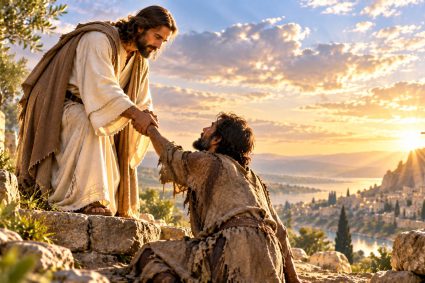
🔍 4. What personal experiences have you had of God lifting up “the contrite and humble” after the shame and misery of sin and welcoming them into His family?
I think of Luke, a young man in my congregation who, at 17, was arrested for theft. He was expelled from school, spent time in rehab—and believed God had abandoned him. In that low place, a counselor read Psalms 32 and 51 with him.
At first, Luke prayed in anger—then in tears, and finally in hope. Today he leads a support group for at-risk youth. He often says:
“I’m not proud of my past. But I’m grateful that God didn’t hold it against me; He forgave my guilt.”
Luke was not only lifted up—he was sent out.
………………………………………………………………….
✨ Spiritual Principles
-
Jesus alone fulfilled God’s covenant perfectly.
-
Forgiveness transforms sinners into witnesses.
-
The Sanctuary lives on in Christ, who intercedes for us.
-
The Psalms mirror our souls and open a window to God’s heart.
………………………………………………………………….
🧩 Practical Application
-
Pray the Psalms: Let them give voice to your heart when you lack words.
-
Rely on Jesus’ intercession in temptation—He stands with you.
-
Be honest with God: David was—and he was heard.
-
Embrace your calling: You are not only forgiven—you are sent.
………………………………………………………………….
✅ Conclusion
Human covenants fail, but Jesus kept God’s covenant. The Psalms narrate this tension: sin and grace, shame and restoration, failure and mission. We live within that story—not as bystanders, but as participants. For one who has received grace cannot remain silent; like David, we will say,
“I will teach transgressors your ways.”
………………………………………………………………….
💭 Thought for the Day
The Psalm ends not in lament, but in praise. Grace has the final word.
………………………………………………………………….
🕯️📘 Illustration – The Quiet Song of the Covenant
Part 1 – Silence After the Applause
Samuel White stood in a dark concert hall in Zurich. The final piece had just ended, and the audience roared its approval. He had performed in a trance—Bach’s Partitas, psalm settings in modern jazz harmonies, a closing “Dona nobis pacem” with choir.
Yet he felt empty.
He bowed, smiled, and stepped offstage. Behind the curtain, only one assistant congratulated him. The rest was silence. The green room was cold; the mirrors were tired. He sat down, unzipped his case, and stared at his reflection—not in a mirror but in the cello’s polished surface.
There he was: the man who could do anything—and the man who had fallen apart before God.
No one knew what happened four years ago. No one but him, one woman—and God.
✝ ✝ ✝ ✝ ✝ ✝ ✝ ✝ ✝ ✝ ✝ ✝ ✝ ✝ ✝
Part 2 – The Psalm in the Subway
Three days later, en route to the airport, Samuel found a discarded Bible on the subway seat. Inside was a slip of paper: Psalm 32, printed in plain type:
“Blessed is the one whose transgressions are forgiven,
whose sins are covered…
When I kept silent, my bones wasted away…
Then I acknowledged my sin to you, and you forgave me.”
His heart pounded. He opened the Bible and read the Psalm. The words struck him like rain after drought. He stepped off three stops early and wandered, Bible in hand, like a thief carrying the world’s greatest treasure.
✝ ✝ ✝ ✝ ✝ ✝ ✝ ✝ ✝ ✝ ✝ ✝ ✝ ✝ ✝
Part 3 – The Look Within
That evening in his hotel room, Samuel prayed—tried to pray—for the first time in years:
“God… I blew it. I messed up. I was proud and selfish. I hurt someone’s life and then hid.”
Tears came—not dramatically, but honestly. He turned the pages to Psalm 51:
“Create in me a clean heart, O God…
Do not cast me away from your presence…
I will teach transgressors your ways.”
Suddenly, inexplicable peace filled him—not the kind that says “all is well,” but that says “I know it all, and I remain.”
✝ ✝ ✝ ✝ ✝ ✝ ✝ ✝ ✝ ✝ ✝ ✝ ✝ ✝ ✝
Part 4 – The Conversation in the Church’s Shadow
He visited a small suburban chapel and met Anna, a counselor who used Psalms more than formulas. He told her everything—broken, honest, unadorned. She listened quietly, then said,
“Samuel, what you did was wrong. But you recognized you broke the covenant. Do you know what the Bible says? One kept it for you: Jesus. You can stop trying to save yourself. He is your High Priest, and He is interceding for you now.”
Samuel wept—not out of remorse this time, but relief.
✝ ✝ ✝ ✝ ✝ ✝ ✝ ✝ ✝ ✝ ✝ ✝ ✝ ✝ ✝
Part 5 – The Invitation
A year later, Samuel performed again—not in Zurich, not for thousands of clicks, but in a youth center in Basel. He played no Bach. He played his own psalms—songs where failure became truth and grace the melody.
Between pieces, he spoke briefly, honestly:
“I broke the covenant. I lost everything. But someone played for me when I could no longer play. Jesus held together what I destroyed on the cross—and He is interceding for me today. That’s why I can play.”
✝ ✝ ✝ ✝ ✝ ✝ ✝ ✝ ✝ ✝ ✝ ✝ ✝ ✝ ✝
Part 6 – The Final Chord
After the show, a seventeen-year-old boy approached him:
“Mr. White,” he said, “my dad says there’s no going back. Once you mess up, it’s over.”
Samuel knelt down and handed him Psalm 51:
“He does not despise a broken and contrite heart.”
The boy’s eyes widened. Samuel added,
“He is the covenant-keeper.”
And with that, he played the final notes of the covenant’s quiet song.

More Stories