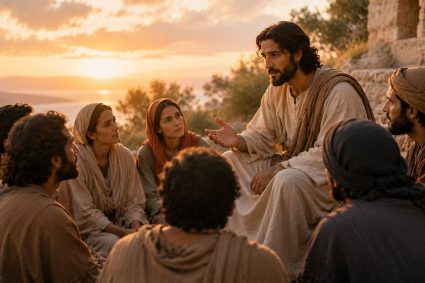
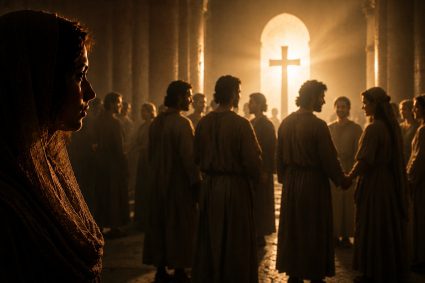
📖 1. Introduction – The most important answer
If someone asks you:
“What is God really like?” – what would you answer?
Many would try to list characteristics:
loving, just, powerful.
But the Bible gives a much simpler answer:
👉 Look at Jesus.
Because in Him, God is not only described –
but made visible.
📜 2. The biblical foundation – Jesus reveals God
Jesus says in John 14:9:
👉 “Anyone who has seen Me has seen the Father.”
That means:
Jesus is not only a messenger of God –
He is the revelation of God.
His life shows us:
- how God thinks
- how God acts
- how God loves
The four Gospels give us a complete picture:
- Matthew → the promised Messiah
- Mark → the serving Savior
- Luke → the compassionate Son of Man
- John → the divine Son
👉 Together they show:
God is personal, near, and full of love.
🌍 3. Connection to our time
Many people believe in God –
but they do not have a clear picture of Him.
Some see Him as strict, others as distant.
But without Jesus, God often remains abstract.
👉 Jesus makes God understandable.
He shows:
- how God deals with people
- how He responds to guilt
- how He loves, forgives, and transforms
Without Jesus, God remains theory.
With Jesus, He becomes relationship.
💡 4. Central message of the lesson
The central truth is:
👉 In Jesus we see what God is really like.
He is not hidden or unreachable.
He comes to meet us,
lives among us,
and shows us His heart.
👉 God is not only “above us” –
👉 He is “with us.”
✝️ 5. Theological focus
At the center is one of the deepest truths of the Christian faith:
👉 The incarnation – God becomes human.
“Immanuel” means:
👉 God with us
This is more than a name –
it is a theological revolution.
The infinite, holy God becomes:
- visible
- touchable
- personally knowable
That means:
👉 God does not remain at a distance.
👉 He enters into our reality.
In Jesus, these come together:
- God’s transcendence (greatness)
- and His immanence (nearness)
Here it becomes clear:
👉 God is not only Creator –
👉 He becomes part of His own creation.
This is unique.
But why is this so decisive?
Because true knowledge of God does not come only through words –
but through revelation in person.
👉 Jesus does not only show that God loves –
👉 He shows what that love looks like.
At the cross, this revelation reaches its climax:
- God suffers
- God gives
- God saves
That means:
👉 God’s nature is not power for its own sake –
👉 but self-giving love.
And one more decisive point:
Matthew 1:23 says:
👉 “Immanuel – God with us”
Matthew 28:20 says:
👉 “I am with you always”
👉 The beginning and the end of the Gospel are the same:
God is with us.
Not only for a short time –
but permanently.
📖 6. Explained Bible texts
John 14:9:
Jesus is the visible revelation of God.
Matthew 1:23:
God comes to us – not we to Him.
Matthew 28:20:
This nearness remains – even after Jesus’ ascension.
John 12:32:
Jesus draws all people to Himself.
Hebrews 1:3:
Jesus is the exact representation of God.
👉 Taken together:
In Jesus, we see God more clearly than ever before.
🔧 7. Application in daily life
This lesson becomes very personal:
How do I see Jesus?
In practical terms, this means:
reading the Gospels intentionally
looking at Jesus in order to understand God
seeking God’s nearness in daily life
trusting that God is truly “with me”
👉 Faith becomes concrete,
when Jesus is at the center.
❓ 8. Reflection question
Is God for me only an idea –
or a real, present Person?
Do I live
as if God were truly “with me”?
🌟 9. Final thought
God did not hide Himself.
He came.
👉 He became human
👉 He lived among us
👉 He remained with us
And that means:
You do not have to guess what God is like.
👉 Look at Jesus.
Because:
👉 In Him, God not only became visible –
👉 but personally knowable.