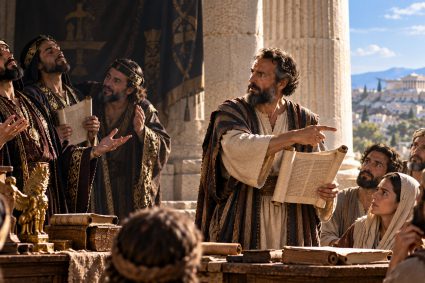
🌱LIVING FAITH | 1.Persecuted but Not Forsaken | 1.1 Paul, the Prisoner of Jesus Christ | ✉️ CHRIST IN PHILIPPIANS AND COLOSSIANS
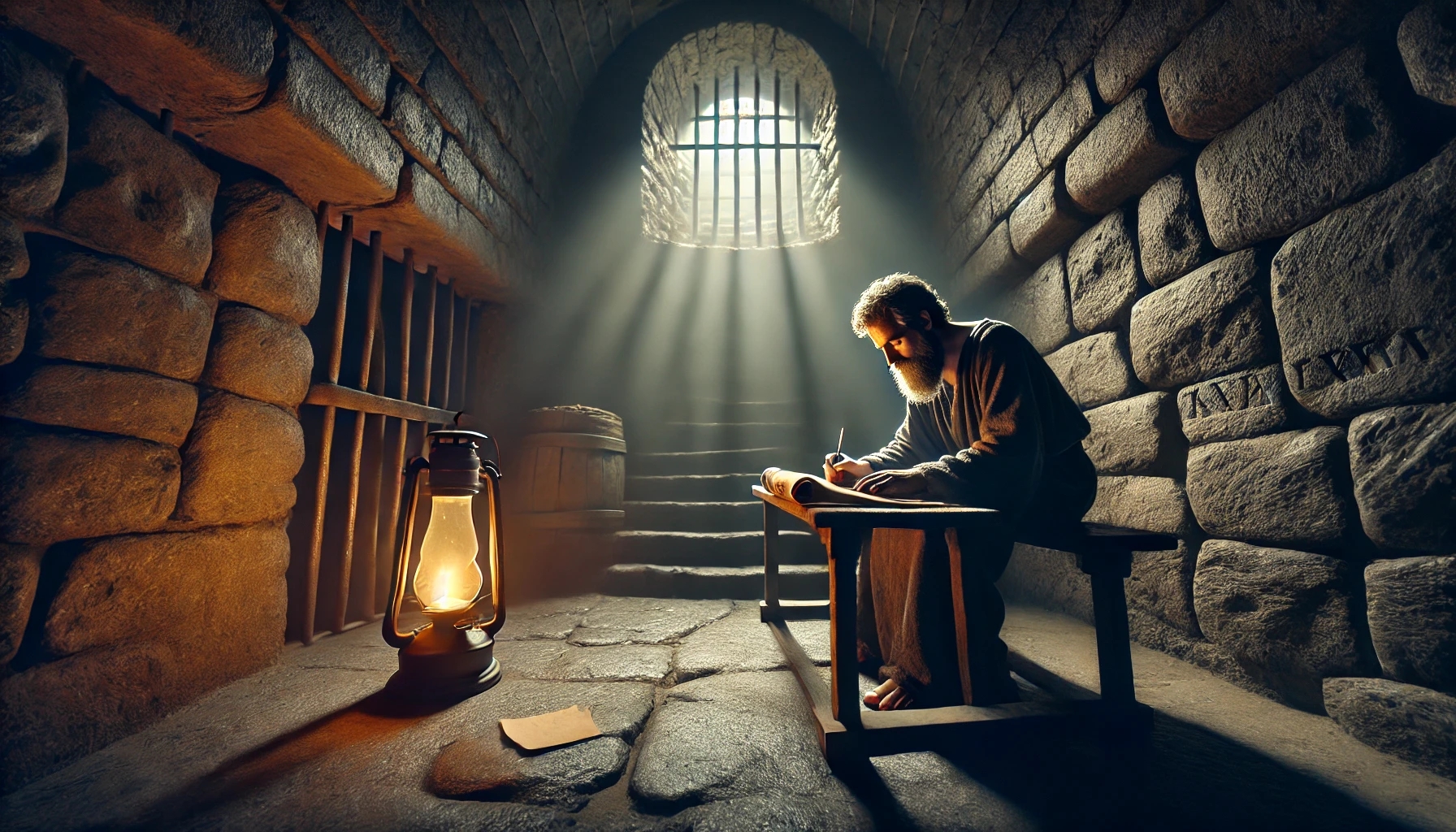
✉️ CHRIST IN PHILIPPIANS AND COLOSSIANS
⛪ Lesson 1: Persecuted but Not Forsaken
📘 1.1 Paul, the Prisoner of Jesus Christ
✨ Faith Behind Bars: Paul’s Witness in Chains
🟦 Introduction
The letters to the Philippians and Colossians belong to the so-called Prison Epistles of the apostle Paul. They reveal a profound spiritual reality: even when the body is in chains, the spirit is free in Christ. Paul did not write these letters from comfort or safety, but from the depths of a dark cell—under Roman imprisonment. And yet his words overflow with joy, hope, courage, and passion for Christ.
This lesson invites us to discover the secret of Paul’s steadfastness — persecuted, but not abandoned.
………………..✉️………………..
📖 Bible Study
🔹 Theme: “A Prisoner, Yet Free — Paul in Chains for Christ”
📍 1. Historical and Geographical Context
Where did Paul write these letters?
The letters to the Ephesians, Philippians, Colossians, and Philemon belong to Paul’s Prison Epistles. They were most likely written during his first imprisonment in Rome (around AD 60–62), as described at the end of the Book of Acts (chapter 28).
Acts 28:30–31:
“For two whole years Paul stayed there in his own rented house and welcomed all who came to see him. He proclaimed the kingdom of God and taught about the Lord Jesus Christ with all boldness and without hindrance.”
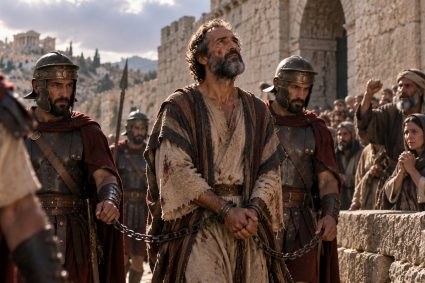
Although officially under house arrest, Paul was guarded by soldiers of the imperial Praetorian Guard, yet he maintained contact with the churches and continued writing letters.
His imprisonment was not a place of inactivity, but a center of mission. During this time occurred:
• the writing of inspired letters,
• the strengthening of distant churches,
• the evangelization of soldiers and even people from the “household of Caesar” (Phil. 4:22).
🔎 2. What Does Paul Mean by “Prisoner of Jesus Christ”?
Ephesians 3:1:
“For this reason I, Paul, the prisoner of Christ Jesus for the sake of you Gentiles…”
Philemon 1:1:
“Paul, a prisoner of Christ Jesus, and Timothy our brother…”
Here a deep spiritual principle becomes clear:
Paul does not identify himself as a prisoner of Rome, but as a prisoner of Jesus Christ.
That means:
-
From a worldly view: Paul is in Caesar’s prison
-
From a spiritual view: Paul is God’s ambassador
-
Worldly: He is in chains
-
Spiritual: He is free in the Spirit
-
Worldly: He is isolated
-
Spiritual: He is connected to Christ
➡️ Paul recognizes: It was not Rome that brought him here, but God’s will.
➡️ His imprisonment is not an accident, but part of his calling.
Through this perspective Paul declares:
“I am not here because people stopped me, but because God placed me here.”
🕊️ 3. Mission in Chains — Evangelism Despite Imprisonment
Philippians 1:12–14:
“Now I want you to know, brothers and sisters, that what has happened to me has actually served to advance the gospel… so that it has become clear throughout the whole palace guard and to everyone else that I am in chains for Christ.”
➡️ The gospel spreads — not despite, but through Paul’s imprisonment!
Notice the results:
• Elite soldiers of the Praetorian Guard heard the gospel.
• People in the household of Caesar came to faith (Phil. 4:22).
• Other believers were encouraged to speak about Jesus more boldly.
❗ Paul was chained — but the gospel was not chained.
→ See also 2 Timothy 2:9:
“I suffer even to the point of being chained like a criminal. But God’s word is not chained.”
💡 4. Spiritual Principles from Imprisonment
💬 1. God is sovereign over our circumstances.
Paul does not see his chains as defeat, but as calling. What looks like setback to the world is progress for God.
💬 2. Our identity in Christ remains — even in hardship.
Paul calls himself “servant of Christ,” not “victim of the system.”
💬 3. True freedom is spiritual, not external.
Many are outwardly free but inwardly bound — Paul is outwardly bound but inwardly free.
💬 4. God uses weakness as a stage for His strength.
Imprisonment becomes a platform for evangelism.
🛠️ 5. Application for Daily Life
➡️ What do we learn from Paul for our own difficult times?
• If you are going through illness, financial hardship, loneliness, or social rejection — recognize: God can use you there.
• Don’t ask only: “Why is this happening to me?”
Ask also: “Lord, how can I glorify You in this?”
• Learn, like Paul, to see your situation with God’s eyes.
🔁 Sometimes God does not change the situation — He changes our perspective.
📚 6. Comparison: The Other Prison Epistles
• Ephesians — The church as the body of Christ — hopeful, theologically deep
• Philippians — Joy in suffering — realistic, yet full of confidence
• Colossians — Christ as Lord over all — affirmation of Christ’s authority
• Philemon — Reconciliation and grace — personal and loving
➡️ All these letters are filled with spiritual clarity, joy, hope, and teaching — despite external hardship.
🧭 Summary
Paul shows us that:
• Imprisonment in God’s service can be part of one’s calling.
• The message is more important than the messenger.
• God’s Word is not bound — even when the preacher is.
• True freedom is found only in Christ.
………………..✉️………………..
🗣️ Answers to the Questions
Question 1: What is the significance of how Paul describes his imprisonment?
Paul reveals a deep spiritual principle: he sees his circumstances through the eyes of faith. His imprisonment is not a disgrace but a mission. Rome is not his master — Christ is.
This shift in perspective shows that our location does not define our spiritual condition. Even in prison, Paul sees himself as God’s ambassador. This is not denial, but spiritual maturity.
He does not identify as a victim, but as an instrument. The phrase “prisoner of Christ Jesus” shows his personal surrender and acceptance of God’s will — even when it leads through suffering.
Question 2: How do we learn to make the best of difficult situations, and why is it so hard?
Paul teaches that it is not circumstances that should shape our perspective, but our faith in Christ. Making the best of hardship means recognizing God’s hand even in darkness.
It is hard because we often:
• focus on what is visible,
• have expectations of how God “should” act,
• interpret suffering as distance from God.
Paul understands: the chains are not the end, but a new beginning. In weakness, God’s power is revealed. Just as Jesus seemed defeated at the cross but actually triumphed, our helplessness becomes an opportunity for God’s strength — if we trust Him.
………………..✉️………………..
💎 Spiritual Principles
-
God’s ways are higher than ours — even imprisonment can be part of His plan.
-
Identity in Christ changes perspective — we are not what we go through, but who we are in Him.
-
Service for God knows no limits — not even prison walls or chains.
-
The power of testimony lies in attitude, not circumstances.
………………..✉️………………..
🛠️ Practical Application
• If you feel trapped — by illness, unemployment, guilt, or family conflict — don’t ask first “Why?”, but “For what purpose?”
• Look at your situation with eyes of faith. Ask: “How can I be a witness here?”
• Strengthen your identity in Christ through prayer, Bible study, and fellowship.
• Trust that no place and no situation can surprise or hinder God.
………………..✉️………………..
✅ Conclusion
Imprisonment did not break Paul — it refined him. His letters from a cell became letters of life for millions. Our suffering too can — through God’s Spirit — become a blessing for others. The gospel does not need external freedom — only willing hearts.
………………..✉️………………..
💭 Thought of the Day
“A Christian is never a prisoner — except of Christ.”
— Paul Gerhardt
………………..✉️………………..
✍️ Illustration
“Chains of Freedom”
Story of a silent reformation
Part 1: The Silence of the Streets
Frankfurt am Main, autumn 2023.
The streets had grown quiet. Germany was no longer the country Pastor Elias Winter once knew. In recent years, a new wave of secular laws had severely restricted religious freedom. Public proclamation of biblical truth was now considered socially harmful. The media called it a “Protection Law against Religious Radicalism” — for Elias, it marked the beginning of a silent war against the gospel.
Elias was pastor of a small Adventist congregation. He was never loud. No protests, no conspiracy theories. Just a voice speaking truth in love — from the pulpit, online, and in personal conversations.
One day, after an online Bible study on “God’s commandments in a morally decaying world,” the doorbell rang. Three men in dark jackets marked “Office of Public Order” stood outside.
“You are temporarily detained for unconstitutional teachings.”
No charges. No trial. Only transfer to the city’s detention center.
Part 2: The Cell
Cell B-13 was three by three meters. Concrete walls. A rusty bed. No window — only a ventilation shaft carrying faint sounds from outside. Elias sat quietly. No anger. No fear. Only questions.
“Lord, why me? I could preach, teach, help… Why now?”
Then he remembered Paul’s words:
“I, the prisoner of Christ Jesus…” (Eph. 3:1)
“My chains have become known throughout the whole Praetorium…” (Phil. 1:13)
He smiled softly. He was not Germany’s prisoner. He was a prisoner of Christ Jesus.
Part 3: The Cellmate
On the third day, a new inmate arrived: Ismael Kadir, 26, former dealer, convicted of aggravated assault. Loud, angry, furious at life, the system, and God. When Elias calmly offered his hand, Ismael spat on the floor.
“Are you one of those Jesus freaks? Save your holy talk.”
Elias said nothing. He prayed. Daily. Quietly. At night.
Ismael watched him. Again and again. Why did this man have peace?
Part 4: The Guard
Mr. Braun was a bitter prison guard in his early fifties, tired of life, cynical. He had seen many preachers come and go — most broke within days. But Elias… was different.
“You’re still praying?” Braun asked one evening.
“I’m speaking with my King,” Elias replied.
Braun scoffed, yet uncertainty trembled in his voice. That peace unsettled him — a peace Braun had never known despite decades of marriage, a good salary, and two children.
Part 5: The Change
After two weeks, Ismael approached Elias at night.
“What do you pray every day?” he asked roughly.
“I thank God that I’m here — because of you,” Elias answered.
Those words struck Ismael deeply. No one had ever told him his existence was a reason for gratitude.
In the weeks that followed, Elias spoke with Ismael about Jesus — about hope, forgiveness, and second chances.
One morning, during yard time, Ismael knelt in the rain, tears in his eyes. Elias stood silently beside him — not as pastor, but as brother.
Part 6: The Message Reaches the Palace
Mr. Braun had begun reading the Bible at night. Elias’s words echoed in him. He read Philippians 4:22:
“All the saints greet you, especially those belonging to Caesar’s household.”
He understood: Paul had brought the gospel into the center of power — through chains. Now Elias sat in Cell B-13… and his words reached him, the hardened Braun.
“Maybe God sometimes needs cells to open hearts.”
One Sabbath, Braun asked Elias for a conversation. It lasted two hours. At the end, Elias prayed for him. For the first time in his life, Braun felt free.
Part 7: The Day of Freedom
After four months, Elias was unexpectedly released. No explanation. Only a letter:
“Due to a change in evidence, you are released. You are now on probation.”
He left the prison with a small bag — but a great song in his heart.
At the gate stood Ismael, now leading a course on biblical values for inmates. And Mr. Braun, planning to be baptized in a free church.
Part 8: Chains that Bring Freedom
Back home, Elias was asked:
“How did you endure it?”
He smiled.
“I was never alone. And I was never imprisoned. I was sent.”
“Paul had his chains — I had mine.
But in both cases, people were set free.”
………………..✉️………………..
📌 Final Reflections on the Story
This fictional story reveals a central truth: God uses trials as platforms. Like Paul, believers today are sent in difficult circumstances — not abandoned. Our “prisons,” whether physical, emotional, or social, can become places of revival and transformation.
✨ Even today, God writes letters — not on parchment, but in lives.
………………..✉️………………..
🔚 Conclusion for Sabbath School
“Persecuted, but not abandoned” is not just a theme of the past, but a reality of faith today. As with Paul and Elias, God shows us: wherever we are, we are in His hands.

More Stories