📅 21 december 2025
📚 BELIEVE HIS PROPHETS
📖 Daily Bible Reading
👑 1 Samuel 13 – Between Fear and Obedience – When Trust Is Tested
✨ Saul’s hasty sacrifice and the consequences of a heart under pressure
🌐 Read online here
🔵 Introduction
Not every test comes in the form of an open attack.
Some tests come quietly—through waiting, uncertainty, and fear.
1 Samuel 13 does not tell of a great moral scandal, but of a moment of inner decision. A moment in which a king comes under pressure and reveals where his trust truly lies.
This chapter is not a heroic tale. It is an honest story about leadership, fear, impatience, and the serious consequences of a small—but decisive—act of disobedience.
══════════════════════════
🟡 Commentary
Saul is still a young king. His kingdom is unstable, his position not yet secure. Israel lives under constant threat from the Philistines, a militarily superior enemy. Yet the chapter begins with hope: Saul organizes an army, and his son Jonathan wins a bold victory against a Philistine outpost. This strike is small but symbolic—a sign that Israel does not intend to surrender completely.
But the victory has consequences. The Philistines respond with overwhelming military force. The numbers mentioned are crushing: chariots, horsemen, and countless soldiers. Israel is outmatched both numerically and technologically. Fear spreads. The men of Israel lose heart, hide, flee, and doubt. Saul’s army shrinks dramatically.
Saul himself is now under enormous pressure. He waits at Gilgal for the prophet Samuel, who is to offer the sacrifice—just as God commanded. He is to wait seven days. Seven days of uncertainty. Seven days in which his people scatter, the enemy draws closer, and fear grows.
And Samuel does not come.
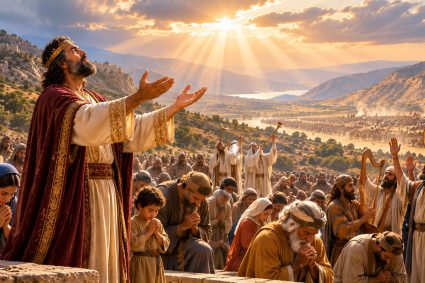
This is the turning point of the chapter. Not the war, not the Philistines—but the waiting. Saul watches his people leave. He sees his authority crumbling. He feels responsibility, but also the fear of losing everything. And in that moment he makes a fateful decision: he offers the sacrifice himself.
At first glance, Saul’s action even appears pious. He wants to seek God’s favor. He wants reassurance. He wants to act. But here lies the problem: Saul replaces obedience with action. He takes on a spiritual role to which he was not called—not out of malice, but out of fear.
When Samuel finally arrives, it is too late. Saul’s explanation is humanly understandable: the people were scattering, the enemy was approaching, Samuel was delayed. But Samuel states the truth clearly and without compromise: Saul has acted foolishly. Not because he offered a sacrifice—but because he did not keep God’s command.
God would have established Saul’s kingdom. It could have endured. But now it becomes clear: Saul’s heart is not ready to trust God when control is lost. Therefore Samuel announces that God has sought another man—a man after His own heart.
The rest of the chapter reinforces Israel’s helplessness. The people are militarily disarmed, dependent on the enemy, without blacksmiths, without weapons. Only Saul and Jonathan possess swords. Humanly speaking, Israel has no chance. And this is the tragedy: in the greatest weakness, deep trust could have grown—but instead, fear grows.
══════════════════════════
🟢 Summary
-
Saul begins his reign under pressure and uncertainty.
-
Jonathan shows courage of faith, but the enemy responds with massive force.
-
Fear paralyzes the people, and Saul’s army scatters.
-
Saul waits for Samuel but cannot endure the waiting.
-
He acts independently and crosses a spiritual boundary.
-
Samuel explains: the problem is not the situation, but disobedience.
-
Saul’s kingdom is rejected because his trust does not endure.
══════════════════════════
📢 Message for Us Today
-
Waiting is often the real test of faith.
Not the battle, but the time in between reveals our heart.
-
Fear can look pious—but it is not obedient.
Saul wanted to seek God, but on his own terms.
-
Obedience weighs more than activity.
Not everything that looks spiritual is spiritually right.
-
God looks for hearts, not positions.
A king can be rejected if his trust does not hold.
-
Pressure does not excuse disobedience.
It explains it—but it does not justify it.
══════════════════════════
💬 Thought Reflection
Where am I inclined to act out of fear instead of waiting?
Where do I replace trust with control?
And am I willing to obey God even when I hold nothing in my hands?
~~~~~ 👑 ~~~~~

📆 21 – 23 December 2025
📚 BELIEVE HIS PROPHETS
📖 Weekly Reading – Spirit of Prophecy
📘 Ellen White | Patriarchs and Prophets – Chapter ´51
🔥 God’s Care for the Poor | Divine Justice – Mercy as a Way of Life
🌐 Read online here
📘 Blog 1
“The Second Tithe – When Giving Creates Community”
How God led His people to care for and celebrate with the weak
🔵 Introduction
God’s commandments were never purely legalistic—they created community, justice, and spiritual joy. The second tithe, in particular, shows how giving was meant to be an expression of togetherness and reverence for God.
══════════════════════════
🟡 Commentary
Two tithes—an unusual concept. The first belonged to the Levites, those serving in the priestly ministry. But the second was intended for the people themselves—and for the poor, who were invited to celebrate with them.
Every two years, the Israelites brought this tithe, or its monetary value, to the sanctuary. There they celebrated—with their families, with the priests, and with those in need. It was not a meager duty offering, but a joyful feast of remembrance and gratitude.
In the third year, this tithe remained in the towns—it was deliberately used for the Levites, widows, orphans, and foreigners. In this way, God established a continuous cycle of help and provision.
This system was not only socially wise—it was spiritually profound. Giving connected worship with compassion. It showed that true faith excludes no one.
══════════════════════════
🟢 Summary
The second tithe was an expression of active love—it fostered community, taught reverence, and provided for those in need.
══════════════════════════
📢 Message for Us Today
Giving is more than donating. It is a way to strengthen relationships and to make God’s heart for the vulnerable practically visible.
══════════════════════════
💬 Thought Reflection
When was the last time your giving enabled someone to be part of a community?