📅 17 december 2025
📚 BELIEVE HIS PROPHETS
📖 Daily Bible Reading
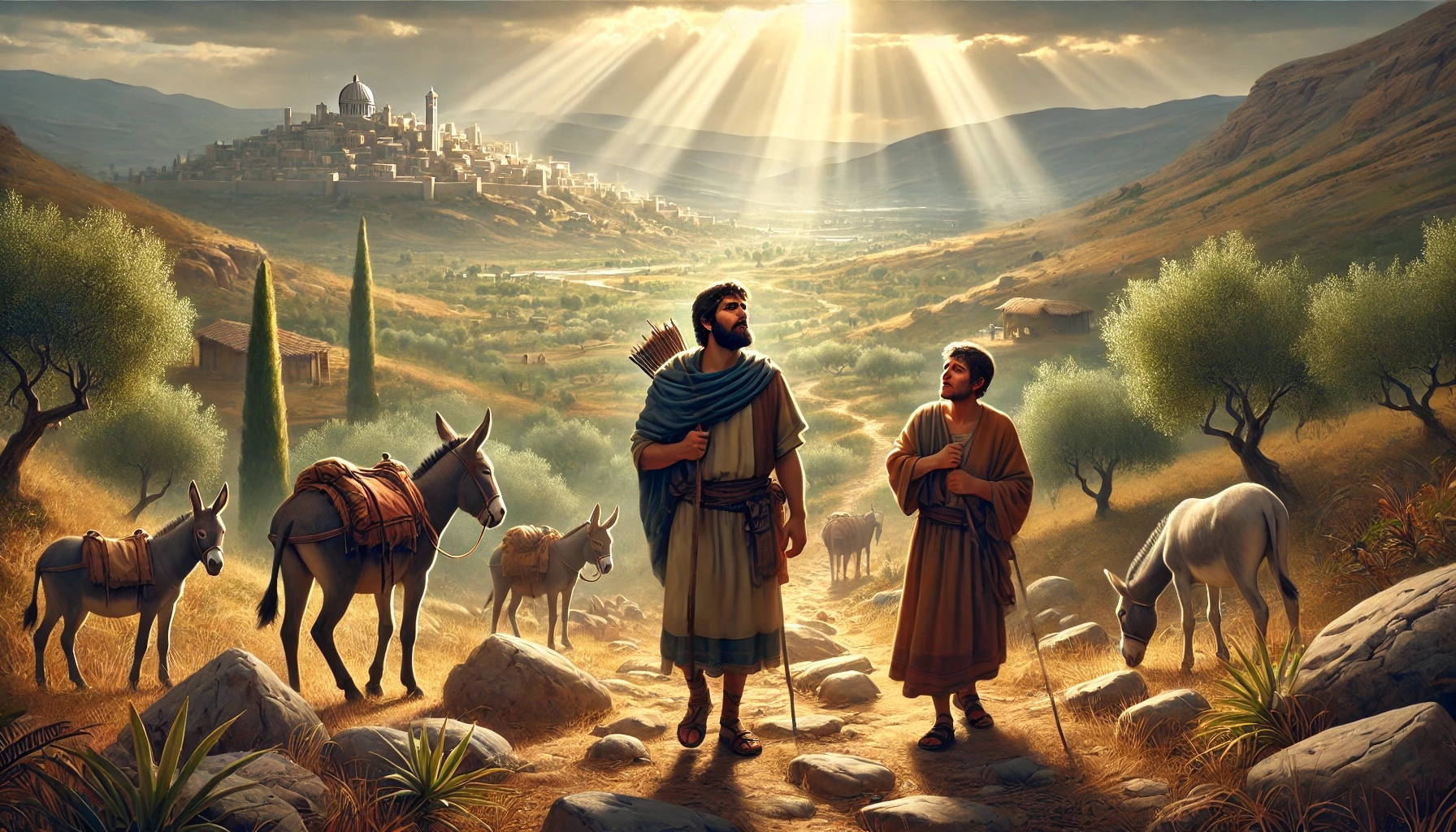
👑 1 Samuel 9 – God leads through ordinary paths
✨ From lost donkeys to a divine calling
🌐 Read online here
🔵 Introduction
Israel demanded a king—and God begins to act. But what’s surprising is the path He chooses. No throne room, no army, no political proclamation. Instead, everything begins with something ordinary: lost donkeys.
1 Samuel 9 shows how God works behind the scenes and how His great plans are often prepared through seemingly insignificant detours.
══════════════════════════
🟡 Commentary
Saul comes from the tribe of Benjamin, from a respected family. He is young, strikingly handsome, and taller than everyone else in Israel. Outwardly, he has everything one would expect in a king—yet inwardly he knows nothing of his calling.
When the donkeys of his father Kish are lost, Saul sets out with a servant. They travel through various regions and search for days—without success. The journey becomes exhausting, supplies run low, and Saul wants to give up. His concern is for his father, who by now is likely more worried about his son than about the animals.
But the servant suggests seeking out the man of God. In the nearby town lives a seer whose words are reliable. Saul hesitates. What are they supposed to bring him? They have nothing left—except a small silver coin. It’s little, but it is enough.
As they approach the town, they meet young women drawing water. They confirm: Samuel is there—today, because of a sacrifice on the high place. The timing is perfect. Without realizing it, Saul and his servant are moving exactly according to God’s timetable.
What Saul doesn’t know: God has already prepared Samuel. The day before, the Lord had revealed to him that a man from Benjamin would come—he is to become Israel’s first king. When Samuel sees Saul, God immediately confirms: This is the man.
Saul approaches Samuel with a simple question: Where does the seer live? But Samuel sees deeper. He invites Saul to eat with him, relieves him of his worry about the donkeys—they have already been found—and speaks mysterious words about the future.
At the sacrificial meal, Samuel seats Saul in the place of honor and has the best portion of the sacrifice brought to him. Everything is prepared long before Saul knows it. Even Saul’s modest reply reveals his inner posture: he sees himself as insignificant—from a small tribe, from an unremarkable family.
The next morning, Samuel and Saul speak alone on the roof. As they leave the town, Samuel asks the servant to go on ahead. Now the moment has come. Saul is to stand still. God has something to say.
The search for donkeys is over—the calling of a king is about to begin.
══════════════════════════
🟢 Summary
-
God often begins great plans with small, everyday events.
-
Saul is searching for donkeys—God is preparing a kingship.
-
Samuel does not act spontaneously, but according to divine revelation.
-
An outward calling meets inner insecurity.
-
God’s timing is perfect, even when we don’t recognize it.
══════════════════════════
📢 Message for us today
God often works behind the scenes of our everyday lives. Paths that seem aimless to us can be part of a bigger plan. What we experience as delay is often preparation with God.
Maybe you’re searching right now for something lost—clarity, direction, purpose. God may be leading you toward something greater than you expect. The question is not whether God speaks, but whether we are ready to stand still and listen.
══════════════════════════
💬 Thought prompt
🤔 Which “detours” in my life could be part of God’s plan?
🤔 Am I ready to trust God even in the ordinary?
👑 Can I believe that God sees more in me than I can recognize myself?
🙏 The God who uses lost donkeys to call a king still guides steps today—quietly, but purposefully.