🟦 Introduction – Beauty that Comes from Within… or Rather from Above?
In a world that defines beauty by likes, filters, and fashion, it’s easy to fall into a dangerous misconception: that our worth depends on how we are perceived. Yet the Bible paints a very different picture—a portrait of a bride, beautiful not by her own doing, but because she is loved.
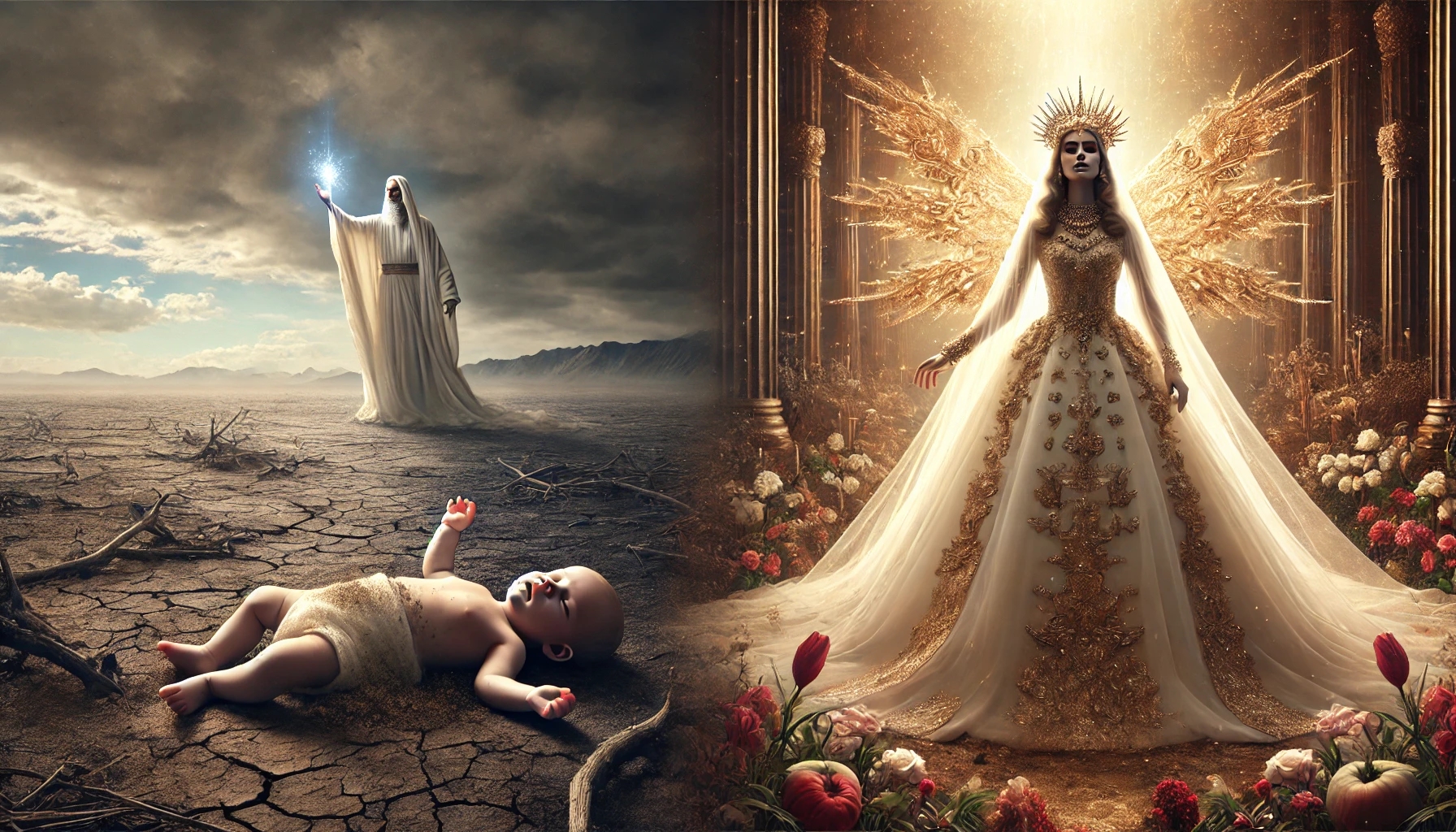
In Ezekiel 16, God describes His people Israel as a foundling, filthy, cast aside, without hope. But He cares for them, cleanses them, raises them up—and at last that small, overlooked child becomes an exceedingly beautiful bride. And then… pride came. And with it, the fall.
📖 Bible Study – Beauty Born of Grace
Ezekiel 16:4–14 God finds Israel in a pitiable state—naked, wounded, unloved. Yet He says, “I let you live.” Out of that mercy the transformation begins. He cleanses the child, clothes her, adorns her with gold, silver, and fine linen—and she becomes “exceedingly beautiful.”
📌 Answer to Question 1: What do these details teach us about God’s intention for us? This scene is more than an allegory for Israel’s history—it mirrors our own spiritual lives. All of us, spiritually speaking, are like that child: without hope, without beauty of our own. But God does not see us as we are; He sees what He will make of us. He exalts us not because we deserve it, but because He loves. The bride’s beauty is a gift— not self-made, but divinely bestowed—a reflection of relationship with God, not human achievement.
Ezekiel 16:15 But the narrative takes a dramatic turn: “You trusted in your beauty…” Israel began to believe that this beauty was her own, and that led to rebellion.
📌 Answer to Question 2: What dangers arise when we trust in our “own beauty”? The moment we think our standing with God rests on our goodness, piety, discipline, or “spiritual accomplishments,” we lose sight of the true source of our beauty: Christ in us. Spiritual pride is insidious because it dresses itself in zeal, discipline, and “pure faith”—but it forgets its Source. Those who believe they can earn God’s love ultimately reject grace. And those proud of their spiritual growth forget that even that growth is the work of the Holy Spirit.
✨ Spiritual Principles – The Bride’s Humility
True beauty is relationship, not performance.
Spiritual maturity acknowledges dependency.
All that is good in us comes from God—not to our glory but to His.
Redeemed people are not better people—they are graciously blessed people.
🧭 Practical Application – Living from Grace
When someone praises your piety or spiritual strength, receive the compliment with a smile, but inwardly give the glory back to God.
Don’t compare yourself to other believers—or even to your past self. The standard is Christ, not your progress.
Pray often: “Lord, guard my heart against pride—and open it to your grace.”
When you fall, remember: you are loved, not because you are strong, but because God is faithful.
Hold fast to the beauty God declares over you—even when you don’t feel it.
✅ Conclusion – The Most Beautiful Bride Is the Humblest
The Church is beautiful—not because it is perfect, but because Christ loves it. His grace is the adornment, His righteousness the garment. Everything that marks us is what He has placed on us.
We may be able to boast— but not in ourselves. Rather, in the One who made us beautiful.
💬 Thought of the Day
Pride says, “I am special.” Humility says, “I am loved.” And in that love lies true beauty.
✍️ Illustration – The Mirror by the Window
Leipzig. A Sunday morning.
Elisa, 26, a law student plagued by doubts, sits by the window of her small apartment. She stares at the old Bible verse she stuck to her mirror years ago: “You are beautiful—because of me” (loosely based on Ezek. 16:14).
Yesterday she argued with her brother again. In church she felt out of place—among all those seemingly perfect people. She wondered, “What am I doing here? I’m too broken, too inconsistent, too… ordinary.”
Then she opens her Bible. It falls open to Ezekiel 16. She reads slowly, word by word:
“I found you in your blood… I let you live… I covered you… You were exceedingly beautiful…” And then: “But you trusted in your beauty…”
Tears fill her eyes. She understands: it’s not her résumé that makes her beautiful. Not her discipline. But His gaze. His love. His cloak.
Elisa looks out the window—and in the mirror recognizes not herself, but a daughter of the King.
📖 “Your beauty was perfect—through the adornment I had bestowed on you.” (Ezekiel 16:14)