🌱LIVING FAITH | Lesson 10 : Complete in Christ | 10.7 Questions | ✉️ CHRIST IN PHILIPPIANS AND COLOSSIANS
✉️ CHRIST IN PHILIPPIANS AND COLOSSIANS
⛪ Lesson 10 : Complete in Christ
📘 10.7 Questions
✨ Deepening the Truth – Christ at the Center
🟦 Introduction
These concluding questions lead us once again into the deepest theological statements of the Letter to the Colossians.
They deal with:
-
the divinity of Christ
-
His supreme authority
-
the understanding of law and grace
-
the role of the ceremonial law
-
and the authority of Holy Scripture
These topics are not merely theoretical. They concern the very foundation of our faith.
………………..✉️………………..
🗣️ Answers to the Questions
❓ Question 1: What does it mean that in Christ “all the fullness of the Godhead dwells bodily” and that He is “the head of all principality and power” (Col 2:9–10)?
Detailed Answer
1. “All the fullness of the Godhead bodily”
The word “fullness” (plērōma) means:
-
complete totality
-
nothing is lacking
-
unrestricted divine nature
Paul does not say:
a part of the Godhead.
Not an image.
Not a representative.
But rather:
the whole fullness.
John 1:1 confirms this:
“In the beginning was the Word … and the Word was God.”
Hebrews 1:3:
“He is the brightness of His glory and the exact image of His being.”
Christ is not a created being.
He is not a higher angel.
He is not a divinely inspired man.
He is true God — bodily.
That means:
-
In Jesus, God is fully revealed.
-
Whoever knows Christ knows God.
-
There is no higher revelation.
2. “Head of all principalities and powers”
1 Peter 3:22 explains:
“Angels and authorities and powers are subject to Him.”
In Colossae there was apparently an overemphasis on angelic beings (Col 2:18).
Paul makes it clear:
Christ stands above:
-
angels
-
spiritual powers
-
cosmic forces
-
satanic authorities
This has practical consequences:
-
We need no mediators other than Christ.
-
We do not need to fear spiritual powers.
-
Our security lies in His rule.
Theologically this means:
Christ is:
-
Creator
-
Redeemer
-
Lord
-
Judge
And we are “complete in Him” (Col 2:10).
❓ Question 2: What other problems arise when Colossians 2:14–16 is used against the fourth commandment?
Detailed Answer
If these verses are interpreted as abolishing the Sabbath of the Ten Commandments, several serious problems arise:
1. Contradiction within the Bible
Romans 7:7:
“Sin is the transgression of the law.”
If the moral law is abolished,
there is no longer any objective definition of sin.
This undermines the entire ethics of the New Testament.
2. Dissolution of the distinction between moral law and ceremonial law
The Bible clearly distinguishes between:
-
the Ten Commandments → spoken by God, written in stone
-
the ceremonial law → written by Moses, placed beside the ark
If Colossians 2 abolishes the moral law,
this biblical structure disappears.
3. Relativizing God’s character
The Ten Commandments reflect God’s nature.
If they had been abolished,
that would mean:
God’s moral standard is changeable.
But:
God does not change.
4. Inconsistency in Christian practice
Whoever argues that the fourth commandment has been abolished
must consistently ask:
Why not the sixth or the seventh as well?
The selective abolition of individual commandments leads to theological arbitrariness.
❓ Question 3: How do we respond to those who claim that the ceremonial law must still be kept?
Detailed Answer
1. Theological Answer
The ceremonial law was:
-
prophetic
-
typological
-
pointing to Christ
The Letter to the Hebrews teaches:
Christ’s sacrifice is perfect and final.
If ceremonial regulations are still regarded as binding, problems arise:
-
The completeness of the cross is diminished.
-
One returns to shadows.
-
One recreates a dividing wall between Jews and Gentiles.
2. Practical Problem
The ceremonial law was inseparably connected with the temple.
Without a temple:
-
no sacrificial service
-
no Levitical ministry
-
no complete system
Its restoration would be impossible or artificial.
3. Spiritual Danger
Even if some experience spiritual depth or discipline in it,
the danger is:
-
performance-based thinking
-
spiritual pride
-
superiority over others
-
confusing symbol with reality
Paul explicitly warns against exactly this tendency.
❓ Question 4: Why must we protect our faith in the authority and inspiration of all Scripture?
Detailed Answer
If we begin to relativize parts of the Bible, a dangerous process begins:
1. Subjective Selection
We accept:
-
what we like
-
what is culturally comfortable
-
what seems modern
We reject:
-
what challenges us
-
what is uncomfortable
-
what goes against the spirit of the age
Then man becomes judge over Scripture.
2. Loss of divine authority
If the Bible is no longer God’s voice,
only human opinion remains.
But Ellen White emphasizes:
Scripture is God’s direct address.
That means:
-
It corrects us.
-
It questions us.
-
It shapes our thinking.
We do not shape it.
3. Protection against relativism
In a time of:
-
moral shifts
-
theological experiments
-
spiritual mixture
Scripture is our objective standard.
If we weaken its inspiration,
we lose our orientation.
………………..✉️………………..
💎 Spiritual Principles
-
Christ is fully God.
-
His authority is absolute.
-
The cross is completely sufficient.
-
Shadows must not become the substance.
-
Moral law remains an expression of God’s character.
-
Scripture is the highest authority.
-
Faith rests on revelation, not on feeling.
………………..✉️………………..
💭 Thought of the Day
If Christ truly is the whole fullness of the Godhead,
then He is perfectly sufficient —
and His Word is enough.
………………..✉️………………..
✍️ Illustration – The Voice Above the Abyss
An Adventist vision in the 21st century
Chapter 1 – The Night of Questions
Vienna, 2031.
Elisa was a theology student and was preparing a Sabbath School lesson on Colossians 2.
The questions from section 10.7 would not let her go:
-
Is Christ really the whole fullness of God?
-
Was the law nailed to the cross?
-
Are parts of the Bible perhaps culturally conditioned?
-
Can we allow ourselves to “reinterpret” certain texts?
Discussions were raging on social media.
Some declared the Sabbath outdated.
Others called for the revival of ceremonial feasts.
Still others questioned the inspiration of certain books of the Bible.
Elisa felt torn inside.
That night she knelt beside her bed.
“Lord, show me what truly holds.”
Chapter 2 – The Open Landscape
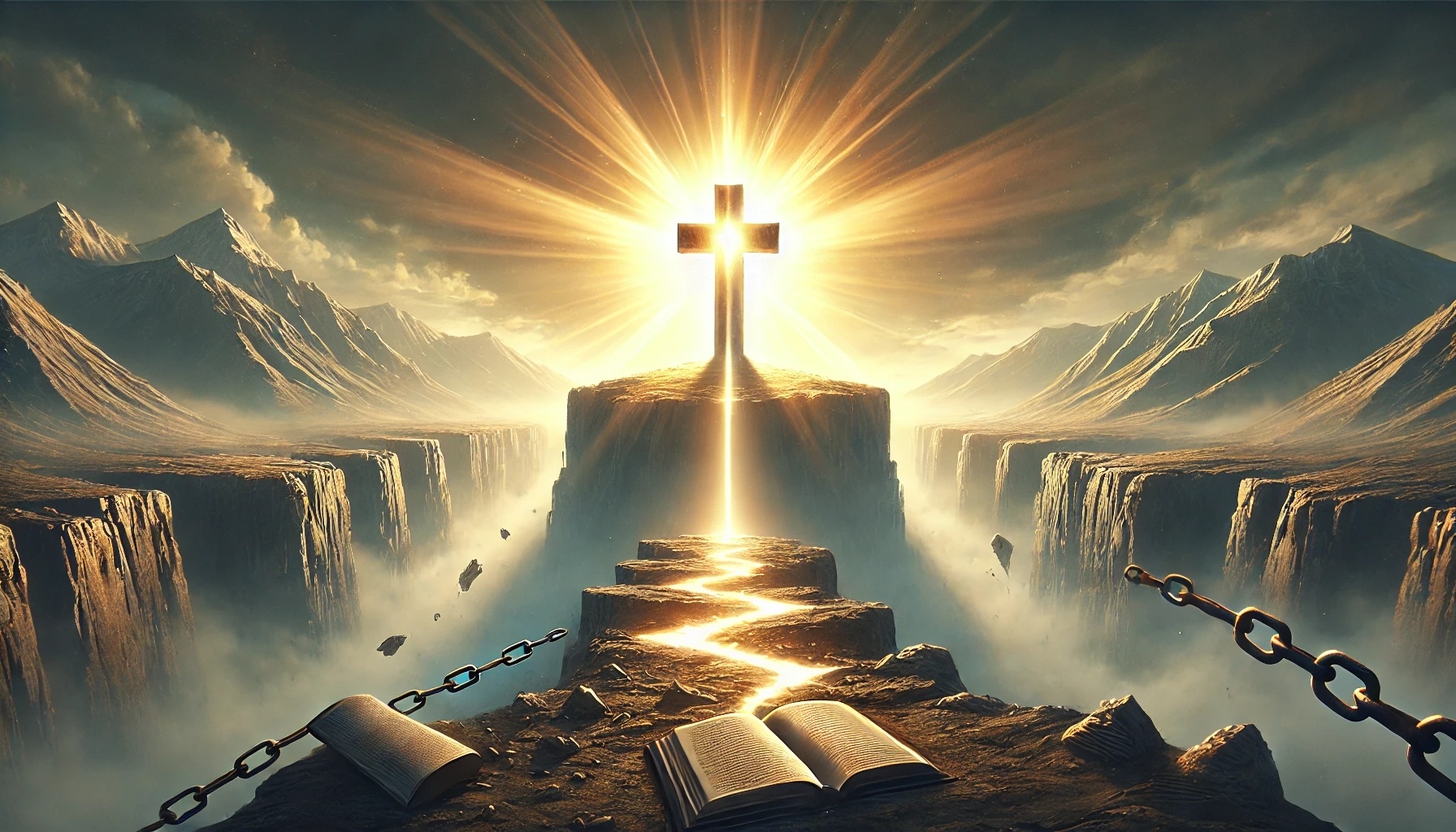
In a dream — clearer than any ordinary dream — Elisa stood on a wide plain.
Before her rose a mighty rock.
Upon it stood a cross — bright, shining.
Above the cross shone a light that did not blind, but warmed.
She knew without explanation:
This is Christ.
Then she heard words from Colossians 2:9:
“In Him dwells all the fullness of the Godhead bodily.”
The light grew stronger.
She understood:
Christ is not partial truth.
Not in need of supplementation.
Not relative.
He is the revelation of God Himself.
Chapter 3 – The Crumbling Bridges
To her left she saw a bridge made of thin glass.
On the bridge stood people with books in their hands.
She heard them say:
“This part of Scripture is time-bound.”
“That was only cultural.”
“That no longer fits our time.”
With every sentence, cracks appeared in the glass.
Suddenly the bridge broke.
Not all fell immediately —
but they no longer had firm ground.
Elisa heard a solemn voice:
“If Scripture is not My voice — then whose voice is it?”
She thought of the statement:
the Bible as the direct voice of God.
Chapter 4 – The Golden Wall
To her right rose a magnificent wall of gold and ornaments.
Engraved on it were:
-
circumcision
-
sacrifices
-
feast days
-
strict rules
People walked along this wall with serious faces.
They carried heavy burdens.
One shouted:
“We must keep everything — otherwise we are not faithful!”
But Elisa saw:
Behind the wall there was nothing.
Only shadows.
The sun stood behind the cross — and cast the wall as a huge shadow onto the ground.
The voice said:
“Why do you cling to the shadow when the substance stands before you?”
Chapter 5 – The Narrow Stairway
Between the rock and the wall, a narrow stairway led directly to the cross.
No splendor.
No decoration.
No burden.
Only a sign:
“Complete in Him.”
People who climbed these stairs carried nothing in their hands.
No merits.
No additional rules.
No theological superiority.
Only trust.
When Elisa took a step onto it, she felt something:
Lightness.
Chapter 6 – The Law in the Light
At the foot of the cross she saw two stone tablets.
They glowed — not threatening, but clear.
She understood:
The law had not been broken.
It had not been destroyed.
It had not been erased.
It reflected the character of the One
who hung on the cross.
Then she saw something decisive:
A document — a certificate of debt — lay torn on the ground.
The voice said:
“It was not My law that was destroyed —
but your accusation.”
Elisa wept.
Chapter 7 – The Abyss of Self-Righteousness
Suddenly an abyss opened behind her.
She saw people who relied on:
-
their discipline
-
their theological superiority
-
their spiritual performance
They stood on narrow ledges of rock — but these were crumbling.
The voice said:
“What happens in you does not save you.
What I have done for you saves you.”
Elisa understood the difference:
Justification is outside of us.
Sanctification is within us.
But the foundation is Christ’s work alone.
Chapter 8 – The Voice
The light above the cross grew more intense.
She heard words that sounded like an echo from eternity:
“I am the Word.
I am the Truth.
I am the Foundation.
If you relativize Me,
you lose your direction.
If you weaken My Word,
you lose your security.
Remain in Me.”
Chapter 9 – The Awakening
Elisa awoke.
Her heart was calm.
The questions had not disappeared —
but they had found a center.
She wrote in her notebook:
-
Christ is fully God.
-
The cross is completely sufficient.
-
The moral law reflects God’s character.
-
The ceremonial law was fulfilled.
-
Scripture is God’s voice.
-
I must not relativize any of it.
………………..✉️………………..
📌 Final Thoughts on the Story
This vision reminds us of the great lines of Adventist faith:
-
Christ as the center
-
the cross as the foundation
-
God’s law as an expression of His character
-
the fulfillment of the ceremonial service
-
the full inspiration of Scripture
-
the expectation of the new earth
In the 21st century we stand between two dangers:
-
relativizing Scripture
-
returning to religious self-righteousness
But the path is narrow — and clear:
Not shadows.
Not performance.
Not human judgments.
But Christ alone.
For in Him dwells all the fullness of the Godhead —
and in Him we are complete.

More Stories