

🌿 Traces of Creation – Discoveries from Nature
🦋 Series 2: Transformation and Order – What Insects Teach Us
🔬 Episode 1 – Metamorphosis – A New Beginning Without Chaos
🌅 Introduction: A Change That Challenges Everything
Change is part of life.
We grow, learn, and age. Yet despite all development, we remain the same people.
In the world of insects, something happens that breaks this understanding:
A living being transforms so fundamentally,
that hardly anything of its original body remains –
and yet it is still the same living being.
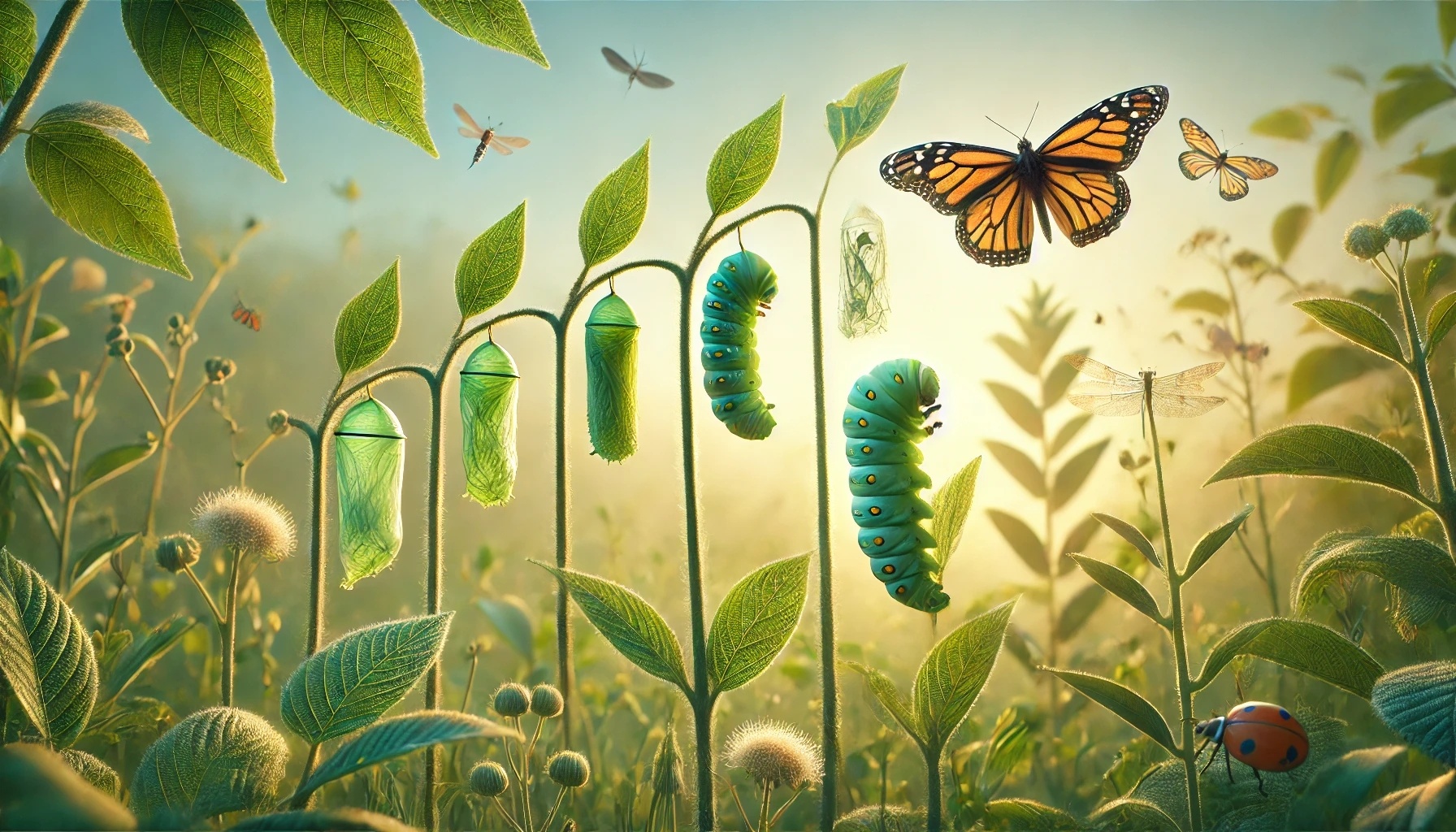
A caterpillar becomes a butterfly.
A larva becomes a beetle.
Not gradually.
Not superficially.
But completely.
How is such a new beginning possible –
without chaos?
🐛➡️🦋 1. Metamorphosis Is Not Growth
Metamorphosis is often confused with growth.
But the two are fundamentally different.
Growth means:
- more of the same
Metamorphosis means:
- something completely new
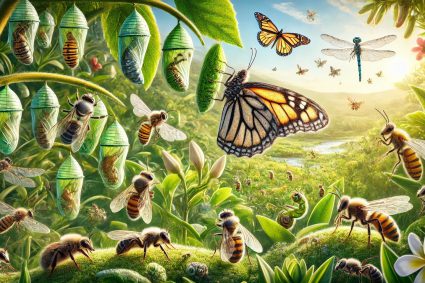
A caterpillar does not simply grow wings.
During pupation, its body is largely broken down.
Cells are dismantled, structures disappear.
And yet no shapeless mass emerges,
but a new, functional organism.
🧩 2. Transformation According to a Plan
During metamorphosis, so-called imaginal discs play a central role.
These groups of cells are already present in the larval stage.
They contain:
- blueprints for wings
- for eyes
- for legs
- for internal organs
While large parts of the old body break down,
these structures are built in a targeted way.
Nothing happens by chance.
Nothing occurs in disorder.
The transformation follows an internal program.
🧬 3. Identity Despite Dissolution
Perhaps the most astonishing aspect of metamorphosis is this:
The animal remains the same individual.
It is not a replacement.
Not a new beginning as a different being.
Memory, behavioral tendencies, and species-specific programs
remain intact or continue seamlessly.
This raises a fundamental question:
👉 How can identity remain,
when the body is completely rebuilt?
⚠️ 4. Why Chaos Would Be Fatal
An unstructured transformation would have fatal consequences.
If:
- the nervous system formed randomly
- the sequence became disordered
- an organ developed too early or too late
the animal would not survive metamorphosis.
Therefore, transformation is not an experiment,
but a highly reliable process.
It only works
if all steps are correctly coordinated.
🎯 5. Metamorphosis from the First Time
What is especially remarkable is this:
Insects do not have to learn this transformation.
The first metamorphosis is:
- the only one
- and fully sufficient
There is no second chance.
No correction.
No adjustment.
This requires a level of biological precision
that we otherwise only know from high-security technical systems.
🌍 6. Why Metamorphosis Is Not a Luxury
Metamorphosis is demanding.
It requires time, energy, and makes the animal vulnerable.
So why does it exist?
Because it offers advantages:
- larva and adult use different food sources
- competition is avoided
- habitats are used efficiently
But these advantages only work
if the transformation functions reliably.
Here too applies:
benefit requires order.
🧠 7. A Rational View of Transformation
In technical systems, complete reconstruction is risky.
It only succeeds with:
- precise planning
- clear sequence
- complete information
The metamorphosis of insects fulfills exactly these criteria –
without technology,
without monitoring,
without external control.
This observation does not force a conclusion.
But it invites honest wonder.
✝️ 8. The Christian Perspective: Renewal Without Loss
The Christian view includes the idea of transformation
without loss of identity.
Something new emerges,
without order being lost.
The metamorphosis of insects fits surprisingly well with this idea:
change does not have to destroy.
it can renew in an ordered way.
Not as proof,
but as an interpretation of observable reality.
💡 9. What Metamorphosis Teaches Us
Metamorphosis teaches us:
- radical change requires order
- identity is more than outward form
- processes can be profound without becoming chaotic
Perhaps it also reminds us
that renewal is not always visibly gentle –
yet it can still be meaningful.
🌟 Final Thought
Within an inconspicuous chrysalis
one of the most radical transformations in nature takes place.
Not loud.
Not spectacular.
But reliable.
Those who are willing to look closely,
will discover even in this quiet transformation
traces of creation.
