
Lesson 6.Through the Red Sea | 6.5 The Song of Moses and Miriam | 🌊 EXODUS | 🌱 LIVING FAITH
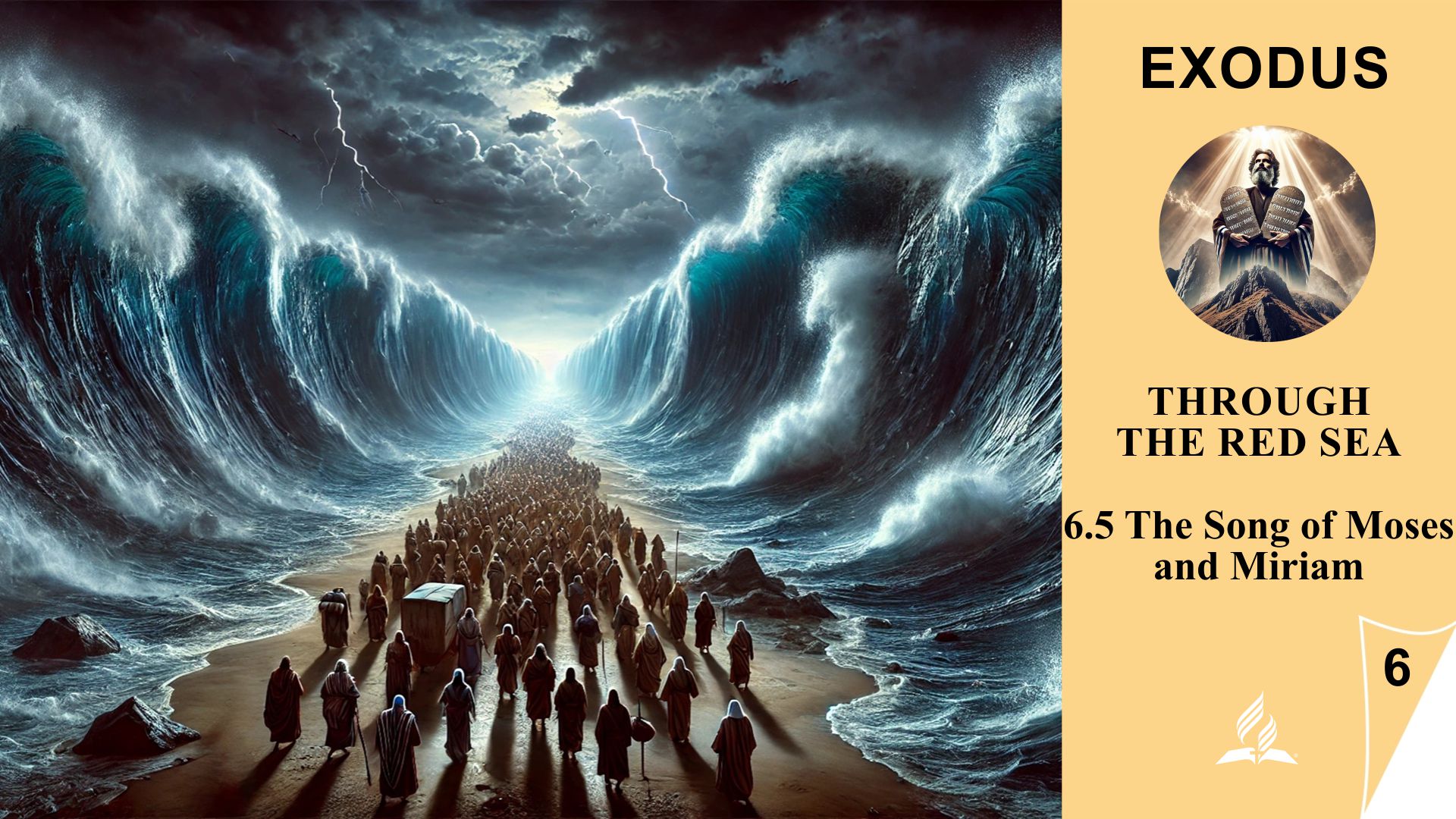

🌊 THE SECOND BOOK OF MOSES
⛪ Lesson 6: Through the Red Sea
📘 6.5 The Song of Moses and Miriam
✨ Praise After the Victory
🟦 Introduction
After the people of Israel had crossed the Red Sea and the Egyptians perished in the waters, joy and worship were the natural response. For the first time in the Bible, a full hymn of praise is recorded—the Song of Moses.
It is not a song of war, but of faith, worship, and hope.
It celebrates the present, remembers the past, and looks to the future with confidence. This song became a symbol for all generations: God saves – God judges – God leads.
…………………………….. 🌊 ……………………………..
📖 Bible Study – The Song of Moses (Exodus 15:1–21)
The song opens festively: “I will sing to the LORD, for He is highly exalted” (v. 1). It is a spontaneous yet structured poem—a poetic response to a miracle that changed the life of the entire nation forever.
🔹 1. God’s Victory over the Enemies (vv. 1–10)
The first stanza focuses on God’s direct intervention in history: He is not a passive observer but a mighty warrior who drowned Pharaoh’s chariots and armies in the sea.
The verses are vivid and almost dramatic—the waters cover the enemies “like a stone,” God’s “wrath consumes them like stubble.” This part emphasizes that the power of the Lord is on the side of the oppressed.
🔹 2. The Personal God (vv. 2–3)
Moses speaks of his experience with God in a personal way:
“The LORD is my strength and my song; He has become my salvation.”
God is not just the Savior of Israel but Moses’ personal redeemer. This echoes later in David, Isaiah, and the Psalms: God is about relationship, not just principle.
🔹 3. God’s Incomparable Glory (vv. 11–13)
Moses rhetorically asks: “Who is like You, O LORD, among the gods?”
The answer is clear: No one.
God’s nature is described in three traits:
– Holiness (“glorious in holiness”)
– Awe-inspiring power (“awesome in splendor”)
– Miraculous works (“working wonders”)
This emphasizes that God is incomparable—neither to idols nor to human power.
🔹 4. Prophetic Hope (vv. 14–18)
Moses doesn’t stop with a backward look. The song becomes a prophecy:
– “The chiefs of Edom were dismayed…”
– “All the inhabitants of Canaan melted away…”
– “You will bring them in and plant them on the mountain of Your inheritance…”
These statements show that Israel is on the path to the fulfillment of the promise. God not only liberated them—He will complete the journey.
🔹 5. The Role of Women (vv. 20–21)
Miriam, the prophetess, takes up the song and leads the women with tambourine and dance. This is a powerful image of communal worship—men and women, led by the Spirit of God, celebrate the victory together.
Miriam’s repetition of the central message shows: God’s truth must be sung, shared, and passed on.
…………………………….. 🌊 ……………………………..
📖 Answers to the Questions
❓ Question 1: Read Exodus 15:1–21. What is the content of Moses’ song?
The Song of Moses in Exodus 15 is one of the oldest known hymns of praise in human history. It was sung at a dramatic moment: right after the deliverance at the Red Sea, when the people of Israel saw with their own eyes how God Himself intervened in history to save His children.
This song is not only a hymn of thanksgiving—it is a theological revelation about God’s character, His power, and His future plans.
First, Moses describes the devastating power of God against the Egyptians. He portrays God as a warrior—a metaphor that may seem foreign today but was then a powerful expression of the idea that God takes sides with the oppressed. In a world filled with abuse of power and slavery, this was a revolutionary message: God is not on the side of the rulers but the victims.
Yet the song doesn’t remain stuck in the past. It becomes prophetic: it speaks of how God will lead and plant His people—on the mountain of His inheritance. The building of the temple on Mount Zion is already hinted at here.
The song is thus a retrospective, a praise for the present, and a vision for the future.
Especially powerful is the personal tone Moses strikes:
“The LORD is my strength and my song, and He has become my salvation.”
This shows that faith is not only collective, but deeply personal.
Anyone who has experienced God like Moses cannot help but sing—from the depths of their heart.
At the end, Miriam and the women dance and sing together: “Sing to the Lord, for He is gloriously exalted!”
Thus, the Song of Moses is more than a moment—it is an attitude of life: gratitude, trust, hope, and unwavering belief that God is holy, just, and wonderful.
This song is sung again in Revelation 15 by the redeemed—because God’s character does not change, and His justice will be praised for eternity.
❓ Question 2: Immanuel Kant said, if God is just, there must be some kind of life after death. Why is this statement true, and how can we learn to trust that one day the long-missing justice will come? How can you find comfort in that hope?
Immanuel Kant, one of the most important Enlightenment philosophers, wasn’t a theologian, but his statement touches on a core biblical truth.
He recognized: If there is a just God, then there must be life after death, because this world holds too much injustice that is never solved or addressed.
We see this injustice everywhere:
– Children abused or killed in wars.
– Innocent people oppressed or murdered.
– Righteous individuals dying in poverty, pain, or loneliness.
If there were no resurrection, no coming day of reckoning, then this injustice would remain forever—then suffering would be ultimately meaningless.
But the Bible offers a different path. It shows that God is not blind to the suffering of His children—and that a day will come when everything will be revealed.
Revelation 15 declares: “For Your righteous judgments have been made manifest.”
Believing in God’s justice means we don’t need to take revenge ourselves.
We can trust: God will bring everything to light.
But how do we learn to trust that promise?
– By relying on God’s track record.
The Song of Moses is an example: God didn’t just speak—He acted. Israel’s deliverance from Egypt was a historical proof of His justice.
– By reminding one another.
Fellowship with other believers helps us remember what God has done—and what He will do.
– By reading the Bible as one big story.
God’s justice runs like a red thread from Genesis to Revelation.
– By praying and entrusting our doubts to God.
God is not afraid of our questions—but invites us to bring them to Him, not against Him.
Comfort arises when we realize: Our suffering is not in vain.
There will be a judgment—not of vengeance, but of holiness and love.
And every oppressed person will hear:
“Well done, good and faithful servant… enter into the joy of your Lord” (Matthew 25:21).
…………………………….. 🌊 ……………………………..
✨ Spiritual Principles
-
Worship follows salvation. True praise flows from grace experienced.
-
God fights for the weak. He is not only Creator, but Liberator.
-
Holiness is God’s trademark. None is like Him.
-
Prophecy is rooted in history. God’s past faithfulness guarantees future fulfillment.
-
Praise is prophetic. Whoever sings today confesses God’s glory for tomorrow.
…………………………….. 🌊 ……………………………..
🛠️ Practical Life Application
-
Write down your personal “victories.” This will strengthen your faith.
-
Learn to use praise as a weapon. Even in crisis—you can sing.
-
See injustice with hope. God has the final word, not evil.
-
Take time for gratitude. Faith grows through remembrance.
-
Live prophetically. Align your daily life with God’s promises.
…………………………….. 🌊 ……………………………..
✅ Conclusion
The Song of Moses is a heavenly song—it sounds at the beginning of Israel’s journey and again at the end of time, in Revelation 15.
It is the song of those who have passed through water—and sing on the other side.
Whoever experiences God cannot remain silent.
And whoever knows God’s justice can rejoice despite injustice.
Because His song continues.
…………………………….. 🌊 ……………………………..
💭 Thought of the Day
Praise is remembrance, hope, and battle all at once.
➡️ Learn to raise your voice today—not because everything is fine, but because God is faithful.
…………………………….. 🌊 ……………………………..
✍️ Illustration – The Sound Behind the Storm
An American Story of Justice, Hope, and the Song That Did Not Die
Chapter 1 – After the Wind
New Orleans, Fall 2021.
Hurricane Ida had shaken the city once again. Homes lay in ruins. Hope seemed erased.
Elijah, 31, returned to his hometown—not as a hero, but as a seeker. The son of a pastor, he felt that not only rooftops had been torn away—but his faith as well.
In the makeshift community center lit only by candles, an old woman, Miss Laverne, began to sing:
“I will sing unto the Lord, for He has triumphed gloriously…”
And something stirred within Elijah. A memory. A whisper from the past.
✦ ─────────────── ✦ ─────────────── ✦
Chapter 2 – The Sound of Childhood
Georgia, 1995.
Elijah was eight years old when his father set up a tent in a hostile small town. Faith was not welcome.
Black Christians were spat on, threatened, even chased. One night, they had to flee into the woods. But his father sang:
“The LORD is my strength and my song.”
Elijah was terrified, but his father’s voice echoed like a shield in the darkness.
It was the first time Elijah realized: God’s song is a song of survival.
✦ ─────────────── ✦ ─────────────── ✦
Chapter 3 – Voices from the Dust
New Orleans, 2021.
Now a preacher himself, Elijah had forgotten how to sing. His faith had grown brittle.
But when Miss Laverne once again began the song—
“The horse and the rider He has thrown into the sea…”
—he felt something ancient, deep, and true begin to resonate.
The room filled with praise.
No microphones. No instruments. Just voices. And tears.
The song became a weapon against despair.
✦ ─────────────── ✦ ─────────────── ✦
Chapter 4 – And They Kept Singing
The days passed. Aid came slowly. But the congregation grew—not in numbers, but in depth.
Elijah began to preach again—not out of duty, but from the realization that justice doesn’t always come quickly, but it comes.
The people began rebuilding. Not just homes. But hope.
In the ruins, they sang the Song of Moses—and they believed that the same God who led Israel through the sea would carry them through the night.
✦ ─────────────── ✦ ─────────────── ✦
Chapter 5 – The Question of a Nation
A CNN reporter stood before the camera.
In the background: destroyed houses.
In the foreground: a singing congregation.
“Why are you singing?” he asked Elijah.
The answer came quietly, but firmly:
“Because our God is greater than our pain.
We don’t sing because we’ve won—
we sing because He is faithful.”
The interview went viral.
✦ ─────────────── ✦ ─────────────── ✦
Chapter 6 – The Legacy of the Song
Five years later.
The church had been rebuilt. It shone again—but its true light wasn’t in its structure, but in its story.
Young people, once homeless, found new purpose through Elijah’s foundation.
One day, a child read from the Book of Revelation:
“And they sang the song of Moses and the song of the Lamb…”
Elijah stood beneath an old oak tree.
He remembered his mother.
The forest in Georgia.
New Orleans after the storm.
He didn’t just hear the child’s voice.
He heard the song.
✦ ─────────────── ✦ ─────────────── ✦
Chapter 7 – The Eternal Refrain
In a world full of pain, injustice, and noise,
we need voices that sing—in spite of it all.
For those buried under water—like the Egyptians.
For those brought through it—like Israel.
For those still waiting—for the song that sets them free.
Because God sees.
God hears.
And God will judge—in righteousness.
His song does not end.
It echoes—
In the forests of Georgia.
In the chaos of New Orleans.
In every voice that believes, hopes, and trusts:
“The LORD is my strength and my song.
And He has become my salvation.”

More Stories