Lesson 6.Through the Red Sea | 6.3 Crossing the Red Sea | 🌊 EXODUS | 🌱 LIVING FAITH

🌊 THE SECOND BOOK OF MOSES
⛪ Lesson 6: Through the Red Sea
📘 6.3 Crossing the Red Sea
✨ When Faith Is Put to the Test
🟦 Introduction
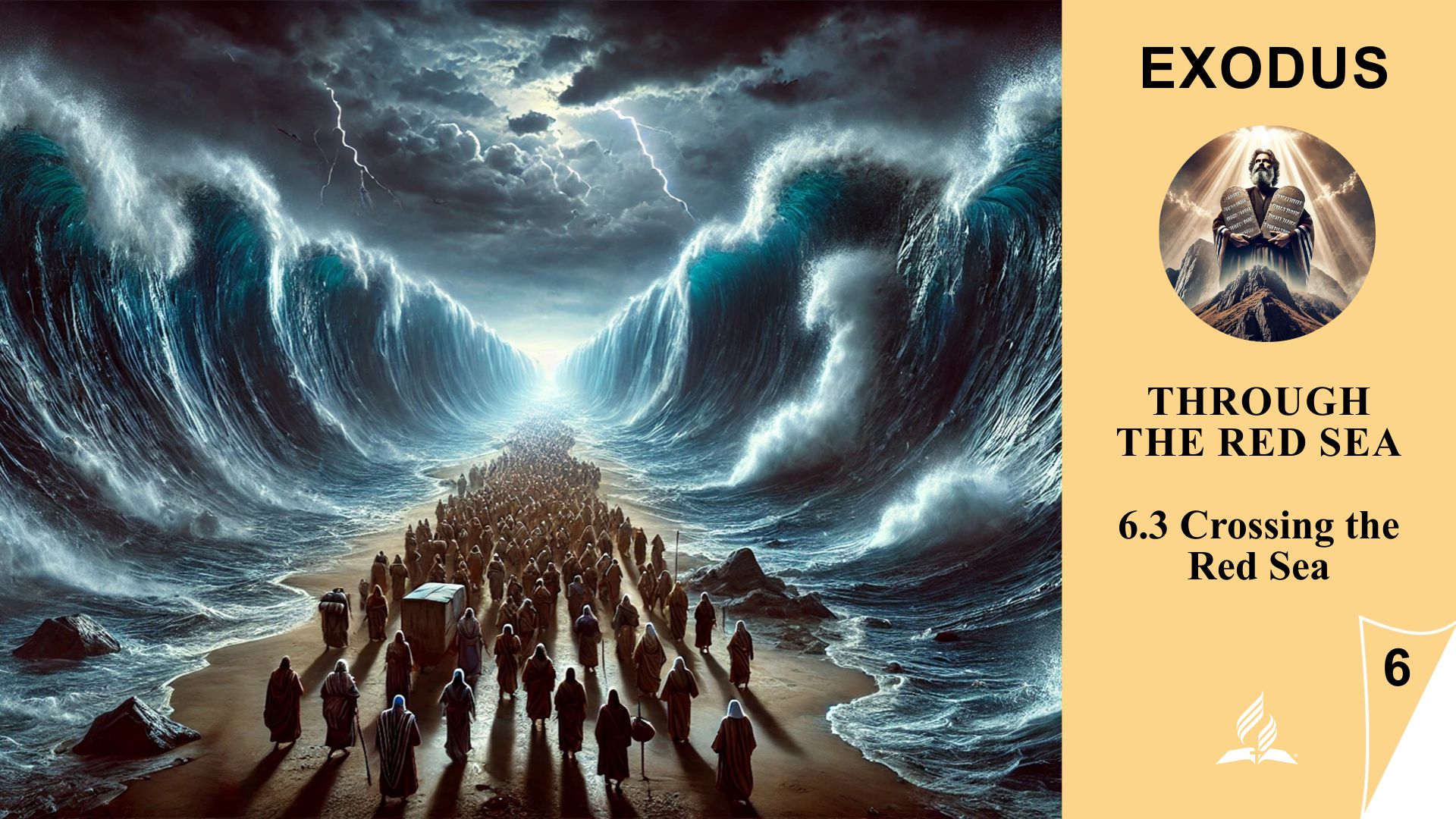
The crossing of the Red Sea is one of God’s greatest acts of salvation in the Old Testament. It marks not only the physical deliverance of Israel from slavery but also the beginning of a new identity as God’s people. The events in Exodus 13:17–14:12 are both historical fact and spiritual symbol: they show that God’s ways often seem hard to understand but ultimately lead to His glory and the good of His children.
…………………………….. 🌊 ……………………………..
📖 Bible Study – Historical and Spiritual Context
🔹 1. God’s Leading – Not Chance, but Plan
Exodus 13:17–18 tells us that God did not lead the people along the direct route through the land of the Philistines, though it was shorter. The reason: He knew the weakness of their faith and that they would want to return to Egypt at the first sign of war.
God led them “by way of the wilderness” – a detour from a human perspective, but protection from a divine perspective.
The organized form (“hosts”) shows that deliverance does not mean chaos, but God-structured order.
Spiritual truth:
God’s leading is often not the shortest route but always the best for our growth and protection.
🔹 2. Joseph’s Faith as a Testimony for Generations
Exodus 13:19: Moses took the bones of Joseph with him. This was not just a symbolic act but the fulfillment of a promise (Genesis 50:24–25).
Joseph lived his entire life with the awareness that God’s promises are sure, even when their fulfillment takes centuries.
Hebrews 11:22 praises Joseph’s faith as an example that true hope does not depend on current circumstances.
Spiritual truth:
Faith in God’s promises has lasting impact – it can inspire generations after us.
🔹 3. Visible Signs of God’s Presence
The pillar of cloud by day and the pillar of fire by night were not mere navigation aids but the visible manifestation of God’s presence.
Exodus 14:19–20 shows that this presence provided both protection and guidance: it stood between Israel and Egypt to keep the people safe.
These symbols remind us of Christ as the Light of the World (John 8:12), who leads and protects His church.
Spiritual truth:
God’s presence is more than comforting – it actively protects and leads us in His righteousness.
🔹 4. Pharaoh’s Hardened Heart
Despite the plagues and the defeat of his nation, Pharaoh’s heart remained hard. His request for a blessing (Exodus 12:32) was not genuine repentance but a momentary reaction to pressure.
Sin had so darkened his perception that he could not accept God’s plan in defeat.
Romans 1:21–22 shows a similar pattern: those who do not honor God have their minds darkened.
Spiritual truth:
Outward defeats do not automatically mean inward repentance. True change begins in the heart.
🔹 5. The People’s Reaction – Fear Instead of Faith
When the Israelites saw Pharaoh’s army, they reacted with fear and complaints (Exodus 14:11–12).
Despite their recent experience of Passover deliverance and the mighty plagues, they doubted again.
This pattern – experiencing God’s help and then doubting again – runs throughout the wilderness journey (cf. Numbers 14:1–4).
Spiritual truth:
Faith must be exercised, or in times of crisis, we will fall back into old patterns of fear.
Additional Symbolic Meaning
The crossing of the Red Sea is a picture of baptism (1 Corinthians 10:1–2): the old life in Egypt is left behind, and the believer is led into a new life.
The sea that meant death for the Egyptians was the way to life for Israel – a picture of the cross of Christ.
…………………………….. 🌊 ……………………………..
📖 Answers to the Questions
📌 Question 1: Read Exodus 13:17–14:12. How did God lead the Israelites when they left Egypt? What happened afterward?
God led the Israelites from the very beginning in a supernatural way. Although the shortest way to Canaan was through the land of the Philistines, God chose to take them by a detour through the wilderness to the Red Sea (Exodus 13:17–18). The reason was clear: He knew that the people, freshly freed from slavery, were neither militarily nor spiritually ready to face war with the Philistines. Instead, He wanted to train them in faith and show them that victory does not come from military strength but from Him (cf. Deuteronomy 8:2–3).
The people marched out in ordered ranks like an army (the Hebrew words tsaba’ and machaneh suggest military organization). This showed that God was not leading them as a fleeing mob but as an organized people with His mission. Moses also took Joseph’s bones with him (Exodus 13:19) – an act of faith and loyalty to God’s promise that Israel would one day return to Canaan (Genesis 50:24–25; Hebrews 11:22).
The visible guidance came through the pillar of cloud by day and the pillar of fire by night (Exodus 13:21–22). These symbols were far more than mere markers – they embodied God’s ongoing leadership, protection, and sovereignty over His people.
Meanwhile, Pharaoh once again hardened his heart. He did not truly repent of letting Israel go. His decision to pursue them with a mighty army (Exodus 14:5–9) revealed his continued pride and rebellion.
When the Israelites saw the Egyptian army, they responded with fear, panic, and complaint (Exodus 14:10–12). They forgot God’s miracles – including the plagues and the protection of their firstborn – and even accused Moses of leading them into the desert to die. This reaction showed a shocking lack of trust, despite God’s clear self-revelation.
Summary:
God led with clarity, care, and visible presence, but the people needed time to learn to trust Him fully. This tension between God’s faithfulness and Israel’s fear is a key theme that applies to us today.
📌 Question 2: Think about the last time you were in a terrible situation. Was your first reaction faith in God or lack of faith? What can you learn from that situation that could help you next time?
I remember a time when suddenly all the securities in my life fell away – in work, finances, and health. My first reaction was not a night of praise but fear, doubt, and the feeling of having no way out. Like the Israelites, I first looked at the “Egyptians” behind me – the problem – instead of the “pillar of cloud” in front of me – God’s guidance.
Over time, I realized this situation was a test of my faith. Looking back, I can see that God opened doors I had not expected, step by step. He placed people by my side, gave me new ideas, and ultimately brought me onto a better path than I had planned.
What I learned:
-
Memory is vital: In the middle of a crisis, it is essential to remember past instances of God’s guidance and miracles (Psalm 77:12–13).
-
God’s timing is different: Just as Israel stood between the sea and Pharaoh’s army, God sometimes brings us into “impossible” situations so we can see that only He can save (Exodus 14:13–14).
-
Faith grows through practice: Fear does not disappear automatically. It is overcome through conscious trust in God’s promises – step by step, prayer by prayer.
For next time:
I want to deliberately pause immediately, pray, and recall biblical promises before reacting to problems. My goal is to seek God as my first reflex, not my last resort.
…………………………….. 🌊 ……………………………..
✨ Spiritual Principles
-
God’s ways are wise, even when they seem longer.
-
Remembering God’s faithfulness strengthens present faith.
-
God’s presence is both protection and guidance.
-
Hardness of heart prevents true repentance.
-
Faith must be consciously activated in times of crisis.
…………………………….. 🌊 ……………………………..
🛠️ Practical Life Application
-
Set daily “memorial stones”: record events where God has guided and helped.
-
See crises not as proof of God’s absence but as opportunities to experience His protection.
-
Hold on to God’s promises even when the “Pharaoh” is behind you and the “sea” is before you.
…………………………….. 🌊 ……………………………..
✅ Conclusion
The crossing of the Red Sea shows God’s sovereign power, His faithful guidance, and our tendency to doubt. Those who trust Him will experience that He makes a way right through the seemingly impossible.
…………………………….. 🌊 ……………………………..
💭 Thought of the Day
“God does not always pave the easiest road – but always the one that will safely bring us to the destination.”
…………………………….. 🌊 ……………………………..
✍️ Illustration – “The Bridge No One Saw”
How a young woman in the USA stood before her own “Red Sea”
Chapter 1 – The Storm over Seattle
It was a chilly November evening in Seattle. Rain whipped against the tall glass fronts of a modern start‑up office. Inside, computer screens flickered as Samantha “Sam” Collins, 29, sat at her desk.
Her eyes were fixed on an email:
Subject: Final Notice – Project Completion Impossible
The words pierced her heart. Her dream of developing an eco‑friendly water filtration technology was falling apart. The system didn’t work as planned, investors were pulling out, and her two co‑founders had walked away just last week.
✦ ─────────────── ✦ ─────────────── ✦
Chapter 2 – The Sea in Front of Me, Pharaoh Behind Me
The next morning, Sam drove her old, rusty pickup south on I‑5. Gray clouds hung low, and traffic crawled forward like an endless snake. She thought about Exodus 14 – a story her father had told her as a child.
Back then, it was just a nice Bible story. Today, it felt like her own life:
Behind her pressed “Pharaoh” – debt, obligations, disappointed expectations.
Before her lay the “sea” – an overwhelming wall of uncertainty and fear.
She stopped at a rest area. Her phone rang. It was her mother in California.
“Sam,” she said gently, “I don’t know everything that’s weighing on you right now. But God split the sea before Israel ever took a step. Trust that He already knows the way.”
✦ ─────────────── ✦ ─────────────── ✦
Chapter 3 – Cloud by Day, Fire by Night
In the days that followed, Sam found stability in small routines. Every morning she sat in a corner café, drank a steaming cappuccino, and wrote her thoughts in an old notebook.
She began to consciously look for “pillars of cloud and fire” in her daily life – signs that God was still present.
A stranger in the café who encouraged her.
An old friend calling out of the blue, not knowing how much she needed to talk.
An email with a small but unexpected donation for her project.
They weren’t grand miracles – more like quiet reminders that God was still leading.
✦ ─────────────── ✦ ─────────────── ✦
Chapter 4 – The Step into the Water
One evening, as rain poured down in sheets, Sam sat back in the office. The pressure was enormous. Three more days and the investors would shut everything down.
She remembered her mother’s words and the picture of Israel at the Red Sea.
She stood up, closed her laptop, and wrote a bold email: she offered a small relief organization in Arizona the use of her flawed filtration system for testing in aid projects.
It felt like stepping into the water – without knowing whether a path would appear.
✦ ─────────────── ✦ ─────────────── ✦
Chapter 5 – The Bridge No One Saw
The next morning, the reply came: the organization was thrilled and not only wanted to test the system but would also fund its further development.
Sam could hardly believe it. Within days, doors opened she hadn’t even known existed.
Her “sea” hadn’t vanished – the challenges were still there. But God had made a way right through, a way she hadn’t been able to see the day before.
✦ ─────────────── ✦ ─────────────── ✦
Chapter 6 – A Testimony in the Desert
Months later, Sam sat at a seminar in Phoenix. Before her stood young entrepreneurs eager to hear her story. She smiled and said:
“I’ve learned that God often doesn’t lead around the sea, but right through it. And sometimes the bridge is already there – we just can’t see it until we take the first step.”
📌 Thoughts after the Story
Sam’s journey shows us that the “Red Seas” in our lives rarely consist of water – they’re often financial crises, broken relationships, health diagnoses, or sudden life changes. They seem impossible to cross until God makes a way straight through them.
The Israelites stood with their backs to the wall: Pharaoh behind them, the sea before them. Sam’s “Pharaoh” was the fear of failure and the weight of her obligations. Her “sea” was the career dead end that seemed impossible to overcome.
Lessons:
-
God’s way isn’t always visible before the first step. Israel had to step into the sea before the waters parted (Exodus 14:15–16). Sam had to send the bold email before the funding came.
-
God’s presence is there, even when it seems ordinary. The pillar of cloud and fire in the Old Testament was just as real for Israel as the small “coincidences” in Sam’s life.
-
Faith grows while walking. Standing still in fear paralyzes us, but obedience in small steps opens paths we couldn’t see before.
Final thought:
Every faith journey has moments when we stand before a “sea.” But the sea that stops the enemy becomes the road to the promised land.

More Stories