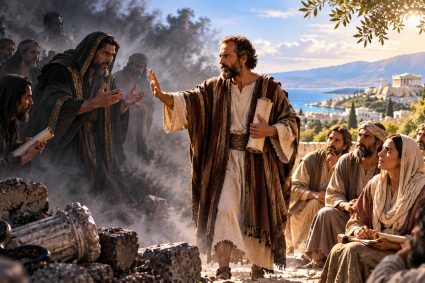
In the final section of chapter 2, Paul honors a largely unknown but deeply impressive person: Epaphroditus. Not an apostle, not a prophet, not a church leader—but a simple messenger, a faithful helper, a man with a servant’s heart.
The story of Epaphroditus is not spectacular—but deeply instructive. It shows us whom God honors—and whom we should honor. Not the loud, not the influential, not those who seem “important”—but those who serve, who suffer, who remain faithful. Those who, like Christ, do not seek their own interests but give themselves.
………………..✉️………………..
📜 Bible Study
📌 Philippians 2:25–30: Epaphroditus – an unknown hero
Paul describes Epaphroditus with five powerful terms:
-
Brother – spiritual family
-
Fellow worker – shared mission
-
Fellow soldier – fighting for the gospel
-
Messenger – a delegate sent by the church
-
Servant in my need – practical help in great distress
His task seemed simple: bring a gift, care for Paul, return with the letter.
But the reality was dangerous, exhausting, and demanding. He became so seriously ill that he nearly died (v.27). And yet he remained faithful—not out of duty, but out of love.
Paul honors him not for preaching or theological writings, but for faithfulness, devotion, and sacrificial commitment.
He was willing to “risk his life” (v.30)—just as Jesus did (v.8). And that is why Paul says:
“Honor such people” (v.29).
………………..✉️………………..
🗣️ Answers to the Questions
Question 1: How does Paul describe Epaphroditus?
Paul presents Epaphroditus as a faithful, selfless, and devoted disciple of Christ.
-
His attitude: deeply humble, caring (he was distressed because the church heard about his illness!)
-
His actions: he served Paul despite his own sickness, made sacrifices, risked his life
-
His character: reliable, courageous, loyal—not seeking recognition, but serving
What defines him is not a great gift, but a great heart. Epaphroditus reminds us: God does not measure people by visibility, but by faithfulness.
………………..✉️………………..
💎 Spiritual Principles
-
True worth is measured not by titles, but by faithfulness.
-
Honor belongs to those who serve—not those who dominate.
-
God sees sacrifices that remain hidden.
-
Spiritual heroes are often invisible to the world—but never to God.
-
A sent messenger with a servant’s heart reflects Christ.
………………..✉️………………..
🛠️ Everyday Application
-
Value quiet servants in your church. Encourage them, thank them, pray for them.
-
Ask yourself: Am I living for Christ’s glory or for human recognition?
-
Practice practical help. Not only teaching—also carrying burdens, caring, empathizing.
-
Recognize spiritual greatness in everyday faithfulness. Not only in the spotlight.
-
Learn to endure suffering without seeking recognition. God sees your sacrifice.
………………..✉️………………..
✅ Conclusion
The church of Jesus needs not only great teachers—but faithful messengers. People like Epaphroditus. People who faithfully do what needs to be done, even when no one notices. Such people change lives. Such people we honor—because God honors them.
………………..✉️………………..
💭 Thought of the Day
“In God’s kingdom, quiet servants are often the greatest heroes.”
………………..✉️………………..
✍️ Illustration – The Invisible Service
The story of a man no one knew—except heaven
Part 1 – The Quiet Assignment
Julius was 62, retired, unremarkable. His church? Small, rural, barely 30 members.
Julius had no spiritual title. But he had a calling—one he never named himself:
He was the helper. The provider. The “Epaphroditus” of his church.
He cleaned the chapel early on Saturdays before anyone arrived. He repaired broken window frames. He drove Sister Elisabeth to the doctor every week. He printed Sabbath School lessons for the elderly who had no internet. And every Friday, he brought groceries to old Brother Willi—never talking about it.
Part 2 – The Illness and the Letter
In winter, Julius became seriously ill. Heart problems. Hospital. Silence.
The church prayed—but no one knew how serious it was. Julius had played it down himself.
What they didn’t know: while in the hospital, he wrote—with trembling hands—a letter.
To the new pastor, barely 30 years old, new in ministry.
“Dear Brother Matthias, thank you for continuing the work. If I have to go, know this: I did it gladly. Not perfectly, but for the Lord. If the church windows squeak again—just add some oil. And if you see Sister Elisabeth: she struggles, but her smile is a prayer. God bless you.”
Part 3 – The Quiet Farewell
Julius died a few days later. No headlines. No obituaries. Just a small funeral in the village cemetery. The sky was clear. A few church members sang:
“Holy God, We Praise Your Name.”
The pastor read Philippians 2:29–30 and then said:
“He was our Epaphroditus. No office, no applause—but faithful to the end. Such people we are to honor.”
Part 4 – The Fruit of the Invisible
One year later. The church had changed. Brother Matthias renovated the church building—in memory of Julius. A plaque hung in the entrance hall:
“In memory of a faithful brother. 1961–2023. ‘He risked his life for the work of the gospel.’”
His example inspired others:
-
Young men began organizing transportation ministries.
-
A sister took over printing the lessons.
-
Children learned: faithfulness is greater than talent.
Julius’ life taught them more than a hundred sermons.
Part 5 – On the Day of Honor
A dream. Sister Elisabeth—now very old herself—had it one night after Sabbath.
She saw a great multitude in heaven. Angels stood in rows.
Jesus approached a man—simply dressed, quiet.
“This one was faithful in little,” said the Lord.
“He was my coworker, my servant, my messenger. Today I honor him.”
It was Julius.
………………..✉️………………..
📌 Final Thoughts on the Story
Honor is not earthly applause. Honor in God’s eyes is the quiet sacrifice, the faithful heart, the unseen deed.
Julius was a modern Epaphroditus—like many today in our churches. Maybe you are one of them. And even if no one sees what you do—God sees it. And He says:
“Honor such people.”
💭 Are you living in a way that God can one day honor you—not for greatness, but for faithfulness?