
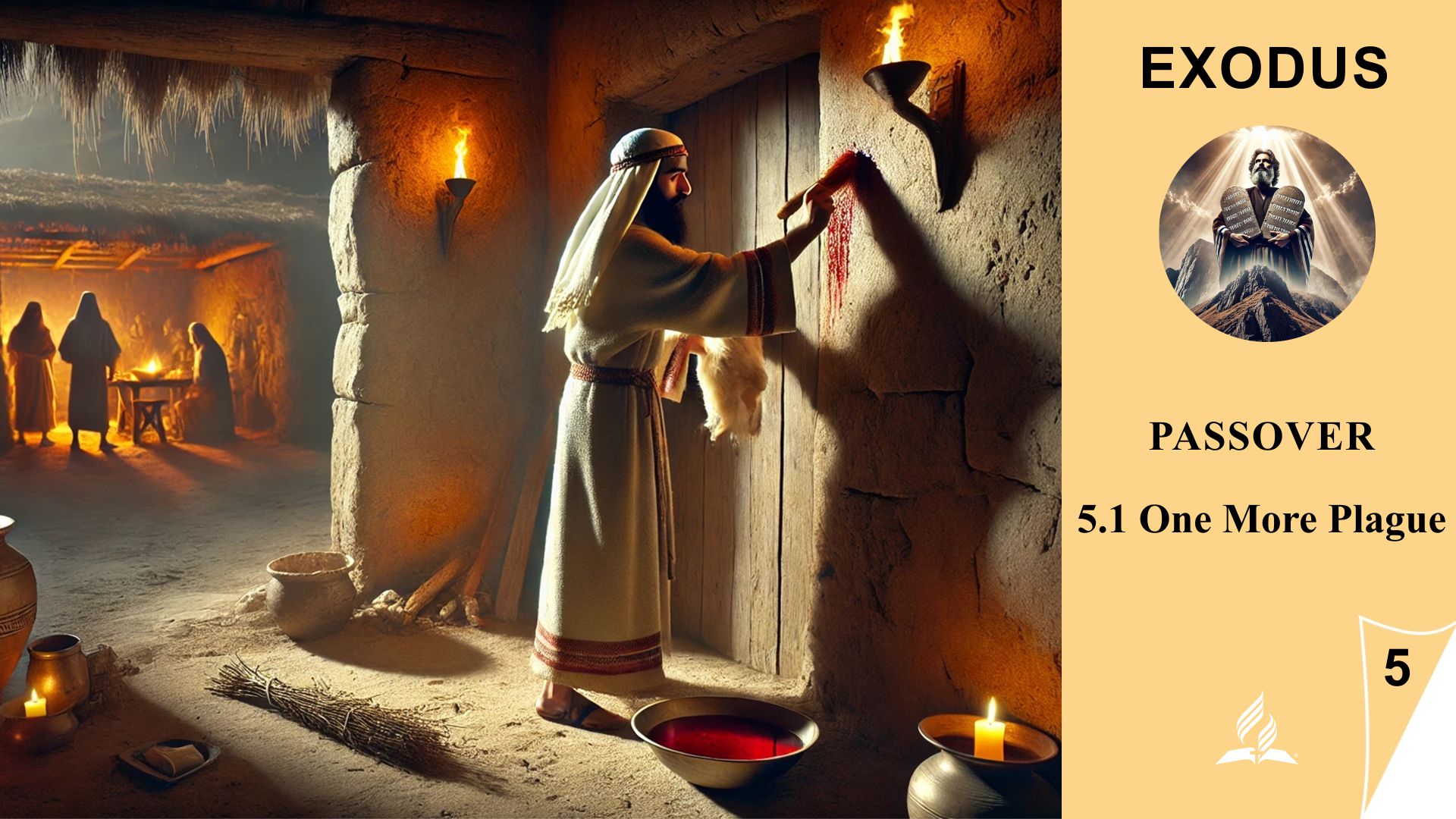
Lesson 5.Passover | 5.1 One More Plague | EXODUS | LIVING FAITH
🟦 Introduction
Lesson 5 leads us into the dramatic finale of the ten plagues and the institution of the Passover. Amid judgment and suffering, God reveals His saving grace: a lamb is sacrificed, and its blood protects the faithful from destruction. This sign becomes a powerful symbol of redemption—then for Israel, now for us through Christ. Passover is more than a historical festival; it is an invitation to remembrance, gratitude, and the passing on of faith. God acts with justice, but His ultimate goal is always salvation. This lesson invites us to trust in His guidance and to place our lives under the sign of His blood.
⛪ Lesson 5: Passover
📘 5.1 One More Plague
✨ The Final Warning – God’s Patience Before Judgment
………………………………………………………………….
🟦 Introduction
This week we dive into a crucial moment in biblical history—the announcement of the tenth and final plague over Egypt. It is a moment of great drama, but also a profound revelation of God’s character: His justice, His patience, and His mercy.
What can we learn from this for our lives in the 21st century? How do we confront injustice? And how can we act both justly and mercifully?
………………………………………………………………….
📖 Bible Study: Exodus 11:1–10
🔹 1. Historical and Literary Context
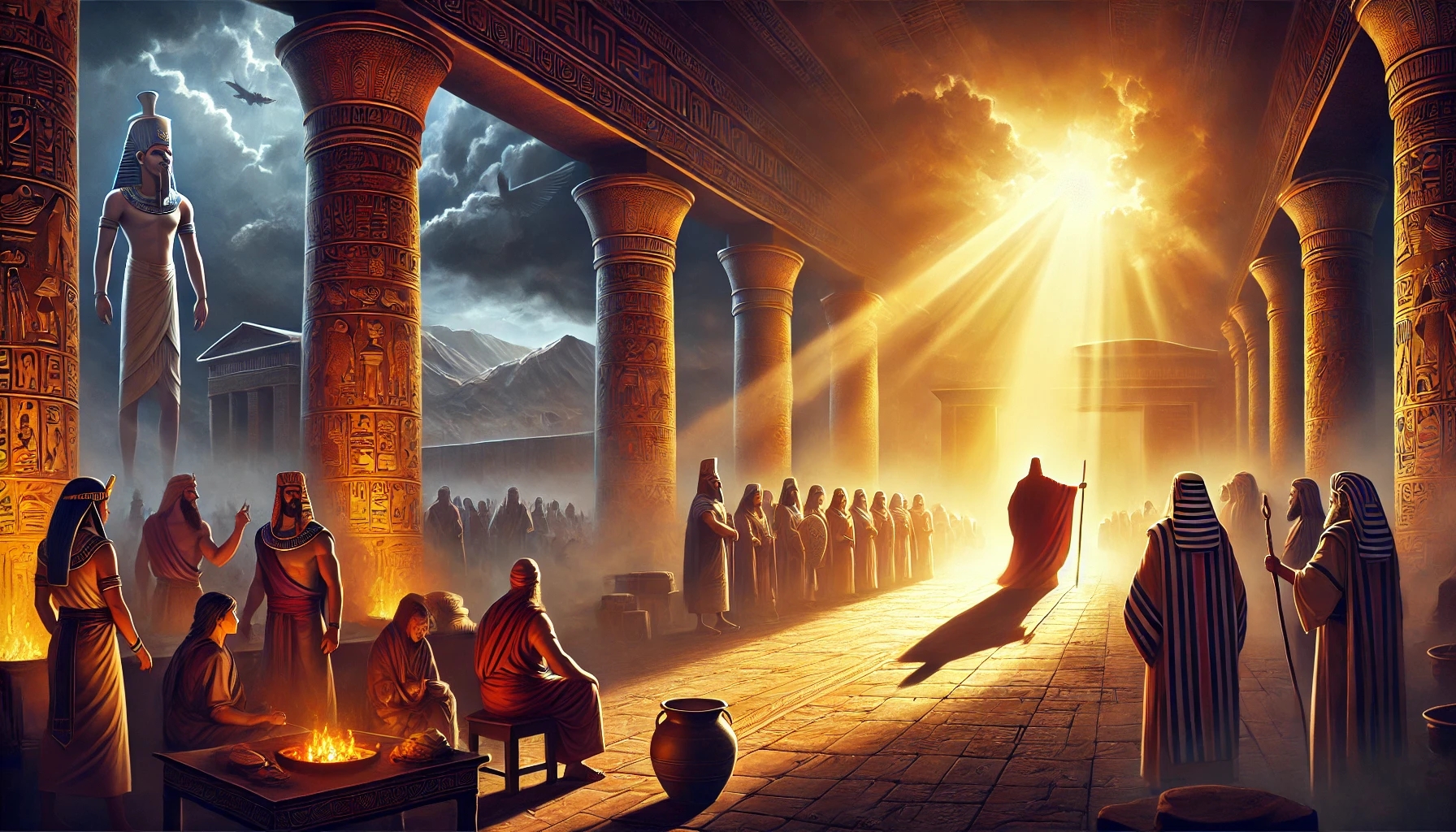
The book of Exodus describes God’s mighty act of deliverance from Egyptian slavery. Chapter 11 comes just before the most dramatic divine intervention: the death of the firstborn, the tenth and final plague.
The previous nine plagues had exposed Egypt’s gods, shaken Pharaoh’s authority, and given hope to the people of Israel. Yet Pharaoh still refused to let Israel go.
Chapter 11 is not a minor passage—it’s the turning point.
This is the last time Moses stands before Pharaoh. It is God’s final public warning to a system defined by oppression, pride, and idolatry.
🔹 2. Verse-by-Verse Explanation (Exodus 11:1–10)
Verse 1
“One more plague I will bring upon Pharaoh and upon Egypt. After that he will let you go from here…”
God announces one final plague—after which Pharaoh will release them. This shows that God had a clear plan all along. The ten plagues weren’t random events, but part of a divine strategy.
God does not bring judgment immediately—He acts step by step, giving room for repentance.
Verses 2–3
“Speak now in the hearing of the people, that each man ask his neighbor for articles of silver and gold…”
God prepares Israel not only spiritually but also materially. What seems like a detail is deeply symbolic: it represents a divine compensation after centuries of exploitation.
Verse 3 also shows that Moses had gained high regard among the Egyptians. Despite the chaos, the people began recognizing God’s power—even if Pharaoh continued to resist.
Verses 4–6
“Thus says the LORD: About midnight I will go out in the midst of Egypt, and every firstborn shall die…”
This is a chilling announcement. It strikes at the very heart of Egyptian society—family, lineage, the future.
Why this plague?
Because the death of the firstborn symbolizes the entire system of Egypt:
-
Egypt had murdered Israelite children (Exodus 1:16–22).
-
It tried to silence God’s promise.
Now judgment is turned back on the very force that tried to suppress life.
Yet even here, God warns ahead of time. Everyone who listens has a chance to choose. The warning itself is an act of grace.
Verse 7
“But among all the people of Israel not a dog shall growl…”
A contrast is drawn: God distinguishes between oppressor and oppressed, between judgment and protection.
The Hebrew word hafleh (to distinguish) also means “to make a miracle.” God’s special care for His people is a miracle in itself.
Verse 8
“All your servants shall come down to me and bow down…”
Moses declares that even Pharaoh’s closest allies will plead for Israel to leave. God’s intervention will be so decisive that even the elite will surrender.
And then the key sentence:
“Then Moses went out from Pharaoh in hot anger.”
Why such anger?
It was righteous anger at injustice.
It was compassionate anger, because Moses knew what was coming—and that it could have been avoided.
Verses 9–10
“But the LORD had said to Moses, ‘Pharaoh will not listen to you…'”
The text ends with a reminder: Pharaoh’s refusal was foreseen—not manipulated, but foreseen.
God uses even human resistance to make His glory and justice known.
His plan will prevail—even through rebellion.
🔹 3. Theological Depth – God’s Character in This Passage
-
God is patient: Nine previous plagues were warnings.
-
God is just: He judges a corrupt, oppressive system.
-
God distinguishes: He sees the suffering and protects the innocent.
-
God is not cruel: Even His judgments reveal His mercy—through warnings, grace, and provision.
This story challenges our image of God: He is not just “the loving God,” but also a just judge who acts when injustice persists too long.
🔹 4. Connection to Today
We live in a world full of modern-day “Pharaohs”—systems that exploit, oppress, and ignore God’s truth.
How long will God remain silent?
What warnings is He giving today?
Are we ready to listen to His voice—before it’s too late?
Do we recognize that even judgment contains mercy—if we respond?
🔹 5. The Symbolic Meaning of the Number Ten
The tenth plague is not arbitrary. In the Bible, ten symbolizes completeness.
-
Ten Commandments = complete moral standard
-
Ten plagues = complete revelation of God’s justice
It’s the finale—God’s full response to rebellion, pride, and oppression.
Exodus 11 is not merely a threat—it’s a call to repentance, a message of hope for the oppressed, and a warning to the powerful.
God will not be mocked—but He waits long. His justice is not cold or blind but rooted in love, patience, and mercy.
The question is: How do we respond when He speaks?
………………………………………………………………….
📖 Answers to the Questions
📌 Question 1: Read Exodus 11:1–10. What warning did God give before executing judgment on Egypt?
Before bringing final judgment upon Egypt—the death of all firstborn—God gave one last, clear, and solemn warning through Moses. This was not merely an announcement, but an invitation to repentance—for Pharaoh and the entire nation.
God had already sent nine plagues, each a divine opportunity for Pharaoh to change course. But he remained stubborn, proud, and unyielding. The ninth plague—three days of total darkness (Exodus 10:22–23)—was especially symbolic: a pause for reflection, a spiritual intermission where Egypt sat in silence and gloom, as though God had turned off the light for a final decision.
In Exodus 11, God announces that He will send a decisive tenth plague—one that will strike at the very heart of Egyptian society. The death of the firstborn—from palace to slave quarters—will finally break Egypt’s resistance and force Pharaoh’s hand.
This warning was significant for several reasons:
-
God does not act suddenly or in secrecy. His justice is preceded by clear and public warning.
-
Even the Egyptians had a final chance to see, to fear, and to act. (Later, we read that many Egyptians left with Israel, Exodus 12:38.)
-
Moses leaves Pharaoh’s court in great anger (Ex. 11:8), not from pride, but from grief. He knew the cost of Pharaoh’s defiance would be unbearable—especially for the innocent.
This final warning reveals God’s patience, but also His resolve to not tolerate evil indefinitely. It shows how seriously He takes oppression, violence, and pride—and how long He waits before acting in judgment.
📌 Question 2: Since we can’t perfectly balance justice and mercy, is it better to err on the side of mercy than justice? Or not?
This question goes to the heart of our faith walk: How do we live out justice and mercy? And what do we do when we have to choose?
The Bible teaches clearly: God is both just and merciful. He judges sin, but He loves the sinner. His justice is never cold, and His mercy is never naive. As human beings, however, we struggle to keep that balance. We often lean to one extreme:
-
Either we insist strictly on what is right—but forget the person’s heart.
-
Or we are so “merciful” that we tolerate wrongdoing, out of fear of seeming harsh.
Yet Scripture encourages us to err on the side of mercy. Why?
-
Because God Himself does.
“The LORD is merciful and gracious, slow to anger and abounding in steadfast love.” (Psalm 103:8)
God does judge—but His first impulse is always grace and patience. -
Because justice without love can destroy.
A verdict may be right, but without love, it can cut deeply and leave scars.
Jesus often spoke with sinners before calling them to repentance—He saw the person before the mistake. -
Because mercy creates space for change.
Justice may correct behavior, but only mercy heals hearts. When people feel seen, accepted, and forgiven, they are more likely to change. -
Because we ourselves constantly need mercy.
Jesus said: “Blessed are the merciful, for they shall receive mercy.” (Matthew 5:7)
If we are harsh with others, can we truly expect God to be gentle with us? -
Because errors in mercy can be corrected—harshness often cannot.
If we forgive too quickly, we may still revisit or clarify. But a harsh judgment can cause deep and lasting wounds. Mercy is the safer risk.
Conclusion:
Yes, it’s true—we won’t always get the balance right. But as long as we’re human, it’s better to lean toward love than toward harshness. Mercy is not the weakening of justice—it’s its highest form.
………………………………………………………………….
✨ Spiritual Principles
-
God always warns before He judges—He acts with purpose, not impulse.
-
True justice is never without compassion.
-
Righteous anger is legitimate when it confronts systemic evil.
-
Mercy is often more healing than punishment.
-
Our decisions should be guided by humility and love, not pride or power.
…………………………………………………………………
🧩 Application for Daily Life
-
When you see injustice—speak, but speak in love.
-
Practice mercy: in conflict, in family, at work—ask yourself, “What would Jesus do here?”
-
If you feel anger, examine it: Is it righteous anger or ego?
-
Remember: mercy transforms hearts. Harshness rarely does.
-
Read Micah 6:8 regularly and pray:
“Lord, help me to act justly, love mercy, and walk humbly with You.”
………………………………………………………………….
✅ Conclusion
The final plague was an act of divine justice—but not without warning. God had shown great patience. Eventually, though, He had to act. This story teaches us that justice and mercy are not opposites—they are partners. We are called to reflect both, even if imperfectly.
………………………………………………………………….
💭 Thought of the Day
“Better to forgive once too often than to judge too quickly.”
Where mercy reigns, God’s Spirit is present.
………………………………………………………………….
✍️ Illustration – “The Last Night in Santa Florencia”
A modern parable of warning, wrath, and grace — inspired by Exodus 11
Prologue: When the Land Weeps
Santa Florencia – a fictional town in the Andes of southern Colombia. From afar, it looked picturesque: surrounded by coffee fields, bright bougainvillea on balconies, hummingbirds fluttering in gardens.
But beneath the beauty lay corruption. The town was ruled by a powerful agri-corporation called Verdemax, exploiting land, water, labor, and silence. Communities lived in debt slavery. Small farmers lost their land. Children worked plantations instead of attending school.
The local authorities were silent—out of fear or bribery.
Then came Mateo Vargas, a quiet pastor who had spent years in the Amazon. His own village had been burned down. He came not for revenge—but as a prophet.
Chapter 1 – The Voice on the Edge
Mateo wasn’t loud. He spoke softly, but his words pierced. In the small chapel El Camino, he preached about Moses, Pharaoh, and God’s anger at injustice.
“We are not Israel,” he said. “We’ve become Egypt.”
At first, few listened: a widow, an unemployed teacher, a few youth. But things began to change: reports of miscarriages, poisoned wells, dead animals.
Then came La Noche Larga—three days of total blackout. No light. No internet. No signal.
Mateo stood on the town square with a lamp, reading from Exodus:
“Thus says the Lord: About midnight I will go through the land…”
Chapter 2 – The Pride of the Powerful
Mayor Don Salcedo, silver-haired and gold-watched, called Mateo a fanatic. “We need solutions, not Bible verses,” he said.
But evidence grew. A teacher’s daughter died from a rare skin disease caused by toxic runoff. A school bus collapsed after pesticide spraying.
Mateo continued to warn, with urgency and love:
“God doesn’t want to destroy—but He will not stay silent forever. This is the final warning.”
Chapter 3 – The Death of the Firstborn
One night, with no rain or storm, a hill above the city collapsed. Deforestation for palm oil had weakened it.
Twelve homes were buried. Twenty-nine people died. Among them: Lucía, the mayor’s only daughter.
She was seventeen. A law student. His pride and joy.
A photo of Don Salcedo kneeling on the rubble, holding his daughter’s dress, spread across the internet. No words. No anger. Just devastation.
Chapter 4 – The Breaking Point
The next day, Don Salcedo came unannounced to the chapel. No cameras. No media.
“Why did God take my daughter?”
Mateo, shaken, answered:
“Because you ignored all the others.”
Silence.
Then:
“But it’s not too late—not for your heart, not for this town. If you humble yourself, if you free the people—God will heal what’s been broken.”
Salcedo asked, “What should I do?”
Mateo replied, “Speak the truth. Open the records. Lay down your power. Begin to serve, not rule.”
Chapter 5 – The Exodus
In the following weeks, the unthinkable happened:
-
Verdemax was sued.
-
Dozens of secret contracts were exposed.
-
Water sources were restored.
-
The mayor resigned publicly, quoting Psalm 85:11:
“Justice and mercy meet, truth and peace kiss.”
Yet many families left Santa Florencia. The trauma was too deep. They settled in the highlands and named the village Nueva Esperanza – New Hope.
Mateo stayed. He helped dig wells, plant herbs, teach Scripture. Not as a hero—but as a shepherd.
Epilogue – Memory in the Ashes
A year later, a young girl, about twelve, came to the chapel. She asked Mateo,
“Why did Lucía have to die? She didn’t do anything wrong.”
He paused, then answered gently:
“Sometimes one carries the sorrow of many. But through her death came new life. Now the city hears what it once ignored.”
On the wall of the chapel hung a wooden plaque:
“And Moses left Pharaoh in fierce anger—but God let His people go.” (Exodus 11:8)
🎯 Message of the Story
Just like in Egypt, God allows injustice for a time, but He never stops watching. His warnings are not cruel—they are calls to salvation.
In Santa Florencia, God spoke through nature, sorrow, and a servant’s voice—not to destroy, but to awaken.
When power fell, there was room for healing, repentance, and a new beginning.

More Stories