
⛪ Lesson 4: The Plagues
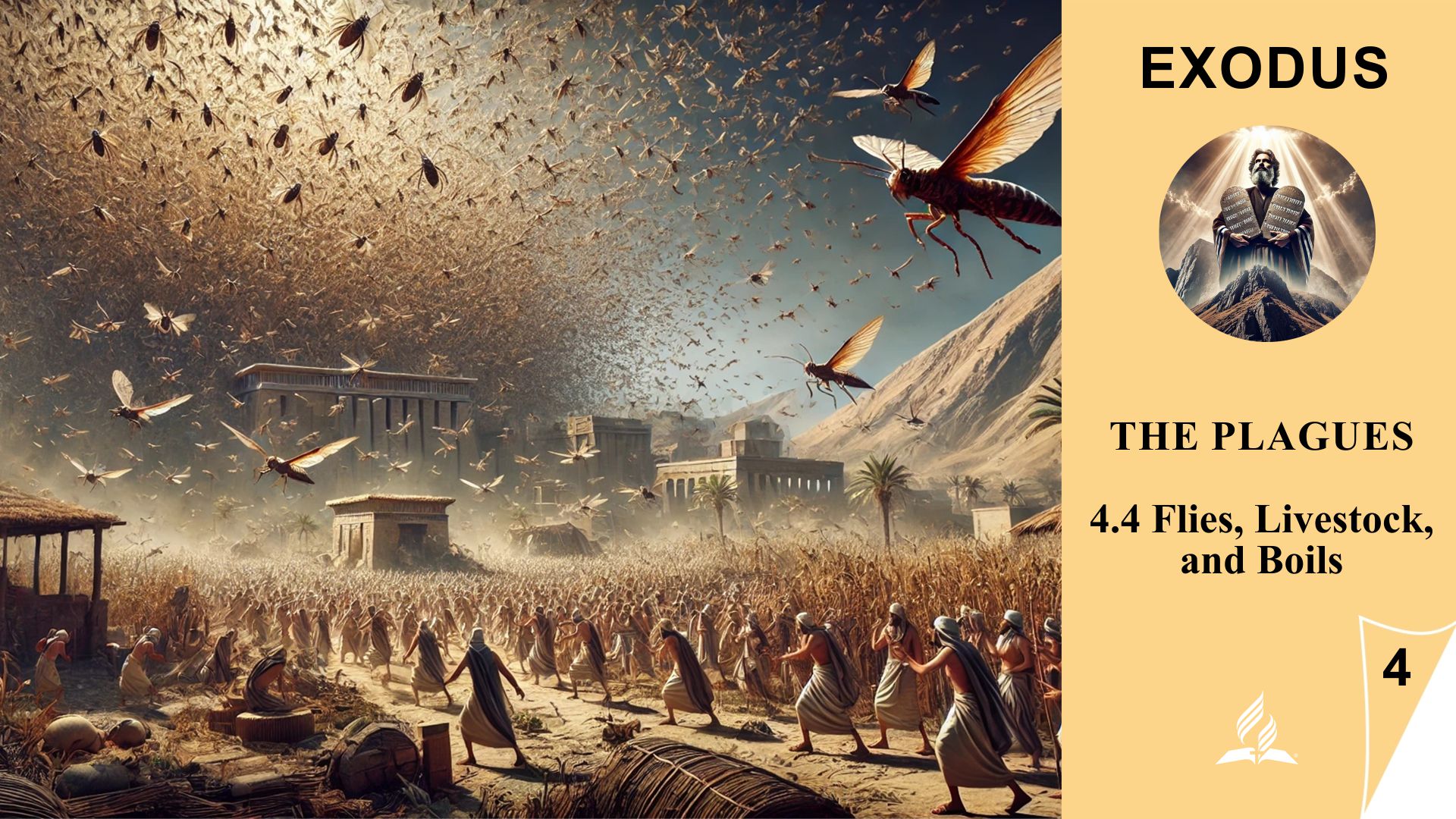
📘 4.4 Flies, Livestock, and Boils
✨ Gods Fall – God Remains
………………………………………………………………….
🟦 Introduction
Opening question: Have you ever received clear guidance about what was right—yet still chosen against it? What happened inside you afterward?
Context note: We stand in the middle of the plague narrative. The first four plagues have shaken the daily life of Egypt. Starting with the fourth plague (flies), a clear distinction emerges between Egypt and Goshen: God can judge precisely and protect His own. Next come Plague 5 (livestock disease) and Plague 6 (boils)—attacks on Egypt’s economy, health, and religious symbols.
Key question: How does a person—or a society—react when their assurances (gods, systems, identities) visibly fail? What does that do to the heart?
………………………………………………………………….
📖 Bible Study
Read Exodus 8:20–9:12. Note your observations in the text.
1. Observations on the passage
- Call and warning: Moses is to confront Pharaoh at dawn (8:20). God initiates; His judgment is not arbitrary but proclaimed.
- Plague of flies (or mixed swarms): Massive disruption of daily life; Goshen is spared (8:22–23).
- God’s aim: To make clear His presence as Lord “in the land” (8:18; cf. 8:22–23).
- Pharaoh’s negotiation: Worship permitted—only within Egypt (8:25). Partial obedience instead of surrender.
- Cultural offense: Hebrew sacrifices in Egypt would defile Egyptian worship (8:26)—clash of worldviews.
- Temporary relief & renewed hardening: Pharaoh pleads; plague eases; his heart hardens again (8:28–32).
- Plague 5—livestock disease (9:1–7): Strikes only Egyptian herds; Israel’s animals remain healthy; diminishes cattle-backed deities.
- Plague 6—boils (9:8–12): Ash from the furnace → scorching dust → painful sores on humans and animals; even the Egyptian magicians are incapacitated; God hardens Pharaoh’s heart (9:12).
2. Historical-religious background (Brief profiles of Egyptian deities)
These summaries provide context; local variations existed in ancient Egyptian religion.
- Wadjet (Uatchit): Protective cobra-goddess, sometimes linked to marsh insects.
- Khepri: Scarab-god of dawn, creation, and rebirth.
- Hathor: Cow-goddess of love, joy, femininity, and protection.
- Apis: Sacred bull of Memphis, symbol of strength, fertility, and royal power.
- Isis: Goddess of magic, motherhood, and healing.
- Sekhmet: Lioness-goddess of war and plague protection.
- Imhotep (deified): Architect and healer, later worshiped as a god of medicine.
The plagues strike domains these gods once protected—environment, livestock, and health—revealing Yahweh as sovereign Creator over all.
3. Literary dynamics: escalation and distinction
- The plagues grow in severity and precision.
- God draws lines: judgment on Egypt, preservation of Israel → His sovereignty and covenant love are revealed.
- Pharaoh offers tactical compromises rather than genuine repentance.
4.Commentary on Plagues 4–6 (Deepening)
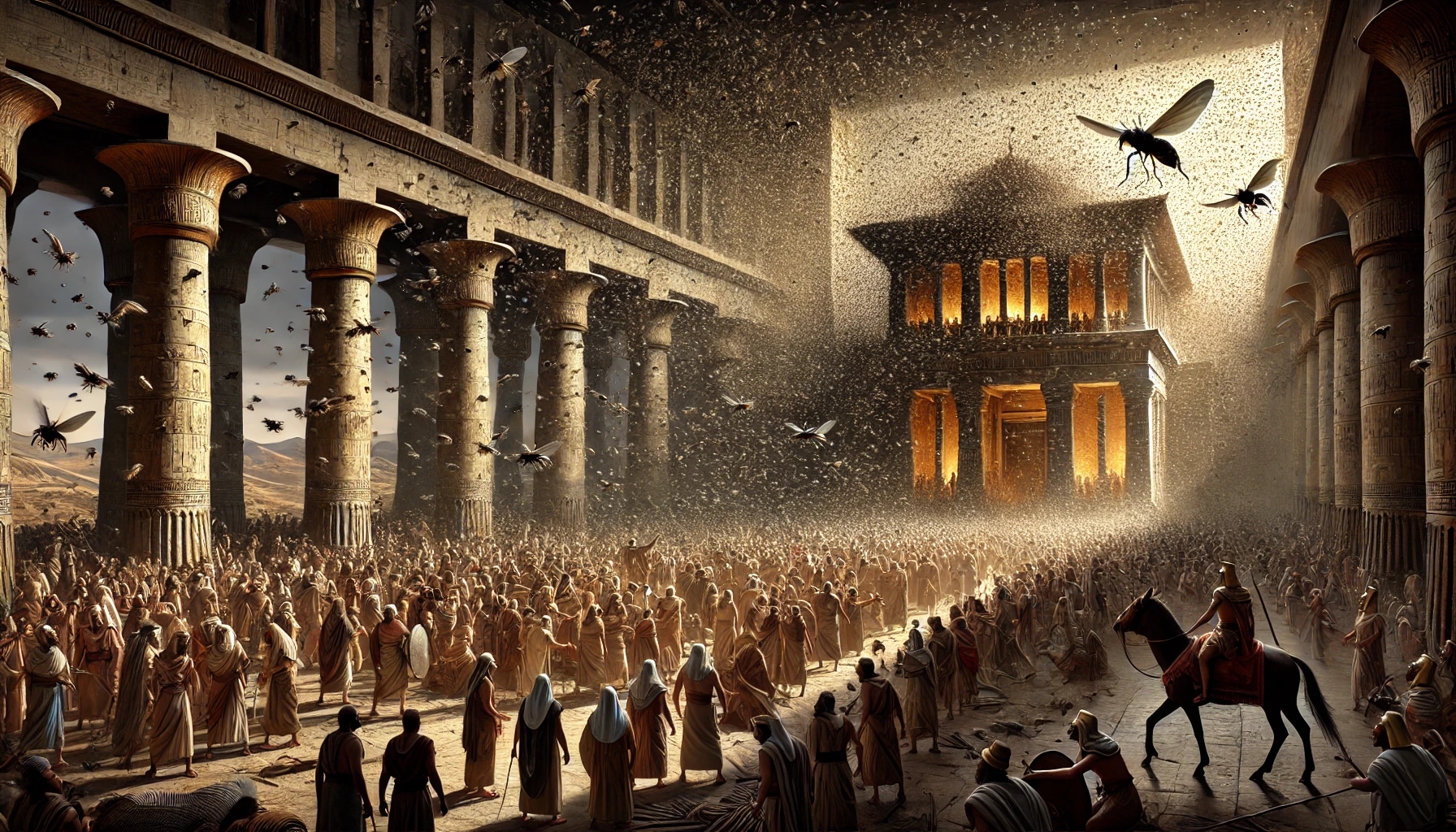
Plague 4 – Flies/Insects (Exodus 8:20–32)
- Core observation: God distinguishes between Egypt and Goshen; His power is targeted, not indiscriminate.
- Toppled “gods”: Wadjet, Khepri, and other nature-bound powers fail.
- Heart lesson: Pharaoh’s partial obedience (“offer sacrifices in the land”) tries to limit God’s authority.
- Today: Selective crises reveal our true trust. Security without obedience is fragile; God’s presence demands full devotion.
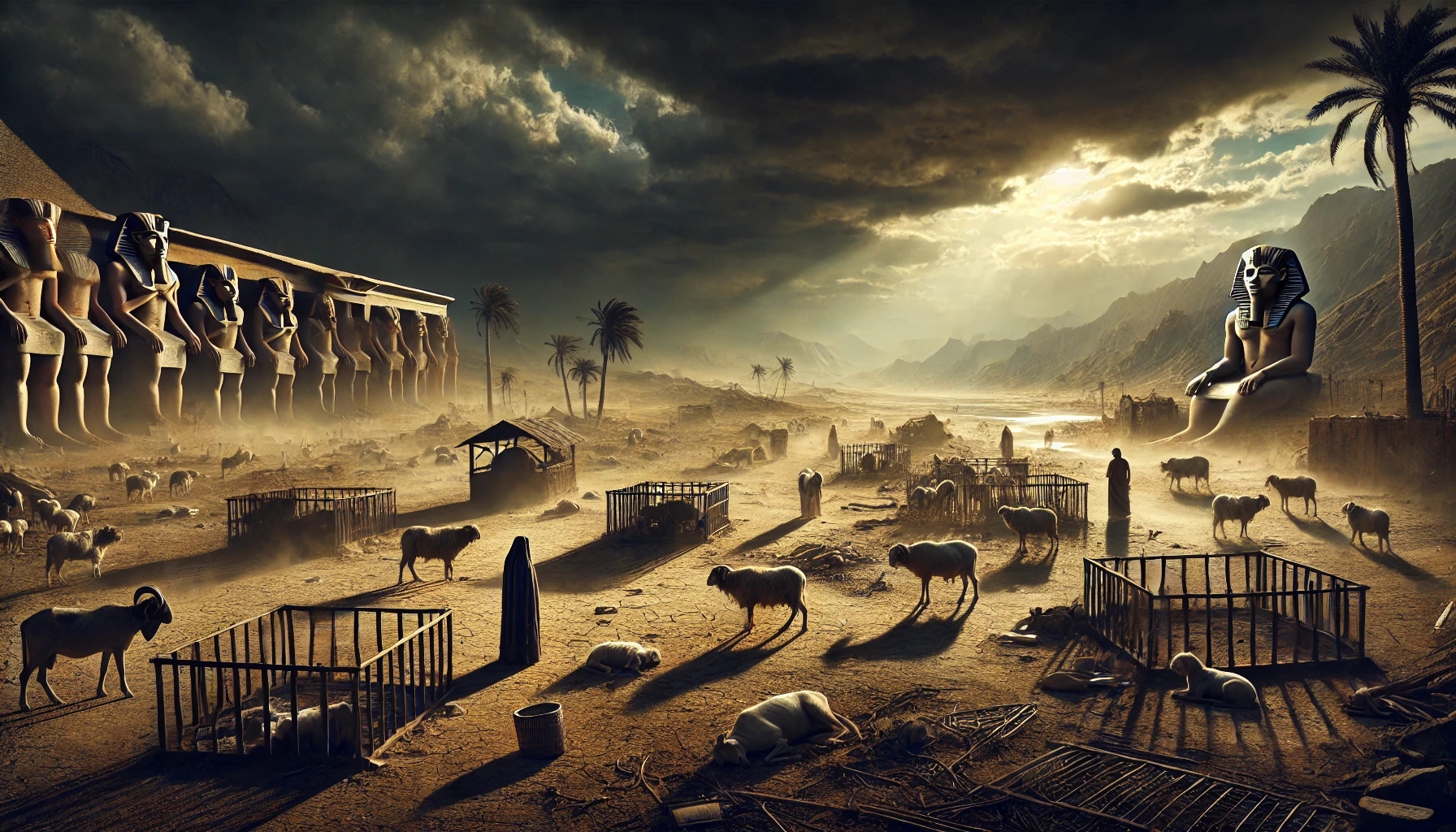
Plague 5 – Livestock Disease (Exodus 9:1–7)
- Core observation: Egypt’s economic backbone collapses; Israel’s herds are unaffected.
- Toppled “gods”: Hathor and Apis—symbols of fertility, protection, and strength—prove powerless.
- Heart lesson: Wealth and status are fleeting; identity cannot rest on flocks, finances, or achievements.
- Today: When markets, supply chains, or careers wobble, we’re called to see possessions as entrusted by God, not idols.
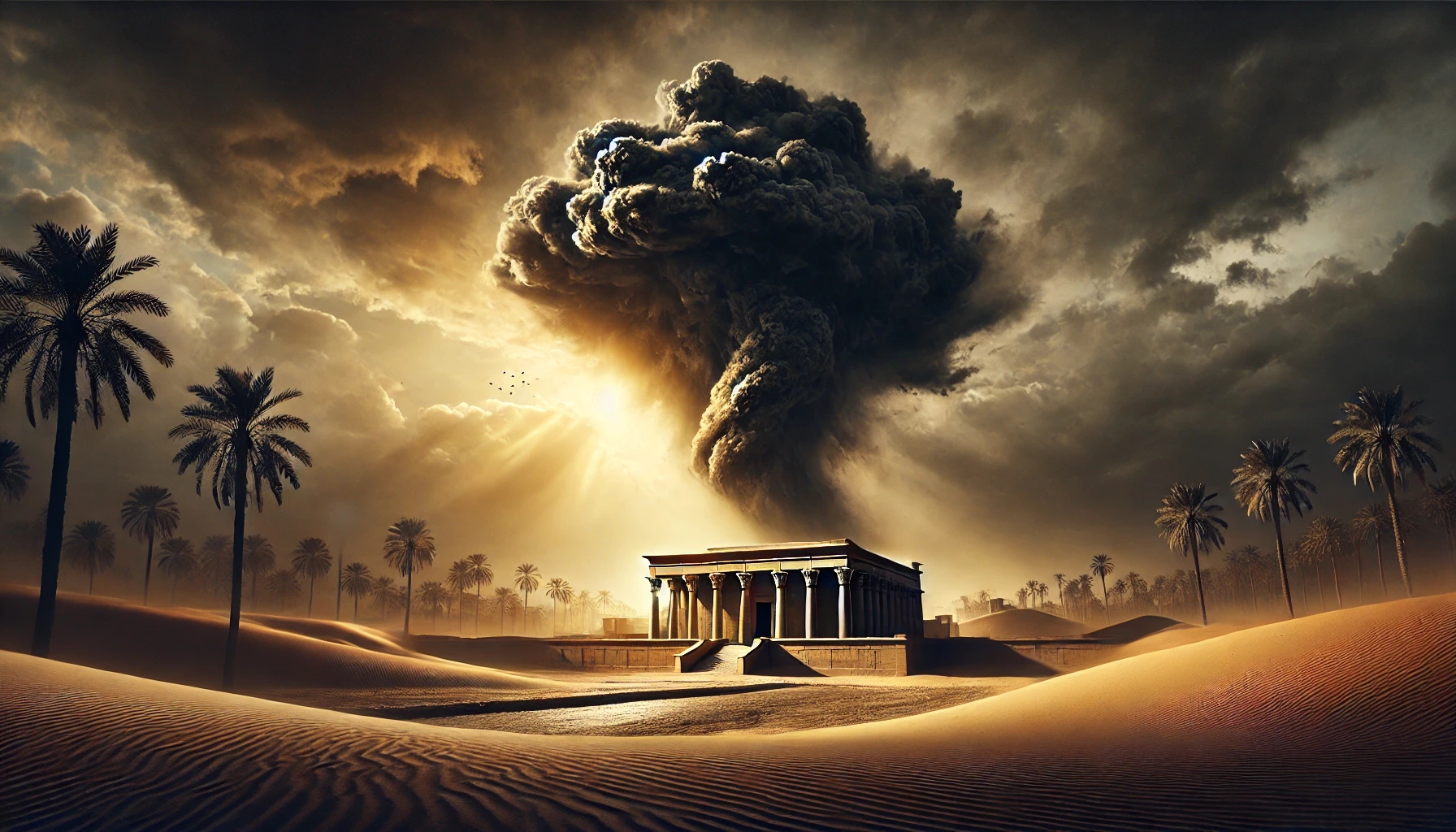
Plague 6 – Boils (Exodus 9:8–12)
- Core observation: Suffering strikes the body directly; even royal magicians are disabled.
- Toppled “gods”: Isis, Sekhmet, and Imhotep—patrons of medicine and magic—fail before the Creator.
- Heart lesson: Pain can open hearts—or harden them if pride wins. Hardening deepens suffering.
- Today: Illness reminds us of our limits. Let us offer our pain to God’s healing presence, compassion, and call to repentance.
Group impulse: Which of these three plagues most resonates with your current situation—environmental crisis (plague 4), economic pressure (plague 5), or physical/psychological strain (plague 6)? Share if you feel led.
………………………………………………………………….
📖 Answers to the Questions
📌 Question 1: Read Exodus 8:20–9:12. No matter how great God’s power and glory become evident, humanity remains free to reject them. What does this account teach us?
- Revelation doesn’t force faith: Signs create accountability, not automatic belief. Pharaoh saw and acknowledged briefly, yet remained untransformed.
- God honors human will: Repeated warnings and opportunities to respond—even in opposition.
- Rejection has consequences: The plagues intensify, suffering increases, societal structures unravel. Hard hearts bring tangible ruin.
- Distinction of God’s people: God can judge while preserving His own. Their protection underscores the accountability of those who persist in unbelief.
- Divine hardening as judgment: “The LORD hardened…” shows God allowing Pharaoh’s chosen path to the fullest.
- Half-hearted compromises fail: Pharaoh’s offer to worship “in the land” tries to confine God; true faith submits to God’s terms.
Summary formula: Greater revelation → greater responsibility; God doesn’t coerce; rejection hardens the heart.
📌 Question 2: Pharaoh’s problem wasn’t intellectual—he had plenty of evidence. Instead, it was a matter of the heart. What does that tell us about why we must guard our hearts?
- The heart directs our choices, not just the mind. Pharaoh had data, not devotion.
- Repeated compromises harden the heart: Each “later” adds another layer of resistance.
- False security deceives: Power, culture, religion, or science can become modern “gods.”
- Spiritual sensitivity is fragile: Bitterness, pride, fear, or comfort dull conscience.
- Guarding the heart requires active care: Daily devotion, honest self-examination, community, repentance, and forgiveness.
- Act now: “Do not harden your hearts” (cf. Heb. 3)—delay is the enemy of openness.
Practical exercise: Invite everyone to name (silently) one situation where they sense God’s prompting yet are postponing. Then, in small groups, share and pray for each other.
………………………………………………………………….
✨ Spiritual Principles
- God is present—even in the crises of our world.
- God distinguishes—judgment and protection can occur simultaneously.
- God’s signs demand a decision; neutrality is only temporary.
- Idols are exposed when life is built on them and they fail.
- Hard hearts develop gradually through repeated resistance.
- God permits what we steadfastly choose—to instruct or to judge.
………………………………………………………………….
🧩 Application for Daily Life
- Identify your modern “gods.”
List silently three things you depend on: career? healthcare? financial stability? social-media affirmation?
Ask: What happens to your faith if one crumbles? - Prayer of surrender.
Pray in two sentences: “Lord, You are in the midst of my life. I give You [X]. Break every hardness in me that resists You.” - Heart-check rhythm.
- Daily: Brief evening reflection—Where did I hear God today? Did I open or close my heart?
- Weekly: Sabbath as a “softener”—step off productivity tracks; celebrate God’s presence.
- Quarterly: Silent retreat or day of reflection for a heart inventory.
- Dealing with recurring resistance.
If you notice the same block rising repeatedly:
a. Name the issue.
b. Ask two trusted friends to pray and hold you accountable.
c. Take one concrete step of obedience (e.g., reconciliation call, generosity act, spiritual practice).
………………………………………………………………….
✅ Conclusion
The plagues reveal God as an involved, present Lord. He judges, preserves, and calls for a response. Pharaoh’s example shows that intellectual assent without heartfelt devotion leads to ruin. Our calling is to guard our hearts, obey God today, and release false securities.
………………………………………………………………….
💭 Thought of the Day
“A soft heart recognizes God’s presence; a hardened heart explains it away.”
………………………………………………………………….
✍️ Illustration – “The City That Buzzed” (Fictional Narrative)
1.Monday Morning in New Cairo West
The air over New Cairo West shimmered—not from heat, which was normal, but from an unusual buzzing drifting from the reclaimed wetlands beyond the ring road. Dr. Layla Mansour, an entomologist with the National Environmental Agency, leaned over her drone-monitoring station atop a research container. “Impossible,” she murmured. Her data revealed an insect swarm of unprecedented density—yet always just outside urban limits. Now millions of tiny fly-like creatures poured into densely populated districts.
2.The Call
Before Layla could descend, her tablet buzzed. Bishop Daniel El-Aziz, leader of a small but growing Sabbath fellowship on the Nile, requested a meeting. “Our members in Goshen Project—you know the old agro-settlement?—report hardly any infestation. Something’s off. You should see it.” Layla laughed. “Goshen? Like the Bible? Very funny.” Daniel remained solemn.
3.The Swarm
Within 48 hours, parts of the city ground to a halt. Restaurants closed; hospitals reported allergy spikes; the international airport suspended flights. News outlets ran headlines: “The City That Buzzed.” Conspiracy theories exploded—bioweapon? climate anomaly? secret experiment? The stock market dipped.
4.Goshen Project
Reluctantly, Layla drove out. The agro-settlement, home to many Sabbath believers, lay 30 km away. Crossing its perimeter, her sensors dropped to zero—no insects. Even more puzzling, the irrigation ponds remained clear, though conditions matched the city’s. Residents said they’d prayed daily for protection. Layla logged: “Anomaly—further analysis required.”
5.Political Negotiations
The government, under pressure, convened an emergency council. As scientific advisor, Layla recommended controlled evacuation zones, bio-traps, and—hesitantly—temporary suspension of mass gatherings. The interior minister waved her off: “We won’t bow to some bugs.” Instead, he ordered all worship centralized within state-controlled halls. Bishop Daniel protested: “Our rituals involve animal sacrifices—that won’t fly in the city.” Officials compromised on a review committee. Privately, the minister told Layla: “Science will solve this.”
6.Livestock Crisis
Two weeks later, large-scale farms reported mysterious lesions and fevers in cattle and goats. Vets diagnosed either foot-and-mouth or a novel viral strain. Yet in Goshen Project, animals remained healthy. Procedures? Identical vaccines and feed—except Goshen opted out of mandated antibiotics, practicing stricter quarantine and purity rituals. Layla began to wonder if biology alone explained everything.
7.The Third Blow: Boils
While the nation battled livestock disease, city residents suffered painful skin eruptions—an inflammatory syndrome. Clinics overflowed. Even Dr. Hussein, Layla’s media-savvy colleague, fell ill. Journalists dubbed it “the Fire Dust,” after satellite images showed a cement plant’s ash cloud passing overhead. Coincidence?
8.Layla’s Turning Point
Exhausted, Layla returned to Goshen. In a barn, she found Daniel with children singing hymns. He laid an open Bible before her: Exodus 8–9. “I’m not asking you to stop researching,” he said, “but ask yourself: if your model explains everything, why are there still gaps?” Logical to her core, Layla felt a crack in her intellectual armor.
9.The Unyielding Minister
The interior minister refused to lift restrictions or allow field gatherings. Prayer was permitted—only under surveillance. International partners threatened sanctions over zoonotic risks. Yet the minister blamed “fanatical sects”—namely the Sabbath fellowship—for spreading fear.
10.Science Meets Prayer
Layla set up identical insect traps in Goshen and two infested districts. Meanwhile, Daniel’s community prayed daily for nationwide protection, including the hostile districts. Result: one district’s swarm collapsed dramatically—coinciding with spontaneous clean-up and relief efforts by local mosques, churches, and synagogues. Prayer? cooperation? microclimate? Layla wrote: “Multifactorial. Hypothesis: humility sparks creativity.”
11.The Downfall
At the crisis peak, the interior minister fell ill. Bandaged and bedridden, he publicly vowed to allow “temporary outdoor worship zones” once conditions improved. But upon recovery, he rescinded the offer. Public trust plummeted. Layla heard Daniel say: “See? Knowledge without response only hardens.”
12.Decision
Late one night in her lab, between samples and satellite maps, Layla remembered her grandmother’s prayers from childhood. Science was her calling—not against God, but to understand creation. Yet she realized: knowledge is a tool; trust is a posture. Placing her hand on the open Exodus pages, she whispered, “If You are in the land, You’re in my lab. Show me where I’ve hardened.”
13.Epilogue
The crises eased gradually—through environmental measures, improved veterinary protocols, and a nationwide solidarity movement of prayer and service that transcended religious divides. Years later, Layla recounted “The City That Buzzed” to students, teaching that data sheds light, but only a soft heart sees the Light.
Moral: Modern societies rarely worship cattle statues, but we trust markets, technology, and health systems. When they fail, God again calls: “Recognize that I am in your midst.” Our response determines whether our hearts soften or harden.
Discussion prompts:
- Which modern equivalents of Egyptian gods appear in this story?
- Where do you see parallels in your own community or city?
- What role can collective prayer play in societal crises?
- How does scientific explanation differ from spiritual interpretation—and must they conflict?
