




⛪ Lesson 13: IMAGES OF THE END
📘 13.2 A Work of Repentance
✨ Repentance Changes the Outcome – Even in the End Times
………………………………………………………………….
🟦 Introduction
The city of Nineveh—infamous for cruelty, idolatry, and moral decay—was the symbol of a world seemingly abandoned to itself. But God had not forgotten it. He sent Jonah with a serious, seemingly final message:
“Forty more days—and Nineveh will be destroyed.”
No call to repentance, no grace period. Just the judgment.
And yet the unexpected happened: The city repented. Against all odds, judgment turned into mercy. This story raises a profound question: How does God deal with sinners—then and now? And what does Nineveh say about our future in the end times?
………………………………………………………………….
📖 Bible Study – A Work of Repentance – Jonah 3:5–10
🔹 Context and Background
Jonah was a prophet with an unusual mission: not to Israel or Judah, but to Nineveh, capital of the Assyrian empire—known for its brutality, idolatry, and oppression. What was astonishing was not only the location but the brevity and bluntness of his message:
“Forty more days, and Nineveh will be destroyed.” (Jonah 3:4)
No invitation to change, no hint of grace—just judgment. A warning without conditions. But God had more in mind.
🔹 The City’s Reaction
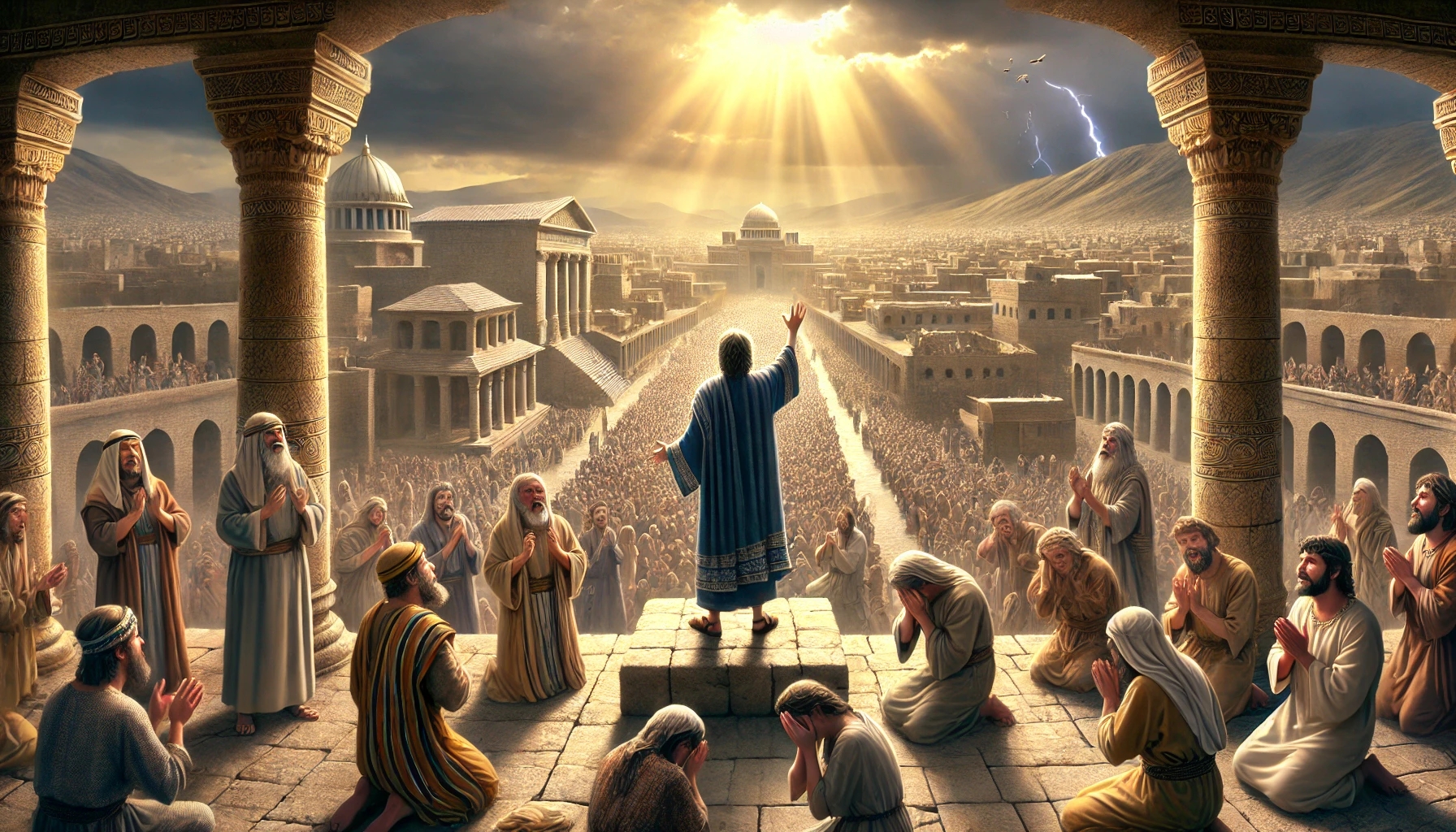
The people of Nineveh could have mocked him. They could have driven Jonah away or ignored him. But something unexpected happened: they believed the message.
Not because Jonah was charismatic—but because God’s Spirit touched their hearts.
From the common people to the king himself, the city put on sackcloth and ashes—a symbol of humility and repentance. They fasted, prayed, mourned, and hoped—even though Jonah had offered no hope. Nineveh’s repentance was total, public, and sincere. Even the animals were included—a rare expression of complete remorse in the Bible.
This was the work of the Holy Spirit. The city recognized its guilt—not just before people, but before the living God.
🔹 The Turning of God’s Judgment
And God? He saw. Not just their rituals, but their actions. The text emphasizes:
“When God saw what they did and how they turned from their evil ways, he relented and did not bring on them the destruction he had threatened.” (v.10)
This was not arbitrary. This is God’s very nature: merciful, patient, slow to anger—ready to withdraw even the harshest judgment if true repentance is found.
This reminds us of a deep spiritual principle as described in Jeremiah 18:7–10:
God’s judgment can be averted by repentance.
It is not inevitable if grace is sought. His judgment is never merely punishment—it is an invitation to return.
🔹 The Relevance for Our Time
What we see here is a prophetic image for our world.
The end times are like Nineveh: corrupt, godless, and near judgment. Yet God still has His “Jonahs”—men and women who proclaim the message with clarity, courage, and grace: “Repent!”
Even today, the message isn’t always accompanied by hope. But God’s goal is the same:
He wants to save, not destroy.
The message of Revelation 14—God’s final call to humanity—is both a warning and an invitation.
And just like in Nineveh, there are people today who will listen. Who will change their lives. Who will come out of Babylon to follow the Lamb wherever He goes (Rev 14:4).
🔹 The Depth of True Repentance
Jonah 3 shows that repentance is more than regret—it is a concrete turnaround.
The king of Nineveh calls for real change:
“…Let everyone turn from his evil way and from the violence in his hands.” (v.8)
God looks for action—not just emotion.
Tears without change mean nothing. But every decision to turn around, no matter how small, is a step toward life.
This repentance saved the city—temporarily. Because as history shows, Nineveh returned to sin years later—and was destroyed. Repentance must be lasting, not momentary.
God gives grace—but it must be nurtured.
🔹 God’s Attitude: Merciful and Just
Some see this story as a sign of a “changeable God” who changes His mind. But the opposite is true. God is consistent—in His character, His justice, and His mercy.
He announces judgment to call people back.
He grants grace where there is repentance.
That’s not change—it’s faithfulness to His nature. God remains true—to love and to truth.
………………………………………………………………….
📖 Answers to the Questions
📌 Question: Why was the prophecy not fulfilled?
The answer lies in the power of true repentance. When Jonah preached, the people did not respond with mockery or indifference—but with fasting, repentance, and a radical change. From the king to the lowest citizen, public remorse was shown. In verse 10 we read:
“When God saw what they did and how they turned from their evil ways, he relented…”
God’s judgment was not mechanical. It was morally based—dependent on response. His love longed for repentance, not destruction.
📌 Question: Can we expect something similar in the end times?
Yes—and no.
Yes: The end-time message, as described in Revelation 14 and 18, is a global call to repentance. People all over the world hear God’s call:
“Come out of her, my people…” (Rev. 18:4)
Many will respond. They will worship God, keep His commandments, and hold fast to Jesus—just as the people of Nineveh once did.
No: Not every end-time prophecy is conditional. Some events—like the coming of Jesus, the plagues, the mark of the beast—are unavoidable. They will happen whether or not people repent. But: Each individual still chooses which side they will be on.
………………………………………………………………….
✨ Spiritual Principles
-
God delights in repentance more than punishment.
→ Mercy triumphs over judgment (James 2:13) -
Prophetic warnings are calls to return.
→ They are meant to save, not condemn. -
God looks at actions that arise from genuine repentance.
→ It’s not just about emotion—but about decision and transformation. -
Delay in judgment is not weakness—it’s grace.
→ “The Lord is not slow… but is patient with you.” (2 Peter 3:9) -
Even pagans can hear God’s call and follow Him.
→ God’s people are not limited by geography or religion.
………………………………………………………………….
🧩 Application for Daily Life
-
Speak the truth—even when it’s uncomfortable. Jonah wasn’t popular, but he was obedient. Are you willing to share God’s message even if it provokes?
-
Don’t underestimate the power of repentance. If God forgave Nineveh, how much more will He forgive you when you truly turn back?
-
Repentance begins with you. Don’t wait for others. Nineveh’s king didn’t wait for the Assyrian army—he humbled himself first.
-
Don’t take time for granted. Today is the day of grace. Tomorrow could be too late.
………………………………………………………………….
✅ Conclusion
Nineveh was destined for destruction. It was declared. But a people who sincerely recognized their guilt experienced God’s mercy. This lesson remains forever:
God is not against us—He is for us.
But only if we don’t turn our backs on Him.
His warnings are not the end—they are a door to salvation. The story of Nineveh is not a myth.
It is a call to us. Now.
………………………………………………………………….
💭 Thought of the Day
“God doesn’t change His mind—but He acts differently when we change.”
– Inspired by Jeremiah 18:7–10
………………………………………………………………….
✍️ Illustration – “A City Listens”
Berlin was as loud as ever. People rushed through stations, screens flickered in shop windows, and cafés buzzed with talk about stocks, doctor’s appointments, and algorithms. It was an ordinary Tuesday morning. And yet something was different—something invisible but felt.
At the edge of Alexanderplatz stood a young woman holding a cardboard sign. No political slogan. No climate appeal. Just handwritten words:
“Forty more days—then Berlin will be shaken.”
People walked by. Some laughed. Others shook their heads. A few took selfies with her and posted them with the hashtag #ApocalypseWithLatte.
But she stayed. Day after day.
Her name was Lea.
Lea wasn’t a prophet. Not a theologian. She had studied literature and worked in an archive. There, among faded letters and forgotten diaries, she suddenly “woke up”—not physically, but inwardly. One night, it felt like her heart lit up like a bulb—and she didn’t know why. She heard no voice. But there was a pull, a knowing: “Say it.”
At first, she thought she’d gone mad. Who stands in a city of millions with a message that sounds like a threat? But the more she resisted, the more restless she became. So she stood. Every morning. Silent. Just the sign.
After a week, reporters came. After two weeks, strangers started talking to her. Not about destruction—but about life.
A middle-aged banker cried as he said he hadn’t spent a single day with his kids in seven years.
A student confessed she felt empty in her relationships—everything was loud, but nothing was real.
An old man asked her: “What must I do?”
Lea didn’t say much. She listened. Sometimes she quietly read from the Bible. Jonah 3 became her go-to passage, even though she never preached. She wasn’t about fear. She was about truth. About repentance. About waking up before the crash.
After 30 days, the movement had grown. Not through noise, but through effect. People began to fast—voluntarily. They came after work, sat quietly on the plaza floor, prayed aloud or silently. They asked each other for forgiveness. An elderly woman brought a sign: “I forgive my son. After 16 years.”
The media mocked, some warned—but the city began to change. Not mass conversions, no signs in the sky. But something happened: A part of Berlin repented. Quietly. Genuinely. Radically.
On the 40th day, it rained. Lea was soaked, her sign falling apart. But she stood. Next to her, a man held a new sign:
“I was deaf. Now I hear.”
That night, nothing happened.
No fire fell from the sky. No earthquake. No lightning.
Just silence. A strange, deep silence over the city. And many felt: God had waited. Acted. Shown mercy.
Three years later, in a public talk, Lea said:
“The true shaking wasn’t in the streets. It was in the hearts.”
