⛪ Lesson 1: Oppression: The Background and the Birth of Moses
📘 1.7 Questions
………………………………………………………………….
🟦 Introduction: When Blessing Becomes Trial
Why does God allow people to suffer? Why does He sometimes intervene so late—so seemingly too late? And how does it fit into God’s plan that a man marked by violence, anger, and guilt—like Moses—becomes the deliverer? These questions are not only theological challenges but also deeply existential, human tensions.
God doesn’t always act according to our timetable—but He does act. This devotion will take you on a journey through ancient biblical truths and a modern story that makes those same principles tangible.
………………………………………………………………….
📖 Answers to the Questions
📌 Question 1: Why did the Hebrews live in Egypt and suffer for so long?
God permitted the descendants of Jacob to live in Egypt because it was part of a larger salvation plan. Originally they came as guests (cf. Genesis 45–46), provided for and preserved during famine. But over time the political situation changed—the memory of Joseph faded, and guests became slaves.
God had already foretold in Genesis 15:13 that Abraham’s offspring would be oppressed for 400 years in a foreign land. This was not a failure on God’s part but part of a grand timetable—including the “full measure of the iniquity” of the Canaanites, whose land Israel would later inherit (Genesis 15:16).
Why did it last so long?
Each individual suffered only as long as he lived. But the nation learned, across those generations, patience, dependence, hope, faithfulness, and how desperately they needed a deliverer.
This distinction—between individual suffering and collective time—is crucial. It helps us understand that God works both with us as individuals and with us as part of a greater story. In God’s eyes, each human life is precious—but He never loses sight of the overarching plan of redemption.
📌 Question 2: How did God use Moses’ impulsive act?
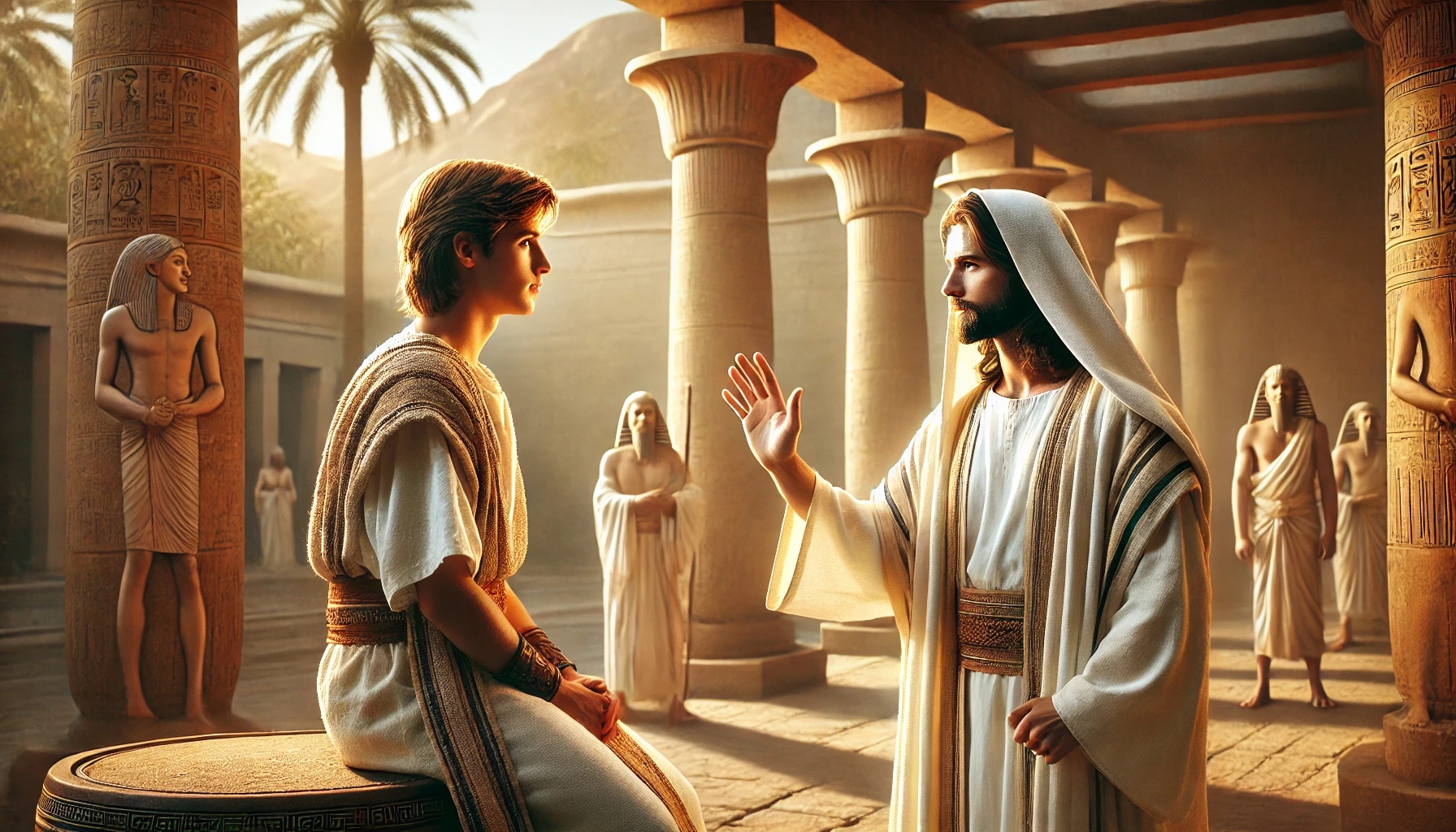
Moses was forty years old when he killed the Egyptian. From a human standpoint it was a mistake—indeed, a sin: murder. Yet God used that hasty deed to set Moses on the path that would ultimately lead him into the wilderness. There—in secret—he was shaped, humbled, and prepared for his true calling.
Would God’s plan have failed if Moses hadn’t done it? No. God never depends on human failure, but He is never surprised by it. He can incorporate detours—and use them for His purposes.
God does not exploit our sin—but He can transform its consequences into grace, if we open ourselves to Him.
Moses was not used in spite of his past, but through it. His flight marked the beginning of his calling. The wilderness became his seminary. And his failure humbled him enough to become God’s instrument.
………………………………………………………………….
✨ Spiritual Principles
-
God’s timing is not our timing—but it is perfect.
-
God allows suffering not to break us, but to shape us.
-
Hidden years are not wasted years.
-
Our guilt can become the starting point of God’s story of grace.
………………………………………………………………….
🧩 Application for Daily Life
-
If you are suffering: Don’t only ask “Why, God?” but also “What are You teaching me?”
-
If you are waiting: Remember that Moses spent forty years in the wilderness before God called him again.
-
If you have failed: Your failure is not the end. It can be the beginning of your calling.
-
If you grow impatient: Know that God works even in long processes—among nations and in hearts.
………………………………………………………………….
✅ Conclusion
God’s plans span generations, yet He sees your heart today. If you are enduring suffering, don’t forget: God has not forgotten you. And if you look back like Moses on something you regret—hear this: It’s not over yet. Perhaps God is just beginning something new right now.
………………………………………………………………….
💭 Thought of the Day
God is patient—with nations, with life stories, with you.
Don’t confuse God’s silence with His absence.
He may be shaping you—perhaps through what you most want to avoid.
………………………………………………………………….
✍️ Illustration: “Waiting Behind Glass”
Jan-David sat motionless in his one-room apartment in Berlin-Neukölln. Rain drummed against the windowpane like a metronome for his inner turmoil. His heart pounded; his hands still shook. On his sweater was a dark stain—dried blood.
He had struck someone.
Not just anyone—an assailant who, on the street, had attacked a refugee youth. Jan had seen it happen, intervened, shouted, shoved, and struck. A reflex. Anger. A kind of justice born raw and explosive.
The boy escaped. The man fell, bleeding from a gash above his eye.
Now? Charges. Police. He faced pretrial detention.
Jan was thirty-two, a social worker at a youth center. Committed. Well-liked. Yet deep down—angry. Always.
He had carried questions for years: Why had his father abandoned them? Why had God taken his mother so early? Why was justice always so slow, so distant?
Now he stood on the brink. Fired. Publicly shamed. Suspended. And inside—empty.
Part 2: The Wilderness
A friend—an ex-colleague—offered him a refuge in southern Germany. A small house at the edge of a forest, far from the city. It was the first time in years Jan had no appointments to keep, no groups to lead, no meetings to attend.
Just trees. Mist. Silence.
There he began to keep a journal—and to pray. At first in fragments. Tentatively. Then more openly, more honestly.
“Why have You brought me here, God? Am I not burned up?”
In an old bookshelf he found a tattered Bible. The cover was torn, but opened—by chance—it lay open to Exodus 2.
“And Moses fled from Pharaoh and lived in the land of Midian.”
He read on of Moses, the prince turned murderer, who fled and spent forty years tending sheep. Forgotten. Lost. And there encountered God—in the burning bush.
Jan closed the Bible.
A thought struck him like an arrow:
“Even if you have failed—God has not written you off.”
Part 3: The Call
Two years later.
Jan lived again in Berlin—but no longer as a social worker. He now served in a “ZwischenRaum” project: a Christian center for men who had fallen through life because of violence or drugs. He was not the leader, not the rescuer—but a listener. A companion.
Once a young man, Bilal, sat before him with folded arms.
“I messed up, okay? I’m done. People like me don’t get a second chance.”
Jan nodded slowly.
“You know who Moses was? A man who killed—and God still used him.”
Bilal looked up, visibly moved for the first time.
“You mean God still sees me?”
Jan smiled.
“Not in spite of it. Because of it. Because you know how dark it can get.”
Epilogue: Afterglow
On a cold autumn morning, Jan sat again by a window. Rain traced lines down the glass.
This time he did not fear the silence.
He thought of his old life—the moment of violence, the loneliness of the wilderness, the still, small voice of God whispering through broken panes.
“I have seen you. I have heard your cry. And I am sending you.”
Not with power. Not with fame. But with wounds that have become bridges.