



🗺️ LESSONS OF FAITH FROM JOSHUA
⛪ Lesson 11 : Living in the Land
📘 11.2 Accusations…
✨ Quick judgment – The danger of misunderstanding
🟦 Introduction
One altar, two perspectives – and a nearly deadly misunderstanding. In Joshua 22, a conflict suddenly arises that threatens to tear the people of Israel apart. The nine and a half western tribes feel betrayed because the eastern tribes have built an altar. The accusation: apostasy. But the truth goes deeper – and it challenges us today in how we deal with hasty judgments, suspicion, and interpersonal tensions.
…………………………….. 🗺️ ……………………………..
📖 Bible Study – Joshua 22:9–20
📖 1. Historical Context and Structure
After years of military service, the two and a half tribes (Reuben, Gad, half-tribe of Manasseh) are dismissed by Joshua with blessing and rich gifts to their inheritance east of the Jordan. They have done their part in the conquest of the Promised Land (see Joshua 22:1–8).
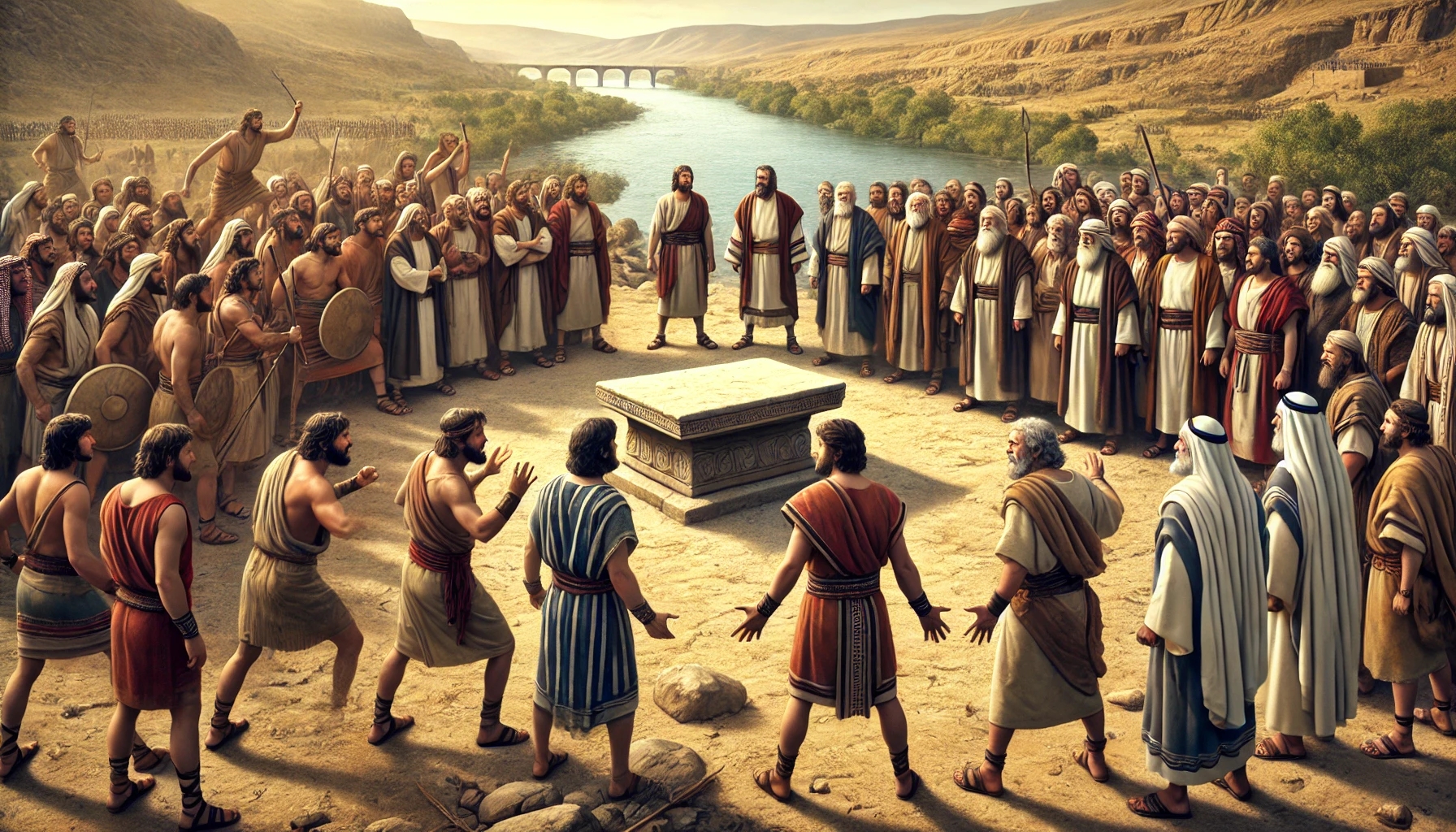
But on their way back, they build a large altar on the bank of the Jordan – right in the border region between east and west Israel. The western tribes interpret this as breaking the covenant with Yahweh, since according to Deuteronomy 12:13–14 sacrifices may only be made at the place God has chosen. A “second altar” could be understood as establishing their own cult – a dangerous split.
🧭 2. Linguistic Clues to Distance
The authors emphasize the growing distance through word choice:
-
The eastern tribes are no longer called by their tribal names, but as “sons of Reuben … Gad … Manasseh” – a designation that anonymizes and distances.
-
The western tribes call themselves “the whole assembly of Israel” (v.12) – a linguistic exclusion.
Interpretation: The wording reflects the perception: the eastern tribes suddenly appear different, foreign, no longer fully belonging.
🔥 3. Content of the Accusations
The western tribes are so shaken that they are ready to go to war against their own brothers (v.12). They compare the situation to two horrible historical events:
-
Achan (Joshua 7): One man who broke God’s command – and brought danger upon the whole people.
-
Baal Peor (Numbers 25): A collective apostasy of Israel through mingling with Moabite pagan practices, which cost thousands of lives.
Core accusation (vv.16–20):
“Why are you acting unfaithfully against the LORD today?”
It is not only about the altar itself – it is about the heart: Is it still faithful to God? Or is dangerous rebellion beginning here?
🧠 4. Spiritual and Psychological Dynamics
This passage offers a strong example of a typical human dynamic – even in our churches today:
-
Observation ➝ Interpretation ➝ Reaction
Instead of asking, they interpret. And then act on that interpretation.
The building of the altar is not questioned, but interpreted as apostasy. -
The western tribes act out of genuine concern – they want to stay faithful to God and avoid His judgment. Their motivation is biblical, but their judgment is hasty.
They believed they were fighting for the truth – but they did not know the whole truth.
🧩 5. Comparison with Joshua 4 – “What do these stones mean?”
In Joshua 4, Israel built a stone memorial to remember the miracle at the Jordan.
In Joshua 22, a stone structure is also built – but without explanation.
The sentence from Joshua 4:6 comes to mind:
“What do these stones mean?”
This is the decisive question that is not asked.
-
The western tribes assume a meaning instead of asking for the meaning.
-
This nearly leads to fratricide caused by a misunderstanding.
🧱 6. The Altar – A Symbol That Unites, Not Divides
We learn from the following verses (vv.21–29) that the eastern tribes did not build the altar for sacrifices, but as a memorial of unity: It was to show future generations that they too have a part in the God of Israel – even though they live geographically separated.
What was meant as a sign of faithfulness was perceived as betrayal.
The same altar – two opposite interpretations.
✨ Spiritual Lessons
-
Words and symbols can be understood differently – we should ask before we judge.
-
Good zeal without wisdom can destroy. Even if our intention is right, we need the Holy Spirit to unite truth with grace.
-
The greatest danger to the unity of God’s people is not the external enemy – but mistrust among us.
…………………………….. 🗺️ ……………………………..
🗣️ Answers to the Questions
❓ Question 1: What accusations do the western Jordan tribes bring against the eastern Jordan tribes? To what extent were these justified?
The nine and a half tribes west of the Jordan accuse their brothers of turning away from the LORD and the faith of Israel (Joshua 22:16). The construction of an altar is interpreted as rebellion, unfaithfulness, and apostasy from true worship – possibly even as founding a new, parallel cult.
👉 The accusations in detail:
-
“You have turned away from the LORD” (v.16): They see the altar as a sign that the eastern tribes no longer want to serve God.
-
Reference to Achan (v.20): The hint at Achan emphasizes that even one person’s sin can have large consequences for the whole nation.
-
Reference to Baal Peor (v.17): Here it concerns collective guilt through idolatry and sexual immorality.
Motivation of the accusers: Genuine concern for the covenant community and God’s honor.
Problem: The reaction is based on a rumor, not on verified facts (v.11).
🧠 Were the accusations justified?
Partly yes – but hasty and based on false assumptions:
-
The concern was understandable: Israel’s history is full of examples where small deviations caused great damage.
-
But the facts were unclear: There was no evidence that the altar was intended for sacrifice.
-
The eastern tribes had noble intentions: The altar was meant to be a sign of belonging to Yahweh (vv.26–29).
Conclusion: The concern was spiritually motivated, but the handling was not godly, because the conversation was missing.
❓ Question 2: What are Jesus and Paul referring to when they warn us not to judge others? Why do we so easily draw false conclusions about others’ motives?
📖 Overview of Bible texts:
-
Luke 6:37: “Do not judge, and you will not be judged.”
➤ Jesus is not against discernment, but against condemning, prideful judgment. -
John 7:24: “Do not judge by appearances, but judge with right judgment.”
➤ It’s about not judging based on outward appearance, but with godly wisdom. -
1 Corinthians 4:5: “Do not judge before the appointed time, until the Lord comes, who will bring to light the hidden things.”
➤ Only God knows the motivations of the heart. We see the outside – God sees the inside.
🧠 Why do we often misjudge others?
-
We see behavior – not the heart.
-
We judge by our own standards.
-
Rumors spread faster than truth.
-
Pride makes us quick to judge.
-
We confuse zeal with righteousness.
💡 Spiritual depth in the answers:
-
A listening ear heals more than a quick judgment.
-
God does not expect uncritical tolerance – but mature, Spirit-led discernment.
-
Humility means: I might be wrong.
🙏 Summary of both answers in one sentence:
True faith does not judge hastily, but first seeks conversation and leaves the final judgment of the heart to God.
…………………………….. 🗺️ ……………………………..
✨ Spiritual Principles
-
⚖️ Do not judge before you know the whole truth
-
🕊️ Seek peace first, then clarification
-
🤲 Faithfulness in community is shown especially in conflict
-
🧠 Think well of your brother – until the opposite is proven
-
🙏 Pray before you react
…………………………….. 🗺️ ……………………………..
🛠️ Practical Application
-
In the church: Instead of talking about others – talk with them
-
In the family: Not every behavior is rebellion – often there is fear, pain, or misunderstanding behind it
-
At work: Give colleagues a chance to explain themselves
-
In marriage: Ask instead of assuming
-
In friendships: Trust in the good – and clarify openly when doubts arise
…………………………….. 🗺️ ……………………………..
🧩 Conclusion
Joshua 22 teaches us a timeless lesson: misunderstandings often arise when communication is missing. The worst conflicts do not come from malice, but from unclarified perceptions. True unity needs conversation, understanding, and humility – not hasty judgments.
…………………………….. 🗺️ ……………………………..
💭 Thought of the Day
“A word spoken at the wrong time can destroy – a conversation at the right time can save.”
…………………………….. 🗺️ ……………………………..
✍️ Illustration
“A River Between Us”
A story about distrust, unity, and the healing power of dialogue
Chapter 1 – One Last Evening Together
It was the final evening. For five years, three youth groups from different regions of Germany — North, South, and East — had worked side by side. Together they had built a Christian aid project in Albania: a school, clean water systems, tutoring for children. Through sweat, prayer, and shared experiences, they had become one family.
By the river that separated the North and South properties, a simple but powerful monument had been built in those days: a small altar made of stacked stones — not a place of sacrifice, not fancy, just a symbol. It was meant to remember their shared ministry, a visible sign for future generations:
“Here young people stood together for God’s cause.”
The East group, who lived farthest away, had built the monument on their way home, near the bridge, quietly and without formal announcement. They wanted it to be a surprise — a sign of gratitude and connection.
✦ ─────────────── ✦ ─────────────── ✦
Chapter 2 – The Picture in the Group Chat
The next morning, a photo appeared in the South group’s chat:
“Hey, look at this!
What’s that by the river? Is that an altar? A new symbol? Without us?”
Within hours, comments flooded in:
– “What’s that supposed to mean?”
– “Are they doing their own thing now?”
– “We should have been asked!”
– “This is division, not remembrance.”
– “I thought we were one…”
An older youth leader, Mr. Benz, wrote sharply:
“It starts like this — today a memorial, tomorrow a separate group.”
That same evening, the North and South leaders scheduled an emergency meeting — without inviting the East group.
✦ ─────────────── ✦ ─────────────── ✦
Chapter 3 – The Accusation
The video call with over 30 participants got heated quickly. Emotions boiled over.
“An altar is a strong symbol — and if it’s built without everyone, it’s a sign of separation.”
“Who knows what they’re planning?”
“Once you break unity, you don’t come back.”
No one actually knew why it had been built, but everyone had a strong opinion.
In the end, they agreed to send an official letter to the East group — a warning. Some even suggested ending the partnership.
✦ ─────────────── ✦ ─────────────── ✦
Chapter 4 – The Phone Call
Lara, 23, from the North group, raised her hand softly but firmly:
“Can I… maybe just ask why they built it?”
Several people rolled their eyes.
“Why? The picture speaks for itself!”
“Maybe not,” Lara said quietly.
The next day she called Jonas, the East group leader.
“Hey. It’s about that altar…”
Silence.
“We didn’t want to exclude you,” Jonas said gently.
“It was a memorial. For you. For all of us. For what God has done through us.”
Lara didn’t reply at first — then tears came.
✦ ─────────────── ✦ ─────────────── ✦
Chapter 5 – The Meeting by the River
Two weeks later, all three groups met again — by the river, in front of the monument.
Jonas and his team explained:
“We wanted a place of remembrance — something that would show what united us. The altar isn’t a new chapter without you — it’s a stone of unity.”
Silence.
Then Mr. Benz, the critic from the first meeting, stepped forward.
“I… judged too quickly. Without asking. I’m sorry.”
A young leader from the South group said softly:
“I thought you wanted to get rid of us. But you wanted to honor us.”
People hugged each other. They prayed. They laughed.
The altar was not removed.
It was completed — with a plaque:
“Dedicated to our shared faith —
and to the conversation that healed everything.”
✦ ─────────────── ✦ ─────────────── ✦
Chapter 6 – The Letter
Some things can be said over the phone. Others cannot.
Two days later, Jonas sent an envelope to every group. Inside was a handwritten letter:
“An altar can build walls or bridges.
We wanted to build a bridge.
But a bridge is not real unless we cross it together.”
There was also a photograph: all three leaders — North, South, and East — standing by the altar, one hand on the stones, the other on each other’s shoulders.
In the corner it read:
“Before you doubt — ask.”
Some cried when they read it.
Others sat in silence for a long time.
Everyone understood.
✦ ─────────────── ✦ ─────────────── ✦
Chapter 7 – The Invitation
A few weeks later, Lara made a bold suggestion:
“Why should altars only be memories? Let’s make them meetings.”
On the second Sabbath of every month, the young people started gathering at that place — at the altar, on the border between groups. 🎒🕊️
Sometimes only five came. Other times fifty. It didn’t matter.
It became the place of questions instead of assumptions.
The place of listening instead of reacting.
The place of prayer instead of suspicion.
Slowly, something changed — not in one dramatic moment, but like water smoothing a stone:
Trust returned.
✦ ─────────────── ✦ ─────────────── ✦
💭 Final Thought of the Story
A river will always separate land.
But a conversation can bring hearts together.
“An altar without explanation may look like division —
but with the right conversation, it becomes a sign of unity.”
