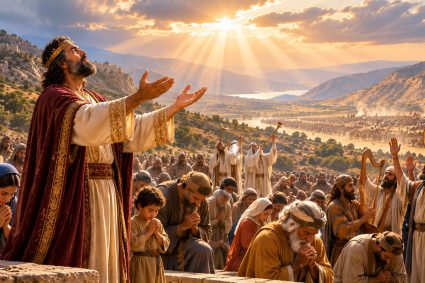
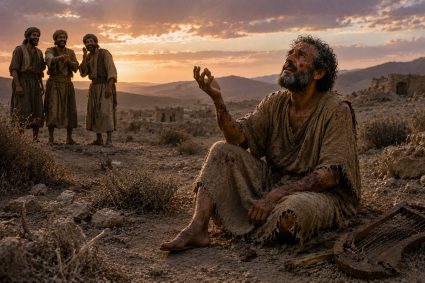
Chapter 22 of 1 Kings brings us to the end of Ahab’s reign. For three years there was peace between Israel and Syria, but this peace was deceptive. Political alliances, false prophets, an uncomfortable truth, and a king in disguise shape this dramatic story. At the same time, we see Jehoshaphat’s rule in Judah and the beginning of Ahaziah’s reign in Israel.
This chapter powerfully shows how God speaks—even when people do not want to hear His voice.
⋯⋯⋯⋯⋯⋯⋯⋯⋯⋯◆⋯⋯⋯⋯⋯⋯⋯⋯⋯⋯
🧵 Commentary
After three years without war, Ahab decides to take back Ramoth in Gilead from the Syrians. Politically, the moment seems favorable. Jehoshaphat, king of Judah, visits him, and Ahab uses the opportunity to form an alliance. Jehoshaphat agrees to fight with him, but he sets one crucial condition: “First, seek the word of the Lord today!”
Ahab then gathers four hundred prophets. With one voice they promise success. Their message sounds convincing, powerful, patriotic. One of them, Zedekiah son of Chenaanah, even supports his prophecy with symbolic iron horns—a dramatic sign of the victory he predicts.
But Jehoshaphat senses that something is missing. He asks for a true prophet of the Lord. Reluctantly, Ahab mentions Micaiah son of Imlah—a man he hates because he never prophesies anything good for him.
On the way, Micaiah is pressured. The messenger urges him to agree with the positive majority. But Micaiah answers firmly: “As surely as the Lord lives, I will speak what the Lord tells me.”
Before the king, Micaiah first speaks with irony in the tone of the other prophets. But when Ahab demands the truth, Micaiah reveals a shocking vision: Israel scattered like sheep without a shepherd—a picture of the king’s death. Then he describes a heavenly scene: God allows a lying spirit to deceive Ahab’s prophets, because Ahab does not truly want to accept the truth anyway.
The reaction is intense. Zedekiah strikes Micaiah on the face. Ahab has him thrown into prison with meager food and water—until Ahab’s supposed peaceful return. But Micaiah remains unwavering: If you return in peace, the Lord has not spoken through me.
The war begins. Ahab tries to escape God’s judgment by disguising himself. Jehoshaphat wears royal robes and becomes the target of the Syrian forces. Only his cry for help saves him.
Then the “random” happens: a soldier draws his bow “at random,” and the arrow strikes Ahab between the pieces of his armor. Wounded, Ahab remains upright in his chariot until evening while blood gathers. At sunset he dies.
His death fulfills the word of the Lord exactly. When the chariot is washed, dogs lick up his blood—just as had been foretold.
Jehoshaphat, however, continues to reign in Judah. He largely follows the ways of his God-fearing father Asa, though he does not remove the high places. In time he also dies, and his son Joram succeeds him.
In Israel, Ahaziah, Ahab’s son, takes the throne. But he walks in the ways of his parents, serves Baal, and provokes the Lord.
⋯⋯⋯⋯⋯⋯⋯⋯⋯⋯◆⋯⋯⋯⋯⋯⋯⋯⋯⋯⋯
🧺 Summary
-
Ahab plans war against Syria.
-
Four hundred prophets predict victory, but Micaiah announces defeat.
-
Ahab ignores God’s word and imprisons Micaiah.
-
In battle Ahab is mortally wounded—God’s word is fulfilled.
-
Jehoshaphat rules Judah comparatively faithfully.
-
Ahaziah follows in Israel and continues the godless path.
⋯⋯⋯⋯⋯⋯⋯⋯⋯⋯◆⋯⋯⋯⋯⋯⋯⋯⋯⋯⋯
🔦 Message for us today
This chapter shows: God’s truth does not depend on the majority.
Four hundred voices can be wrong—one faithful person can be right. Truth is not democratic.
Ahab wanted confirmation, not truth. He heard God’s word but did not submit to it. Even a disguise could not prevent God’s plan.
Jehoshaphat shows how important it is to ask for God’s word—even when, politically or personally, a decision already seems made.
For us, that means:
-
Seek God’s will honestly, not just confirmation for your plans.
-
Have the courage to embrace truth, even when it is uncomfortable.
-
God’s word will be fulfilled—whether we believe it or not.
⋯⋯⋯⋯⋯⋯⋯⋯⋯⋯◆⋯⋯⋯⋯⋯⋯⋯⋯⋯⋯
📝 Reflection
Where am I looking more for approval than for truth today?
Am I willing to hear God’s voice even when it challenges my plans?
Sometimes you stand alone like Micaiah. But it is better to stand alone with God than with the majority against Him.
════════ ✶ ✶ ════════
📆 22 – 28 February 2026
📚 BELIEVE HIS PROPHETS
📖 Weekly Reading from the Spirit of Prophecy
📘 Ellen White | Patriarchs and Prophets
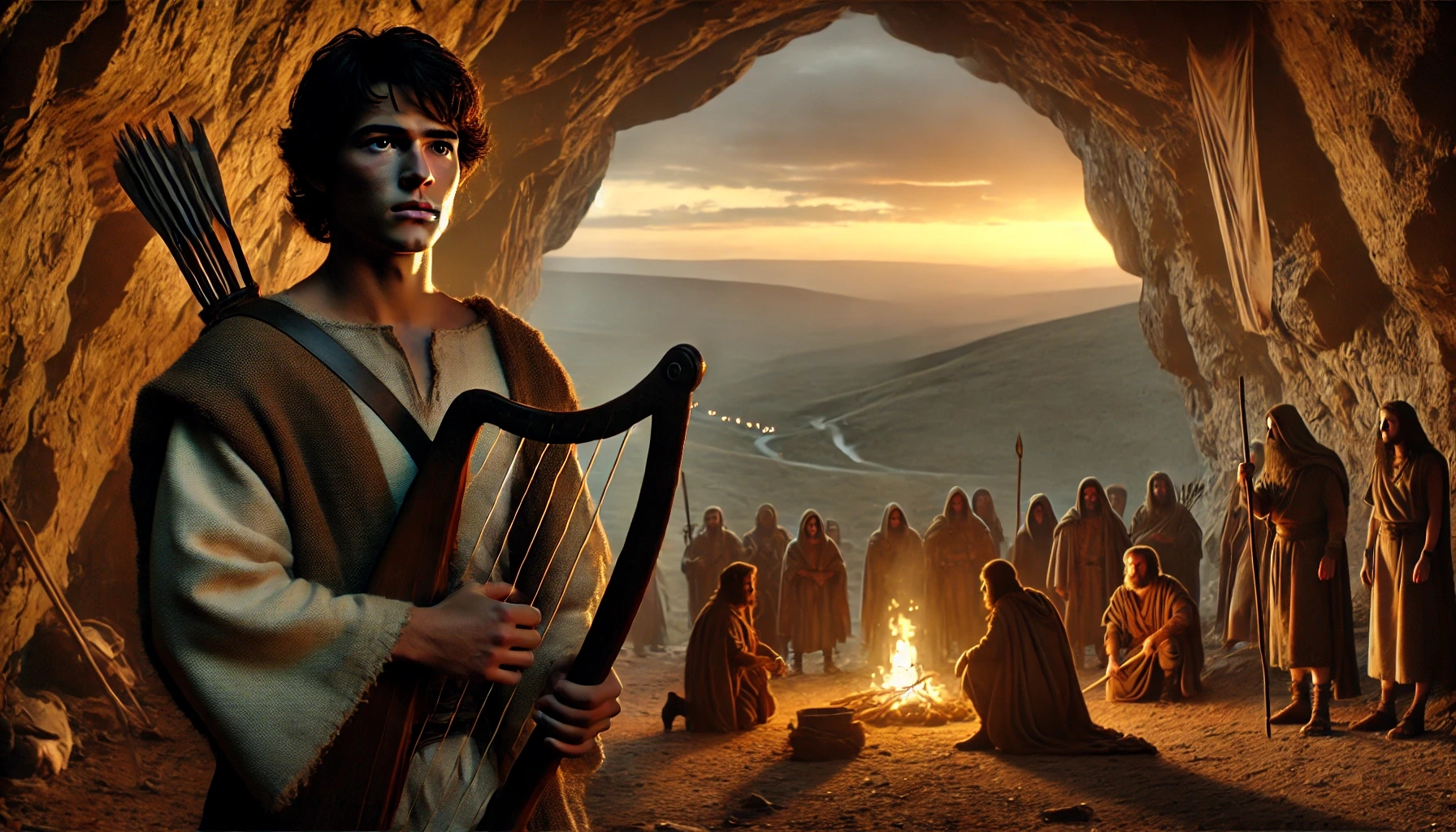
🔥 Chapter 64 : David a Fugitive
✨ Hunted by the king, sustained by God
🌐 Read online here
📘 Blog 2: 🎶 The Poisoned Applause
How envy destroys a heart
📍 Introduction
A song, a comparison, a moment—and Saul’s heart changes. Not because of David’s actions, but because of the people’s applause.
⋯⋯⋯⋯⋯⋯⋯⋯⋯⋯◆⋯⋯⋯⋯⋯⋯⋯⋯⋯⋯
🧵 Commentary
When the women sang, “Saul has slain his thousands, but David his tens of thousands,” it was more than a folk song. It was a mirror—and Saul could not bear the image he saw in it.
His deepest character flaw was his craving for applause. As long as he was in the spotlight, he felt secure. But now David was celebrated—and Saul began to lose his inner footing.
Envy is quiet at first: a thought, a comparison. But when it is fed, it poisons the whole being. Saul gave that feeling room. He did not suppress it. He did not seek correction from God.
Instead, he let himself be driven—right into an attempt at murder. Twice he hurled the spear at the man who had shown him nothing but loyalty.
The applause of people had enslaved his heart. And when he lost it, he lost himself.
⋯⋯⋯⋯⋯⋯⋯⋯⋯⋯◆⋯⋯⋯⋯⋯⋯⋯⋯⋯⋯
🧺 Summary
Saul’s downfall did not begin on the battlefield, but in the heart—through uncontrolled envy.
⋯⋯⋯⋯⋯⋯⋯⋯⋯⋯◆⋯⋯⋯⋯⋯⋯⋯⋯⋯⋯
🔦 Message for us today
Anyone who bases their identity on the approval of others will break when that approval is withheld.
⋯⋯⋯⋯⋯⋯⋯⋯⋯⋯◆⋯⋯⋯⋯⋯⋯⋯⋯⋯⋯
📝 Reflection
Where do I compare myself to others—and allow bitterness to grow as a result?