📅 16 February 2026
📚 BELIEVE HIS PROPHETS
📖 Daily Bible Reading
🏛️ 1 Kings 15 – Kings Compared – Between Faithfulness and Apostasy
✨ A Lamp for David’s Sake
🌐 Read online here
📍 Introduction
Chapter 15 leads us deeper into the history of the two divided kingdoms: Judah in the south and Israel in the north. Kings come and go. Some reign only briefly, others longer.
Yet over every life stands the same evaluation: Did he do what was right in the eyes of the Lord – or not?
Amid many dark developments, a small but hopeful light still appears.
⋯⋯⋯⋯⋯⋯⋯⋯⋯⋯◆⋯⋯⋯⋯⋯⋯⋯⋯⋯⋯
🧵 Commentary
First, the focus turns to Judah. Abijam, the son of Rehoboam, becomes king. He reigns only three years in Jerusalem. The text describes soberly: His heart was not fully devoted to the Lord like the heart of his father David. He walked in the same sins that had been committed before him.
And yet something remarkable happens. For David’s sake, God gives him a “lamp” in Jerusalem. David had done what was right—and that faithfulness continues to have an effect.
After Abijam, his son Asa becomes king.
Asa is different.
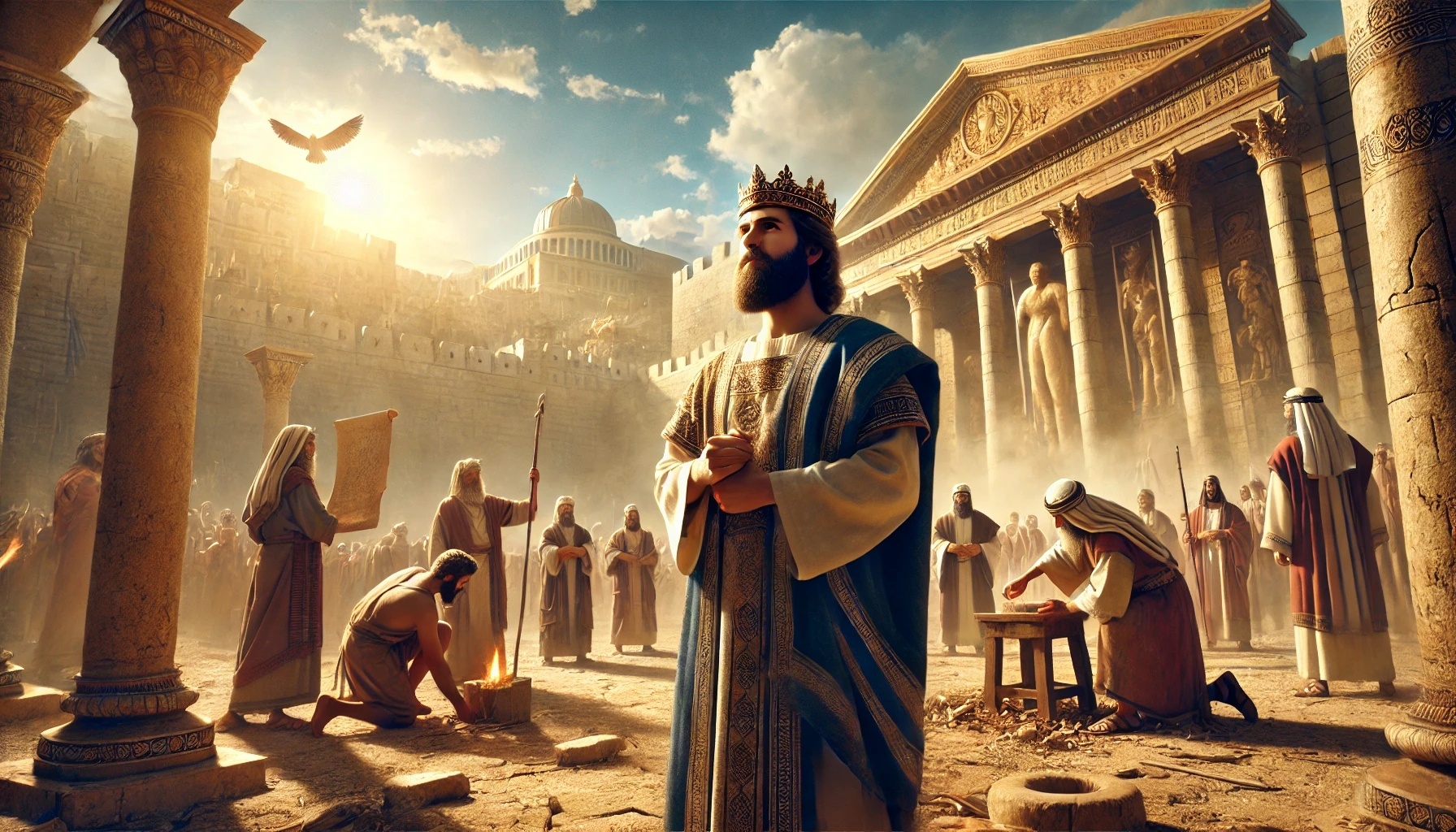
He does what is right in the eyes of the Lord—like David his father. He removes the male shrine prostitutes from the land and abolishes the idols. Even his grandmother Maacah he removes from her position as queen mother, because she had made an idol for Asherah.
Asa destroys this image and burns it in the Kidron Valley.
He is consistent. He cleanses the land. He brings treasures again into the house of the Lord.
Yet he is not perfect either. The high places remain. Nevertheless, it is said: Asa’s heart was fully devoted to the Lord all his life.
In the north, in the kingdom of Israel, the situation looks very different.
Nadab, the son of Jeroboam, reigns only two years. He does what is evil in the eyes of the Lord and walks in the way of his father.
Then Baasha rises up against him and kills him. With Nadab’s death, the announced destruction of Jeroboam’s house begins. Baasha kills all his descendants—not a single one remains. Thus the word of the Lord through the prophet Ahijah is fulfilled.
But Baasha himself learns nothing from history. He also walks in the sins of Jeroboam and continues to lead Israel into sin.
War between Asa and Baasha marks this time. Distrust and power struggles shape the political climate.
The chapter ends with the impression of a spiral: In the north, sin follows sin. In the south, there is light—but also imperfection.
⋯⋯⋯⋯⋯⋯⋯⋯⋯⋯◆⋯⋯⋯⋯⋯⋯⋯⋯⋯⋯
🧺 Summary
-
Abijam reigns in Judah but remains in a sinful path.
-
Asa becomes king and carries out reforms.
-
Asa removes idolatry and remains faithful to the Lord.
-
In the northern kingdom, Nadab is killed by Baasha.
-
Jeroboam’s house is completely destroyed.
-
Baasha also reigns godlessly.
-
There is war between the northern and southern kingdoms.
⋯⋯⋯⋯⋯⋯⋯⋯⋯⋯◆⋯⋯⋯⋯⋯⋯⋯⋯⋯⋯
🔦 Message for us today
Chapter 15 shows us:
-
God evaluates the heart—not just outward success.
-
Faithfulness has an effect across generations.
-
Spiritual reform requires courage and consistency.
-
Those who do not learn from the failure of others repeat it.
-
A life can be right in God’s eyes despite troubled circumstances.
Even in dark times, God can kindle a “lamp.”
⋯⋯⋯⋯⋯⋯⋯⋯⋯⋯◆⋯⋯⋯⋯⋯⋯⋯⋯⋯⋯
📝 Reflection
Am I willing to consistently remove wrong things from my life—even when it is uncomfortable?
What spiritual legacy am I leaving behind?
════════ ✶ ✶ ════════

📆 15 – 17 February 2026
📚 BELIEVE HIS PROPHETS
📖 Weekly Reading from the Spirit of Prophecy
📘 Ellen White | Patriarchs and Prophets
🔥 Chapter 62: David’s Anointing
✨ God’s choice according to the heart, not according to appearance
🌐 Read online here
📘 Blog 2: ❤️ God’s Perspective
Why the heart matters more than appearance
📍 Introduction
People judge quickly. Often a single glance is enough to form an opinion. But God’s standards are fundamentally different from ours.
⋯⋯⋯⋯⋯⋯⋯⋯⋯⋯◆⋯⋯⋯⋯⋯⋯⋯⋯⋯⋯
🧵 Commentary
Samuel stood before Eliab and was impressed. The stature, the bearing, the dignity—everything seemed to fit. Perhaps he thought of Saul, perhaps of the people’s expectations. A king surely had to look royal.
But right in the middle of this human assessment, God spoke. Not this one. It is not the impression that decides. Not the height. Not the outward appearance.
One after another came forward—and one after another was not chosen. The tension grew. Had God decided differently? Had Samuel misunderstood something?
Only when the unnoticed youngest was brought in did God’s choice become clear. David had not been forgotten—he had been prepared. While his brothers stood in the house, he had learned to carry responsibility. While others were being seen, he had served in secret.
God had tested his heart—out in the fields with the flock. There, where courage was required when danger threatened. There, where patience was necessary. There, where loneliness became a school of closeness to God.
And it was precisely there that a trusting heart had grown.
The anointing was not the beginning of his development, but the confirmation of what had matured in secret.
⋯⋯⋯⋯⋯⋯⋯⋯⋯⋯◆⋯⋯⋯⋯⋯⋯⋯⋯⋯⋯
🧺 Summary
God’s criteria for choosing are different from human standards. He does not seek an impressive outward appearance, but a trusting heart.
⋯⋯⋯⋯⋯⋯⋯⋯⋯⋯◆⋯⋯⋯⋯⋯⋯⋯⋯⋯⋯
🔦 Message for us today
We can stop constantly comparing ourselves by outward standards. What matters is not how we appear, but who we are within.
⋯⋯⋯⋯⋯⋯⋯⋯⋯⋯◆⋯⋯⋯⋯⋯⋯⋯⋯⋯⋯
📝 Reflection
What standards do I use to evaluate myself and others?