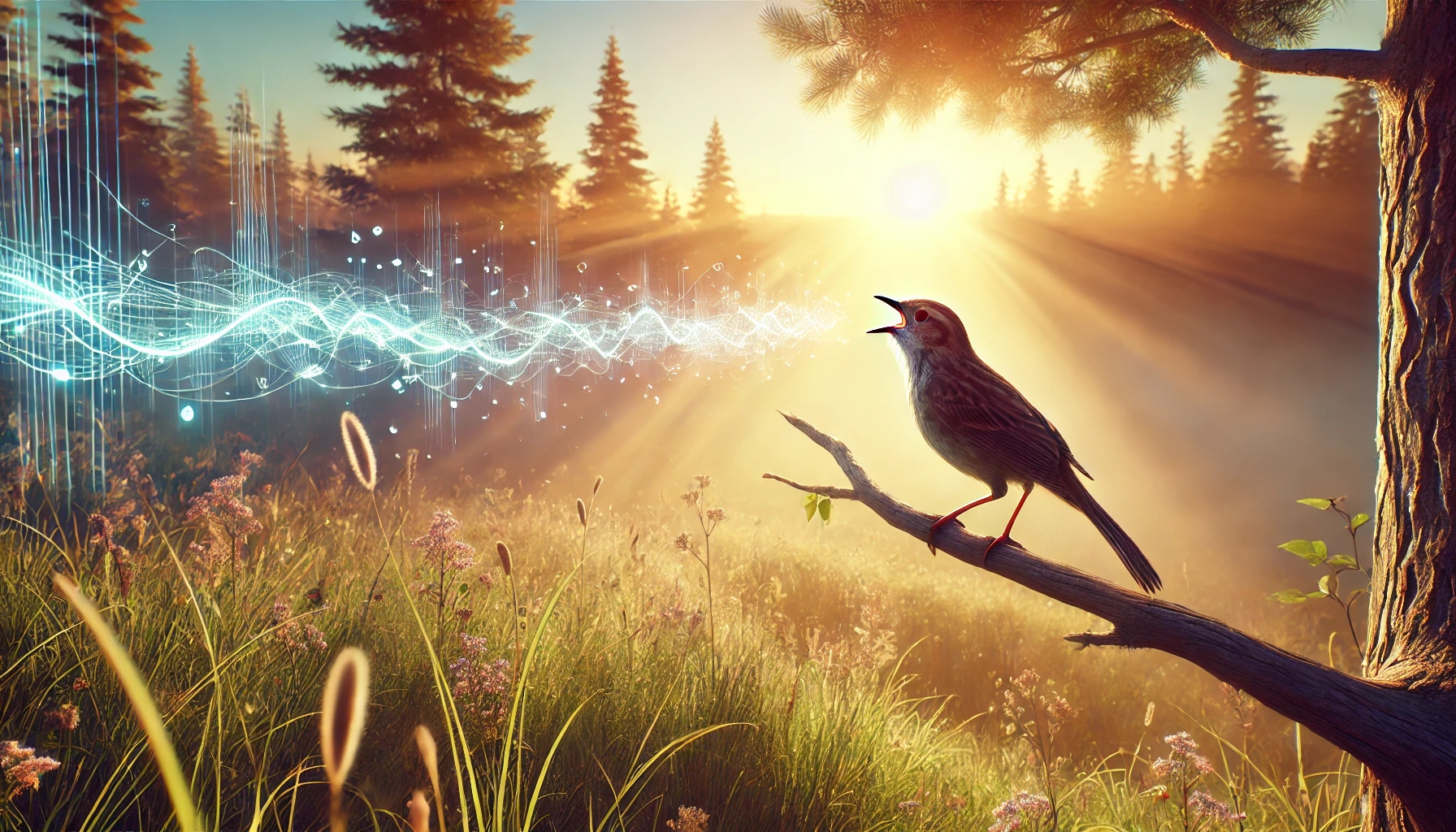
📖 Introduction: More Than Pretty Sounds
For many people, birdsong is simply part of the natural background.
It accompanies the morning, announces spring, or creates a pleasant atmosphere.
But what we perceive as “beautiful” is, for birds, not decoration—
it is a central means of communication: precise, purposeful, and rich in information.
Anyone who hears birdsong only as sound
misses its real function.
🗣️ 1. Song Is Language — Not Randomness
Birds do not sing at random.
Their songs follow clear rules and fulfill specific tasks.
Some of the most important functions are:
-
territory marking
-
mate selection
-
warning of danger
-
contact within the group
A bird doesn’t just sing “somehow.”
It sends a message—
and other birds understand it.
You can see this because members of the same species respond in specific ways:
-
they reply
-
they come closer
-
or they move away
Without interpretation, there would be no reaction.
🎼 2. Structure in Sound
Birdsong is structured.
It consists of:
-
motifs
-
repetitions
-
pauses
-
fixed sequences
Many species have a limited repertoire
that is used in clearly defined ways.
What’s especially interesting is this:
small deviations in song
can have great significance.
A wrong note
can determine
whether a rival stays away
or a potential partner shows interest.
So song is not just noise—
it is coded information.
🌍 3. Dialects: Regional Differences with Meaning
A little-known detail is that many bird species have dialects.
Birds of the same species sing slightly differently depending on the region.
These differences are not random.
They help:
A bird can often tell
whether another bird “belongs”
or is a stranger—
from song alone.
That requires fine perception
and stable patterns.
🧠 4. Learning and Instinct — Working Together
Not every part of singing is the same.
One part is:
Another part can be:
But even here the same principle applies:
learning requires a working foundation.
A young bird:
The basic pattern is already there.
Fine-tuning happens through listening and practice.
Without this built-in foundation,
learning would lead nowhere.
🚨 5. Alarm Calls: Information Under Time Pressure
Especially impressive are alarm calls.
Many bird species distinguish between:
Depending on the situation, birds vary:
Other birds react immediately—
often even across species.
Here song shows what it truly is:
a fast information system
that protects life.
⚖️ 6. Why Song Is Not a Luxury
Singing costs energy.
It makes birds audible—
and therefore potentially vulnerable.
If song were only decoration,
it would be an unnecessary risk.
But the benefit outweighs the cost:
-
clear communication
-
conflict avoidance
-
targeted mate choice
In the end, song saves energy
because it reduces misunderstandings.
Here too the rule applies:
👉 function explains effort.
👂 7. Why We Often Misjudge Song
We hear birdsong with human ears.
We focus on melody,
not meaning.
But meaning is not in the sound itself,
it is in its function.
What is music to us
is language to birds.
This distinction changes the perspective:
not beauty is central,
but purposefulness.
🔎 8. A Rational View of Communication
In every functioning system, it is true that:
-
information must be unambiguous
-
sender and receiver must be compatible
-
misinterpretations have consequences
Birdsong meets exactly these criteria.
It is:
-
species-specific
-
situation-dependent
-
reliable
Such communication systems do not arise from noise,
but from order.
✝️ 9. The Christian Perspective: Order in Expression
From a Christian view of nature, communication is understood
not as a product of chance,
but as part of an ordered creation.
That even animals have differentiated forms of expression
points to a world
in which relationship and understanding are intended.
Not as proof,
but as a reminder
that order reaches even into sound.
🌱 10. What Birdsong Teaches Us
Birdsong teaches us:
-
communication is more than volume
-
meaning requires structure
-
beauty and purpose do not exclude each other
Perhaps it also reminds us
that listening is a prerequisite for understanding—
in nature as well as in human relationships.
✨ Final Thought
When a bird sings,
it doesn’t simply fill the air with sound.
It shares information.
It marks boundaries.
It calls.
It warns.
Those who are willing to listen more closely
will discover in song
not only music,
but
traces of Creation.