




🌿 Traces of Creation – Discoveries from Nature
🐦 Series 1: What Birds Teach Us
🧭 Episode 5 – Instinct Without Learning – Knowledge from the Beginning
🌅 Introduction: Ability Without Instruction
When humans are able to do something, they have learned it.
Walking, speaking, reading, acting – all of this is the result of practice, correction, and experience. Mistakes are part of the process.
In the bird world, however, we observe something fundamentally different.
Birds perform highly complex actions without ever having been taught to do so.
They build nests, feed their young, flee at the right moment, and choose suitable food – often successfully on the very first attempt.
We call this ability instinct.
But what truly lies behind this word?
🔎 1. Instinct Is More Than a Reflex
Instinct is often misunderstood.
It is not a simple stimulus-response mechanism, like pulling your hand away from a hot surface.
Bird instincts are:
-
situation-dependent
-
goal-directed
-
variable within clear boundaries
A bird does not build a random nest.
It builds a nest that:
-
fits its own species
-
fits its habitat
-
fits the breeding season
In doing so, it makes decisions
without conscious deliberation –
but not without information.
🪺 2. Nest Building: Precision Without a Blueprint
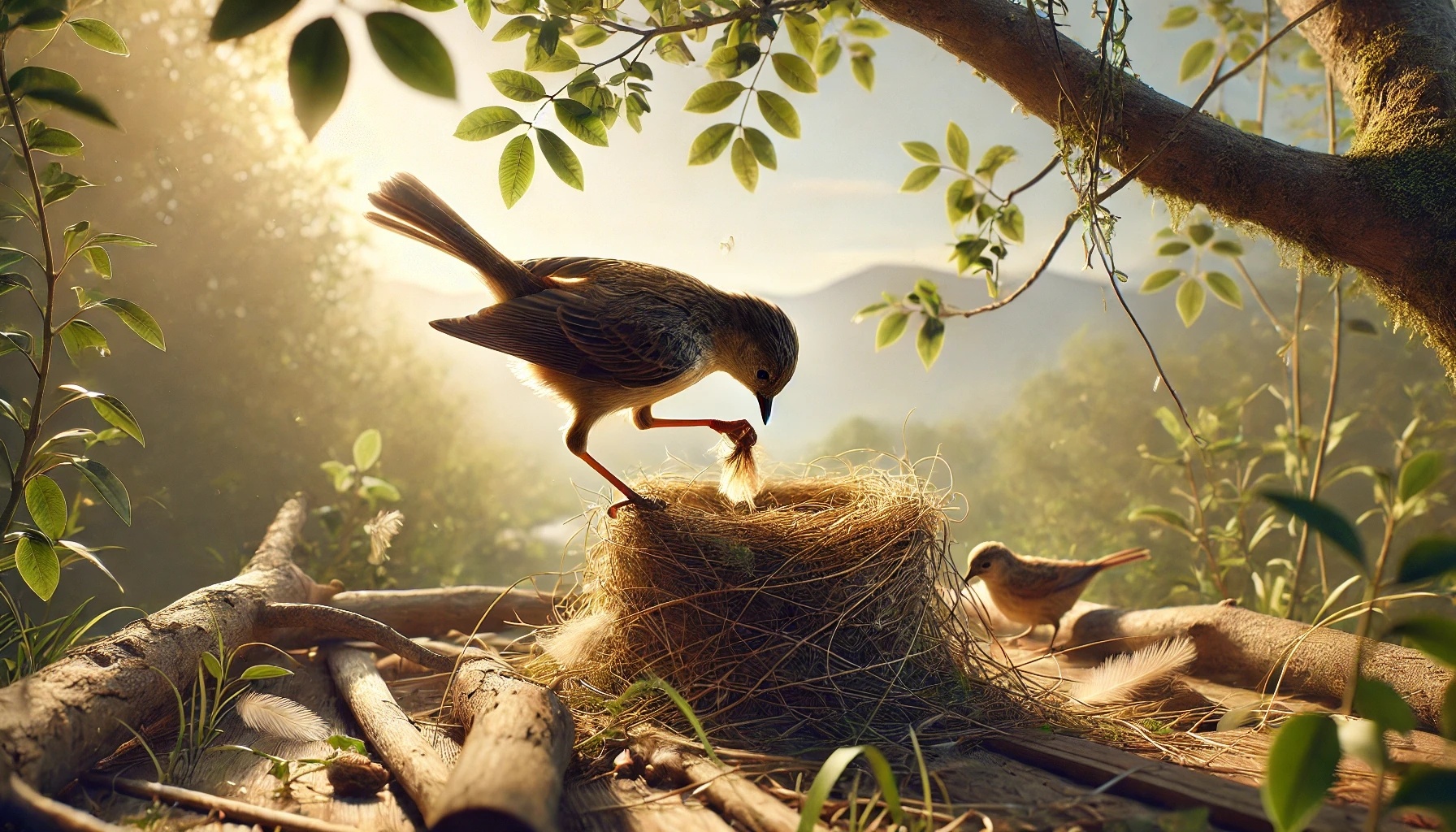
Nest building is one of the most striking examples of instinctive knowledge.
Each bird species builds:
-
a specific nest shape
-
with specific materials
-
in typical locations
A weaver bird weaves.
A swallow builds with mud.
A woodpecker carves out cavities.
Young birds have:
-
no model
-
no instruction manual
-
no trial phase
And yet, the first time they build, they do so correctly according to their species.
This shows that instinct is stored construction information,
not improvised behavior.
🍽️ 3. Feeding Without Mistakes
Even more astonishing is behavior during rearing.
Parent birds know:
-
when to feed
-
how often
-
with what
They do not give their young random food.
They deliberately choose:
-
protein-rich insects
-
easily digestible food
-
later, more solid nourishment
A mistake would have immediate consequences.
Food that is too hard can be fatal.
Too little energy can be fatal as well.
And yet, this system works reliably –
even with their very first offspring.
🚨 4. Fleeing at the Right Moment
Instinct also appears where there is no time to learn:
in danger.
Birds react:
-
quickly
-
precisely
-
species-specifically
A bird does not flee at every stimulus.
It distinguishes between:
-
real threat
-
harmless movement
-
familiar vs. unfamiliar patterns
This differentiation requires evaluation.
Not conscious – but functional.
Fleeing too early wastes energy.
Fleeing too late costs life.
Instinct therefore operates within a narrow optimal range.
📖 5. Learning Supplements – But Does Not Replace
Of course, birds also learn.
Song, fine-tuning of food search, social interaction – all of these may involve experience.
But learning presupposes something:
👉 a functioning foundation.
A bird does not learn how to feed.
At most, it learns to feed more precisely.
The core behavior is present from the beginning.
Learning is an addition, not the origin.
⚖️ 6. Why Half an Instinct Would Not Be an Advantage
A partially functioning instinct
would not be an evolutionary advantage.
A bird that:
-
feeds “almost” correctly
-
flees “most of the time” correctly
-
builds “approximately” correctly
would not get a second chance.
Instinct must be sufficiently complete
to make life possible.
This distinguishes instinctive behavior
from abilities that can be gradually optimized.
💡 7. Instinct as Information
The more closely one examines instinct,
the clearer it becomes:
it is information.
Not as a thought,
but as actionable knowledge.
Information has characteristics:
-
it is specific
-
it is goal-directed
-
it is transferable
Instinct is passed on.
Not through instruction,
but biologically.
The decisive question is therefore not only:
How does instinct function?
but also:
👉 Where does this information come from?
🤔 8. Why We Often Underestimate Instinct
Because it is quiet.
Because it appears self-evident.
Because it requires no conscious decision.
Yet that is precisely what makes it remarkable.
Instinct functions where thinking would be too slow.
It protects life
before it can reflect.
✝️ 9. The Christian Perspective: Life with Provision
The Christian perspective describes life not as unprepared,
but as equipped.
Instinct fits precisely into this picture:
Not everything must be learned
for life to succeed.
From this perspective, instinct is not a product of chance,
but an expression of provision.
Not as proof,
but as an interpretation of observable order.
🌱 10. What the Instinct of Birds Teaches Us
Instinct teaches us:
-
Knowledge can exist without being conscious
-
Life needs orientation from the very beginning
-
Function presupposes information
Perhaps this theme also reminds us
that not everything valuable must be learned –
some things are entrusted to us.
✨ Final Thought
When a bird builds its nest
without ever having seen one,
something remarkable becomes visible:
Knowledge can precede experience.
Action can be secure
without prior practice.
Those who pay attention to these quiet abilities
discover here as well
traces of Creation.
