🌱 GROWING IN A RELATIONSHIP WITH GOD
⚖️ Lesson 9: Sin, the Gospel, and the Law
📘 9.5 Knowing and Doing
True faith does not consist only in knowing God’s truth, but also in living it
📖 1. Introduction – Knowledge alone does not yet change a life
Many people possess great knowledge about the Bible.
They know:
- stories
- commandments
- prophetic themes
- doctrines
- spiritual concepts
But Jesus makes it clear:
👉 Knowledge alone does not save.
One can:
- appear religious
- speak much about God
- explain spiritual truths
and still not have a genuine relationship with Christ.
That is why Jesus says:
👉 “Not everyone who says to me, Lord, Lord, will enter the kingdom of heaven.”
This is a serious warning.
📜 2. The biblical foundation – Hearing and doing
In Matthew 7, Jesus describes two people:
- a wise one
- a foolish one
Both hear the same words.
The difference is not in knowledge,
but in action.
The wise person:
- hears God’s Word
- trusts it
- puts it into practice
The foolish person:
- also hears
- but does not change their life
When the storm comes,
the foundation is revealed.
👉 True discipleship is shown in lived faith.
🌍 3. Connection to today
Even today, there is the danger
of living the Christian faith only theoretically.
People:
- consume sermons
- read books
- discuss theology
- collect knowledge
but their hearts often remain unchanged.
One can:
- know truth
- but lack love
- speak about grace
- but remain bitter
- defend God’s commandments
- but have no living relationship with Jesus
The Bible makes it clear:
👉 Knowledge without surrender easily leads to spiritual pride.
💡 4. Central message of the lesson
👉 God’s truth should not only be understood, but visibly lived in everyday life.
✝️ 5. Theological focus
This lesson deals with the connection between:
- knowledge
- faith
- obedience
- relationship
In biblical thinking, “knowing God” means much more than mere information.
The Hebrew and biblical understanding of knowledge means:
- personal fellowship
- relationship
- experience
- closeness
That is why Jesus says:
👉 “This is eternal life: that they may know you.”
So it is not only about
possessing correct information about God,
but about living in a living connection with him.
The Pharisees knew Scripture very well.
Nevertheless, many of them missed the true meaning:
- love
- humility
- mercy
- surrender to God
For this reason, Jesus criticized a religion
that was outwardly correct,
but inwardly empty.
Another important theological thought:
Genuine faith bears fruit.
The Gospel does not only change a person’s status before God,
but also their character.
Whoever encounters Christ
is transformed:
- in thinking
- in behavior
- in relationships
- in priorities
Perfect people are not saved,
but saved people do not remain unchanged.
Therefore, the Bible always connects:
- faith and obedience
- love and truth
- knowledge and discipleship
James explains:
👉 “Faith without works is dead.”
By this he does not mean
that works save,
but that genuine faith becomes visible.
It is also theologically important:
Obedience is never the basis of salvation,
but the fruit of a relationship with Christ.
A person is not saved
because they act correctly.
They act differently
because Christ transforms their heart.
This protects:
- against legalism
- against superficial Christianity
- against mere religiosity
📖 6. The foundation on the rock
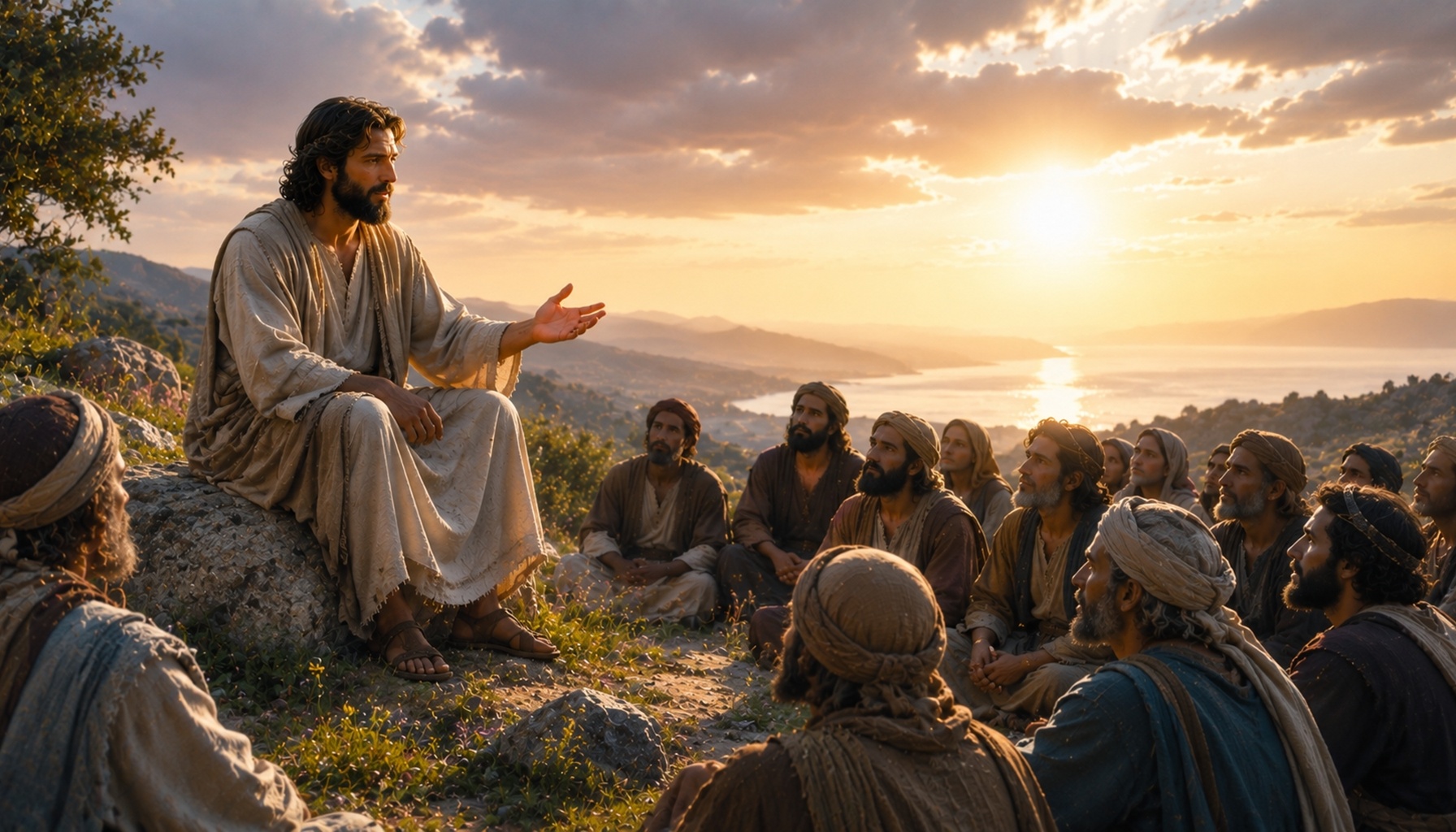
Jesus ends the Sermon on the Mount with the image of building a house.
This image is deeply spiritual.
The foundation of a life is not revealed in calm times,
but in the storm.
Storms can be:
- temptations
- suffering
- doubts
- crises
- disappointments
- trials
Then it becomes visible
whether faith was only theory
or a real connection with God.
The house on the rock represents:
- trust in Christ
- obedience out of love
- a steady relationship with God
The sand, by contrast, symbolizes:
- superficial religion
- self-deception
- mere knowledge without transformation
Another deep thought:
Jesus’ words demand a decision.
No one remains neutral
when they hear God’s truth.
Either:
- the heart opens
or: - the heart hardens
That is why the lesson calls us
not only to be hearers,
but doers of the Word.
In practice, this means:
- taking God’s truth seriously
- applying it in everyday life
- allowing relationships to be transformed
- making decisions according to God’s will
👉 True Christianity is not information alone,
but transformation through Christ.
🔧 7. Application in everyday life
Practical questions:
- Does God’s Word change my daily life?
- Where do I know the truth, but act differently?
- Is my faith visible in my behavior?
- Am I merely living religiously, or truly with Jesus?
- What is the foundation of my life built on?
❓ 8. Reflection question
If others observed my daily life, would they recognize only religious knowledge, or genuine fellowship with Christ?
🌟 9. Final thought
Jesus is not only looking for people
who hear his words.
He is looking for people
who trust him,
follow him,
and build their lives on him.
Because:
👉 True faith does not remain in the head — it transforms the whole life.