🌅 Back to the Source of Life
Sabbath reflections for silence, renewal, and encountering God
🙏 The Prayer That Changes the Heart
❤️🩹 6.And forgive us our debts
“And forgive us our debts, as we also have forgiven our debtors.”
Matthew 6:12 – first part
🕊️ A story – the tears in the house
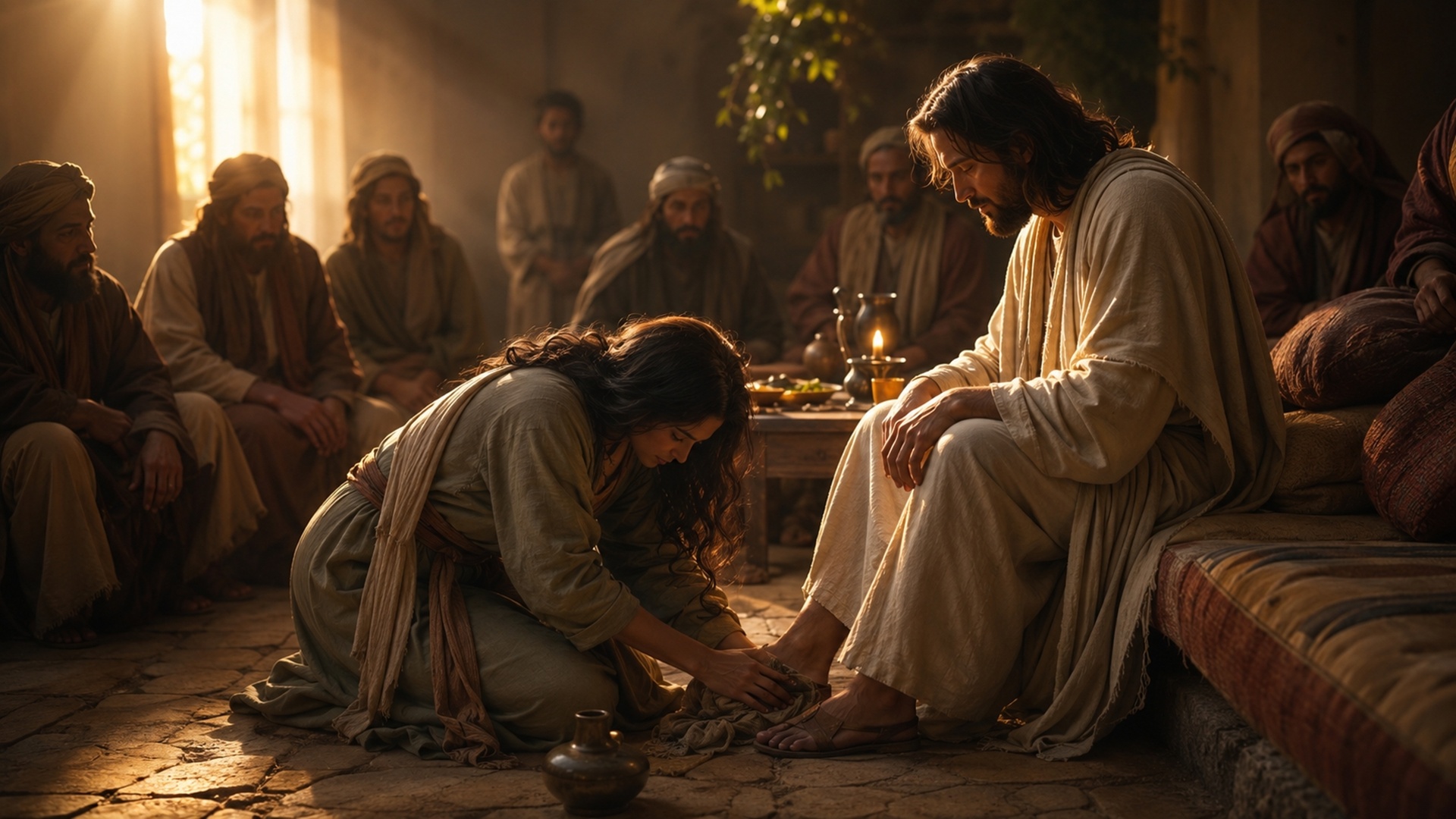
The house was filled with voices. People sat around the table, conversations flowed, everything seemed orderly and controlled. It was a room where people knew how to behave, how to speak, what to show — and what was better to hide.
Into this atmosphere, the door opened.
A woman entered. Her steps were cautious, almost hesitant, and yet there was a determination in them stronger than all the looks in the room. She knew she was not welcome there. She knew what people thought of her. But she had not come because of the people.
Jesus was there.
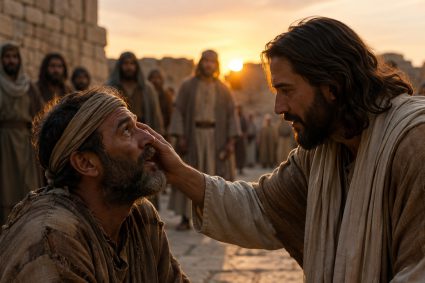
Without many words, she came closer. She knelt down, and then something happened that no one expected. Her tears began to flow — not held back, not controlled, but honest and deep. They fell on Jesus’ feet and became an expression of her entire inner condition.
She had brought nothing with which she could explain herself. No justification, no defense. Only her heart.
The people in the room saw her — and judged. They saw her past, her mistakes, her life. But Jesus saw more. He saw not only what had been, but what was happening in her now.
And then He spoke words that changed everything:
“Your sins are forgiven.”
(Luke 7:48)
In that moment, something happened that could not be seen. Not only was her guilt addressed — her whole life received a new direction.
🌿 Forgiveness begins with honesty
With the request “forgive us our debts,” the prayer becomes deeply personal. It leads us away from general thoughts toward what we ourselves know — toward what we may hide from others, but not from God.
These words invite us to become honest. They leave no room for excuses, comparisons, or beautifying our own situation. They lead us to a point where we recognize: I need forgiveness.
Ellen G. White describes it this way:
“When we ask for forgiveness, we acknowledge our guilt before God. We stop justifying ourselves and come honestly before Him. This openness is the beginning of healing, because only what is brought into the light can be forgiven.”
(Ellen G. White, Thoughts from the Mount of Blessing, chapter “The Lord’s Prayer”)
And she further writes:
“God does not forgive reluctantly. His forgiveness is an expression of His love. Whoever comes to Him is not rejected, but accepted and cleansed.”
(Thoughts from the Mount of Blessing, chapter “The Lord’s Prayer”)
Forgiveness, then, is not a hesitant concession from God, but an expression of His willingness to restore us.
🌙 The depth of forgiveness
The woman in the story came with empty hands — and left changed. Not because she had accomplished anything, but because she had received.
This shows what forgiveness truly is. It is not earned. It is received.
Ellen G. White describes this experience as follows:
“God’s forgiveness does not mean only that guilt is no longer counted against us. It also means that the heart is renewed. A person is not only acquitted, but changed.”
(Thoughts from the Mount of Blessing, chapter “The Lord’s Prayer”)
And she adds:
“The one who experiences forgiveness becomes free. The burden of the past loses its power, and a new life begins.”
(Thoughts from the Mount of Blessing, chapter “The Lord’s Prayer”)
Forgiveness does not only take something away — it gives something new.
🌾 The Sabbath as a place of forgiveness
The Sabbath is more than an interruption of our everyday life — it is an invitation to come to rest before God and allow Him to touch our heart. In His presence we do not have to hide anything. We may come as we are: with our joy, but also with our guilt, our questions, and our failure.
The request “forgive us our debts” receives a special depth on the Sabbath. For this holy day reminds us that our relationship with God is not based on our performance, but on His grace. While we let our work rest, we may also lay the burden of our guilt down at Christ’s feet. We no longer have to carry it with us, because He invites us to entrust it to Him.
Already in the Old Testament, the Sabbath was a sign of redemption. God reminded His people that He had freed them from the slavery of Egypt (Deuteronomy 5:15). The Sabbath was therefore not only a memorial of creation, but also of liberation. This truth points to the even greater redemption that Christ accomplished for us on the cross. In Him we are freed not only from outward burdens, but also from the burden of sin.
Ellen G. White writes:
“The Sabbath points not only to creation, but also to redemption. It reminds us of Christ’s power to free human beings from sin and lead them into a new life.”
Precisely for this reason, the Sabbath is a special day of self-examination — not in the sense of an anxious search for mistakes, but as a loving invitation to let our hearts be viewed in the light of God. In His presence we do not have to minimize or hide our guilt. The Father already knows it, and yet He invites us to come to Him.
Like the woman in the Pharisee’s house, we too may come before Jesus with empty hands. He does not expect a perfect past or convincing explanations. He seeks a heart that is willing to be touched by His grace. Where we confess our guilt, we encounter His forgiveness.
The Sabbath gives us time not only to understand this forgiveness with our minds, but to accept it deeply in our hearts. Often people carry guilt with them for a long time, even though God has already forgiven. The Sabbath reminds us that God’s Word carries more weight than our feelings. When Christ forgives, His forgiveness is complete.
Therefore, on this day we may not only look back, but also begin again. Every week, the Sabbath speaks to us of the hope that God’s grace is greater than our failure. What we sincerely entrust to Him no longer has to hold us captive.
Perhaps this is one of the most beautiful messages of the Sabbath: we do not have to enter a new week carrying the burden of our past. The God who created us is also the God who renews us. He gives forgiveness, lifts us up, and opens a new beginning again and again.
So the Sabbath becomes a holy space of grace — a place where guilt loses its power, hearts find peace, and people may experience anew what Jesus said to the woman: “Your sins are forgiven.”
🤲 Invitation
Take a moment of honesty today. Do not try to organize your thoughts or explain your situation.
Simply come before God.
Just as you are.
✨ Prayer
Father,
You know my heart better than I know it myself.
You know what I have done,
what I have thought,
and what I often hide from others.
I come to You without excuses.
I ask You: forgive me.
Take from me the burden that I cannot carry myself.
Cleanse my heart
and give me a new beginning.
And help me truly
accept Your forgiveness.
Amen.