

📆 July 12–18, 2026
📚 BELIEVE HIS PROPHETS
📖 Weekly Reading from the Spirit of Prophecy
👑 Ellen White | Prophets and Kings
🏔️ Chapter 13: “What Doest Thou Here?”
🌿 God’s Gentle Voice Leads Us Back to Our Mission
🌐 Read online here
📍 Introduction
After the great victory on Mount Carmel, Elijah expected a widespread revival in Israel. Instead, he was forced to flee, discouraged and exhausted. At Mount Horeb, God did not meet him in the storm, the earthquake, or the fire, but in a still, small voice. There the prophet learned once again that God’s work advances not only through mighty signs, but above all through His quiet work in people’s hearts. This chapter encourages us to trust God even in times of disappointment and not to abandon the mission He has given us.
⋯⋯⋯⋯⋯⋯⋯⋯⋯⋯◆⋯⋯⋯⋯⋯⋯⋯⋯⋯⋯
🧵 Commentary
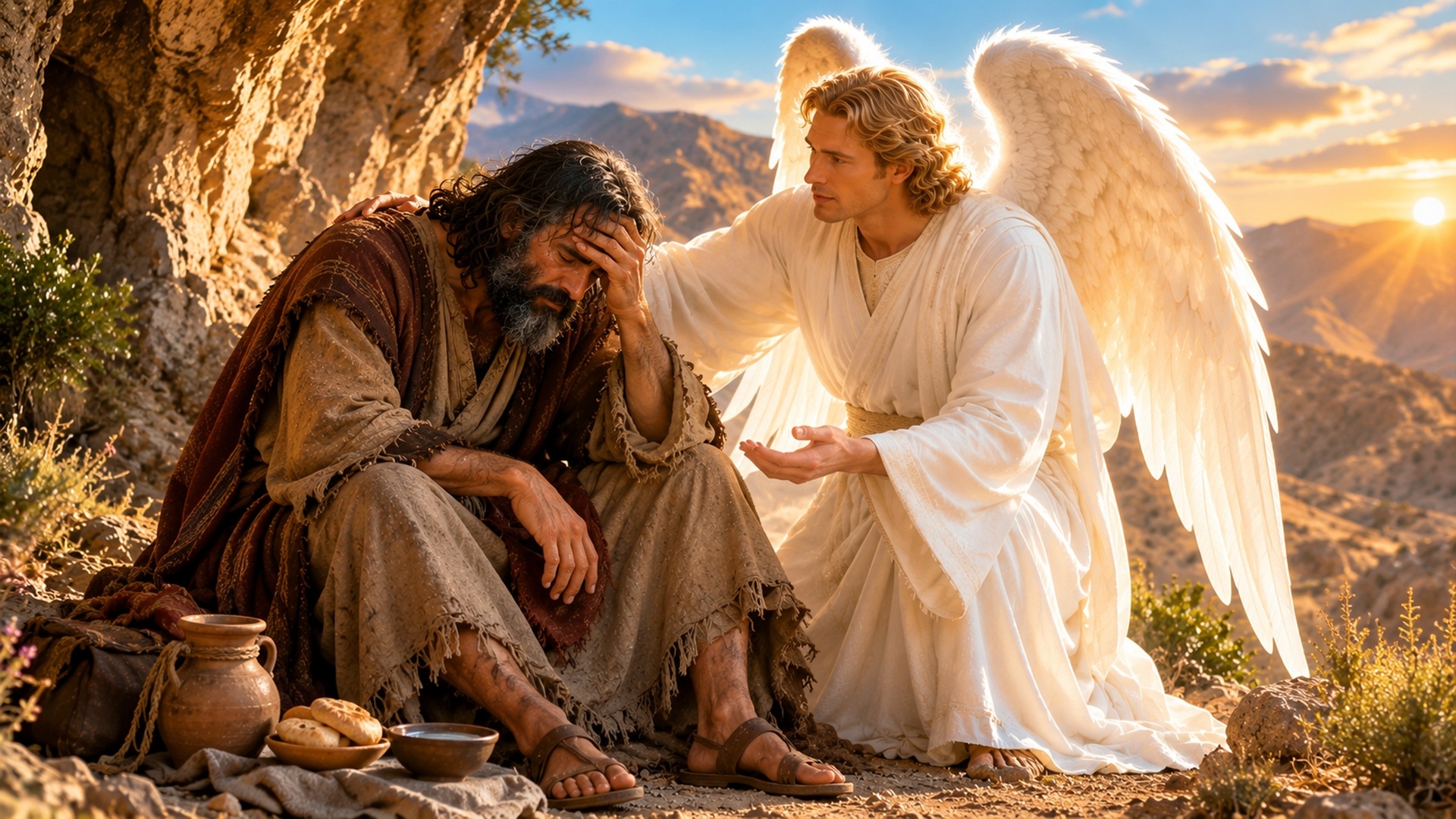
No one knew where Elijah had fled. His path was hidden from human eyes, but God had not lost sight of His faithful servant. While Elijah remained exhausted and discouraged in a cave at Horeb, the Lord came to meet him. God did not begin the conversation with accusations, but with a simple question: “What are you doing here, Elijah?” This question was not intended to shame the prophet, but to lead him to reflect. Why had he left the place where God had appointed him to serve?
Elijah opened his heart and spoke honestly about his disappointment. He had fought for God with all his strength. He had publicly exposed the worship of Baal, witnessed God’s power on Mount Carmel, and hoped that all Israel would now repent. Instead of revival, however, hatred flared up once again. Jezebel threatened him with death, and in his loneliness Elijah believed that he was the only faithful servant of God left. His words reflected the pain of a man who had completely exhausted himself and could no longer see a way forward.
God did not immediately answer Elijah’s complaint. Instead, He led him out of the cave. There the prophet was to witness the Lord passing by. A mighty wind swept over the mountain and shattered the rocks. Then a powerful earthquake shook the ground. Afterward, a consuming fire blazed. Each of these natural events displayed God’s power. Yet His presence was not revealed in any of them.
Only afterward did everything become quiet. A gentle, soft whisper filled the mountain. When Elijah heard that quiet voice, he reverently covered his face with his cloak and stood at the entrance of the cave. Then he knew that God was present. The Lord showed His servant that His work does not always take place through overwhelming miracles. God often reaches hearts through His quiet voice, the gentle work of His Spirit, and His patient guidance.
This encounter changed Elijah’s perspective. He realized that God’s work does not depend on one person alone. Although the prophet felt alone, the Lord had already prepared people who had remained faithful to Him. God revealed that there were still seven thousand men in Israel who had not bowed their knees to Baal. What Elijah regarded as total defeat was in reality only a small part of God’s much greater work.
Elijah then received a new mission. He was to return to Israel. God showed him that his ministry was not yet finished. Hazael was to be anointed king over Aram, Jehu was to become king over Israel, and Elisha would one day become Elijah’s successor. In this way, God made it clear that His plans continue even when individuals grow weak. His work never rests on the shoulders of one person alone.
For Elijah, this meant gaining a new perspective. He was no longer to focus on his disappointment, but to walk once again on the path God had appointed for him. Fear of Jezebel was no longer to determine his actions. God’s mission was greater than any threat.
Elijah’s experience still speaks today to everyone who serves God. Times of deep discouragement may follow great successes. It is precisely then that the enemy tries to sow doubt and direct our attention toward failure. God, however, meets His children with patience. He does not reject them because of their weakness, but strengthens their faith and leads them step by step back to their mission.
Even today, God often works not primarily through extraordinary events, but through the quiet voice of His Spirit. His Word changes hearts in ways that may go unnoticed, yet produce lasting results. Where people listen patiently to Him and trust His Word, new life and new hope arise.
Elijah eventually learned that God’s kingdom is greater than what human eyes can see. Even when everything appears dark and faithfulness seems rare, God always preserves people who serve Him wholeheartedly. No sincere faith remains hidden from Him. No faithful service is forgotten by God.
Especially in times of spiritual confusion, God therefore calls His children not to remain paralyzed by discouragement. His question to Elijah still applies to every believer today: “What are you doing here?” It invites us to reconsider our calling, not to be controlled by fear or disappointment, and to continue along the path God has prepared.
God’s work is never dependent on visible circumstances. People may gain the impression that evil is increasing and that truth is being pushed further and further aside. But the Lord sees farther than we do. While Elijah saw only decline and apostasy, God saw faithful hearts serving Him in secret. In this way, He encouraged His prophet not to judge by appearances, but to trust in God’s work.
Even in our time, many people long for truth, although they do not yet fully know God. The Holy Spirit often works quietly in a person’s heart long before anyone else notices. Therefore, God’s children must not lose courage, but should continue sharing the gospel, because the Lord is preparing people who are ready to accept His truth.
Elijah also had to learn that he was not meant to carry the burden of God’s work alone. God placed Elisha by his side, who would later become his faithful companion and successor. In this way, the Lord showed that His work continues from one generation to the next. People come and go, but God’s plan remains.
Elijah’s experience at Horeb became a turning point in his life. He arrived as a discouraged fugitive and left the mountain with renewed hope and a new mission. This was not because all difficulties had immediately disappeared, but because he had encountered God afresh. His trust was renewed, his perspective broadened, and his heart strengthened.
This story also reveals God’s loving character. He does not harshly rebuke the exhausted prophet, but meets him with patience, understanding, and care. God knows the limitations of His children. He knows their weariness, fears, and disappointments. It is precisely in such moments that He draws especially near and lifts them up again.
Thus, Elijah’s encounter at Horeb remains a timeless source of encouragement. Anyone who feels weak, believes they are standing alone, or sees no way forward may know that God still asks the same question: “What are you doing here?” He does not ask in order to condemn, but to redirect our attention toward Him. Those who follow His voice will discover that God’s plans are greater than every crisis and that His power is revealed precisely in weakness.
⋯⋯⋯⋯⋯⋯⋯⋯⋯⋯◆⋯⋯⋯⋯⋯⋯⋯⋯⋯⋯
🧺 Summary
At Mount Horeb, God did not meet the discouraged Elijah in the storm, the earthquake, or the fire, but in a still, small voice. The prophet realized that God often works quietly and that he was not alone in his faithfulness. God lifted him up, gave him a new mission, and showed him that His work would continue. Elijah’s story makes it clear that God does not abandon His children in times of discouragement, but strengthens them and sends them out again.
⋯⋯⋯⋯⋯⋯⋯⋯⋯⋯◆⋯⋯⋯⋯⋯⋯⋯⋯⋯⋯
🔦 Message for Us Today
We also experience times when disappointment, weariness, or apparent defeat can shake our faith. But God sees more than we do. He often works in hidden ways and continues His work even when we cannot see any results. His gentle voice invites us to trust Him anew, not to abandon our mission, and to believe that His strength overcomes our weakness.
⋯⋯⋯⋯⋯⋯⋯⋯⋯⋯◆⋯⋯⋯⋯⋯⋯⋯⋯⋯⋯
📝 Thought for Reflection
Do I still listen for God’s gentle voice amid noise, worries, and disappointments? Am I willing to remain faithful to my mission even when I sometimes feel alone or powerless?
“And after the fire came a still, small voice.” (1 Kings 19:12)