
🌅 Back to the Source of Life
Sabbath reflections for silence, renewal, and encountering God
🙏 The Prayer That Changes the Heart
✨ 2. Hallowed Be Your Name
“Hallowed be Your name.”
Matthew 6:9 – second part
🕊️ A story – the burning bush
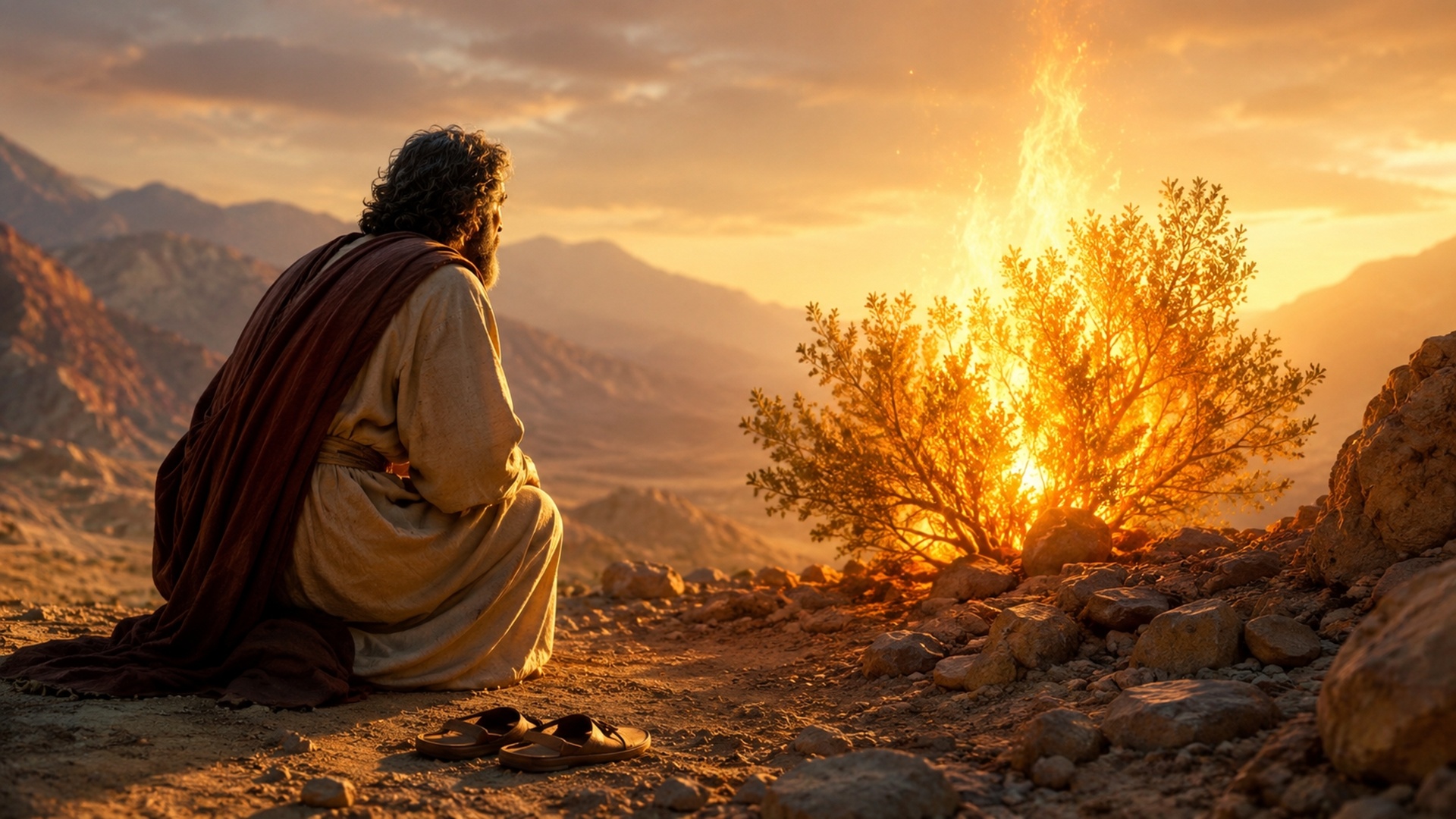
The wilderness was silent. No sound, no shadow, only the dry land and the wide sky. Moses was on his way with the flock, as on so many other days. It was an ordinary moment; nothing suggested that something special was about to happen.
Then he saw the fire.
A bush was burning, and yet it was not consumed.
Moses stopped. Something about this sight would not let him go on. He came closer, carefully, searching, and at that very moment the silence was broken.
“Moses, Moses.”
He answered. But before anything more happened, a command came that changed everything:
“Take your sandals off your feet, for the place where you stand is holy ground.”
(Exodus 3:5)
In that moment, Moses realized that he was not merely seeing something special — he was standing in the presence of God.
It was no longer an ordinary moment.
It was holy.
🌿 What does “Hallowed be Your name” mean?
After teaching us to address God as Father, Jesus leads us in the next step to an attitude that is often lost: reverence.
“Hallowed be Your name” does not mean that we could make God holier. It means that we recognize who He is and give Him the place that belongs to Him.
It is an inner acknowledgment: God is not like us. He is pure, truthful, perfect. His name stands for His character, for everything He is.
Ellen G. White describes it this way:
“God’s name is hallowed when we honor Him in our lives. It is not only about words, but about an attitude of the heart that gives God first place and acknowledges Him as holy.”
(Ellen G. White, Thoughts from the Mount of Blessing, chapter “The Lord’s Prayer”)
And she further writes:
“Whoever truly knows God will not treat Him lightly. Reverence arises where a person begins to understand with whom they are dealing.”
(Thoughts from the Mount of Blessing, chapter “The Lord’s Prayer”)
🔥 Between closeness and reverence
It is interesting that after “Father,” Jesus immediately speaks of “holiness.” Both belong together.
If we see only closeness, we lose reverence.
If we see only reverence, we lose closeness.
A mature prayer holds both together: God is near — and at the same time holy.
This also means that our relationship with God cannot be superficial. His presence changes our attitude. Just as Moses stopped, just as he took off his sandals, so our prayer also begins with an inner pause.
🌙 God’s name in everyday life
“Hallowed be Your name” concerns not only the moment of prayer. It concerns our whole life.
How we speak.
How we think.
How we act.
Everything we do reflects how we see God.
Ellen G. White writes:
“The name of God is honored or dishonored not only by words, but by a person’s life. Whoever belongs to God will also honor Him through their conduct.”
(Thoughts from the Mount of Blessing, chapter “The Lord’s Prayer”)
Thus this petition becomes a direction: my life should show who God is.
🌾 The Sabbath as a place of reverence
The Sabbath reminds us every week that there are things that are holy. In a world that makes almost everything appear available, controllable, and ordinary, God invites us to reflect anew on His holiness.
When God blessed and sanctified the seventh day (Genesis 2:3), He set apart time for a special purpose. Therefore, the Sabbath is not merely a day off, but a holy time of encounter between the Creator and His creatures. It reminds us that God is the source of all life and that, ultimately, our lives are not in our own hands.
For this very reason, the Sabbath is closely connected with the petition: “Hallowed be Your name.” For on this day we are invited to consciously honor God’s name, His character, and His presence. The Sabbath leads us out of the ordinary and directs our eyes to the Holy One.
Just as Moses stopped before the burning bush and recognized that he was standing on holy ground, the Sabbath also invites us to pause. Of course, we do not have to take off our shoes. But inwardly we may take on the same attitude: respect, wonder, and reverence before the living God.
Ellen G. White writes:
“The Sabbath continually points human beings to the works of God and reminds them that the Lord of heaven and earth is their Creator. In this way, people are led to worship God and honor His name.”
(From the Treasury of Testimonies)
The Sabbath teaches us that reverence does not mean fear. True reverence arises where we recognize God’s love and greatness at the same time. It does not lead us away from God, but closer to Him. Whoever recognizes God’s holiness also begins to appreciate His grace more deeply.
On this day we may consciously slow down. We lay aside work, worries, and everyday obligations in order to make room for what matters most. In the stillness of His Word, in prayer, in fellowship with other believers, and in contemplating His creation, we learn anew who God is.
The Sabbath reminds us that God’s presence can transform any place. A simple bush became holy ground because God was there. In the same way, a church, a home, or a quiet place in nature can become a place of encounter when we become aware of His presence.
Perhaps this is one of the most beautiful invitations of the Sabbath: not only to ask God for help, but to remain before Him. Not only to seek His gifts, but the Giver Himself. Not only to expect answers, but to worship Him.
Thus the Sabbath becomes a weekly reminder that God’s name is holy — and that we have the privilege of entering His presence. There we learn anew to marvel, to trust again, and to recognize once more that the holy God is at the same time our loving Father.
🤲 Invitation
Take a moment today to consciously come before God. Not quickly, not thoughtlessly, but with an attitude of reverence.
Do not merely say the words — understand them.
✨ Prayer
Father,
You are near — and yet You are holy.
Help me not to treat You superficially,
but to truly know You.
Teach me to honor Your name,
not only with my words,
but with my life.
And give me a heart
that becomes still in Your presence.
Amen.