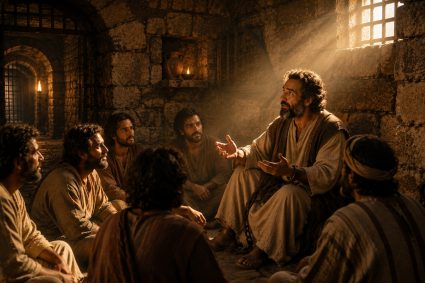
Hardly any biblical person embodies the theme of setbacks as clearly as Job. Within a very short time, he lost his possessions, his children, his health, and finally even the understanding of those around him. His suffering was so great that even his friends were speechless at first. Many people experience similar times, when everything seems to collapse at once and no explanation is visible. The story of Job shows that genuine faith does not depend on having all the answers. Sometimes faith means holding on to God even when we do not understand Him.
📜 2. The Biblical Foundation
Job lost almost everything that was important to him. His friends tried to explain his suffering with a simple formula:
“Whoever suffers must have sinned.”
But Job knew that reality was more complicated. In the midst of his pain, he confessed:
“I know that my Redeemer lives.” (Job 19:25)
And although he could not understand God’s ways, he said:
“I have kept to his way.” (Job 23:11–12)
Job’s story shows that God’s plan is often greater than what we can see in the moment.
🌍 3. Connection to Today
Even today, people experience situations they cannot explain. Illness, loss, disappointment, or an unfulfilled dream can raise deep questions:
Why is this happening?
Where is God?
Did I do something wrong?
Often people try to give quick answers, much like Job’s friends. But not every suffering is a direct consequence of personal guilt. Sometimes we simply live in a fallen world, where the great conflict between good and evil becomes visible.
💡 4. Central Message of the Lesson
👉 True faith trusts God even when His ways remain hidden and His answers do not come.
✝️ 5. Theological Focus
The book of Job opens a unique view behind the scenes of the great conflict between God and Satan. While Job suffers on earth, the reader learns something that Job himself does not know: his fate is connected to a cosmic conflict.
Satan claims before God that people serve God only because they are blessed:
“Does Job fear God for nothing?” (Job 1:9)
With this, Satan attacks not only Job but God’s very character. He claims that genuine love and genuine faith are impossible. In his opinion, people serve God only out of self-interest.
Job’s trials therefore become a demonstration of true faithfulness. Although he does not understand what is happening, he holds on to God. This does not mean that Job never asks questions. In fact, he laments, wrestles with God, and openly expresses his pain. Here the Bible shows an important principle:
Faith does not mean never asking questions.
Faith means bringing the questions to God.
It is also remarkable that God never explains to Job the real background of his suffering. In the end, Job does not receive a detailed answer to his “why.” Instead, he receives an encounter with God Himself.
This makes clear:
God’s greatest answer to human suffering is often not an explanation, but His presence.
Job learns that his trust must not be based on his understanding, but on God’s character.
🌌 6. Spiritual Deepening
One of the hardest aspects of suffering is that we often cannot recognize any meaning in it. We long for clear answers and understandable explanations. But many of the greatest tests of faith happen precisely where such answers are absent.
Job found himself in this situation. From his perspective, the events made no sense:
He had served God faithfully.
He had prayed for his family.
He lived uprightly.
And still, everything collapsed.
This reminds us that God’s work is often greater than our present perspective. Job saw only his pain. God saw the entire conflict between heaven and earth.
We too often see only the current chapter of our story. God, however, sees the beginning, middle, and end all at once.
Job’s statement is especially remarkable:
“I know that my Redeemer lives.”
He does not say:
“I understand everything.”
He does not say:
“I feel strong.”
He does not say:
“I have no doubts.”
His hope is founded solely on his Redeemer.
This is the heart of Christian faith. Our security does not lie in favorable circumstances, but in a living relationship with Christ.
Job also shows that suffering does not necessarily have to drive a person away from God. It can also draw them closer to God. Many of the deepest experiences of God’s presence arise precisely in the darkest hours of life.
Paul later expresses the same truth:
“For we walk by faith, not by sight.” (2 Corinthians 5:7)
Faith means trusting God more than circumstances.
It means holding on to God’s goodness even when we cannot recognize it in the moment.
It means saying:
“Lord, I do not understand everything, but I still trust You.”
That is precisely what made Job an example for all generations of believers.
🔧 7. Application in Daily Life
Practical steps:
Bring your questions honestly before God.
Do not compare your situation too quickly with others.
Avoid trying to explain every suffering immediately.
Hold on to God’s promises, even when feelings say something else.
Regularly remember how God has guided you in your life so far.
❓ 8. Reflection Question
Is there an area of my life where I am waiting for answers and need to learn to trust God even without complete understanding?
🌟 9. Closing Thought
Job lost almost everything, but he did not lose his faith. His story reminds us that God’s faithfulness is greater than our questions and that Christ remains by our side even when we cannot recognize His plan.