✉️ FIRST AND SECOND CORINTHIANS
🏛️ Lesson 1: Paul’s Ministry in Corinth
🚶♂️ 1.2 From Athens to Corinth
🔥 Paul Uses Every Opportunity for Proclamation
📖 1. Introduction
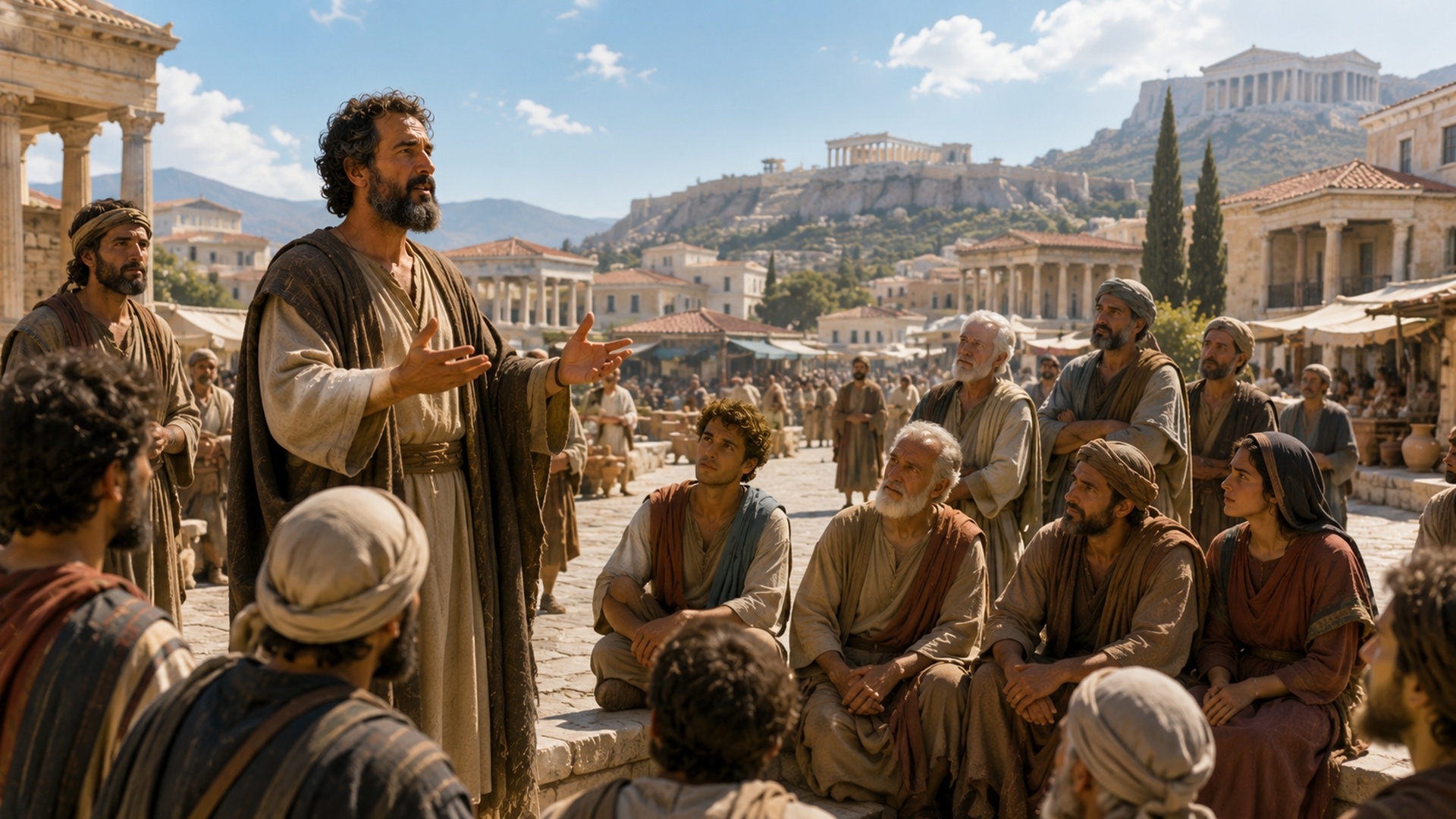
Paul came to Athens after he had to leave Berea because of opposition. Although Athens was apparently not his original missionary destination, he also used the opportunity there to speak about Jesus. While he was waiting for Silas and Timothy, he did not remain inactive. He saw the spiritual need of the city and began to share the gospel. Paul spoke in the synagogue, in the marketplace, and finally at the Areopagus. His example shows that whoever is filled with Christ finds opportunities to witness even in unplanned situations.
📜 2. The Biblical Foundation
In Acts 17 we read that Paul was in Athens and saw that the city was full of idols. The Bible reports:
“Now while Paul waited for them at Athens, his spirit was stirred in him, when he saw the city wholly given to idolatry.” Acts 17:16
Then Paul spoke with different people:
“Therefore disputed he in the synagogue with the Jews, and with the devout persons, and daily in the marketplace with them that met with him.” Acts 17:17
Later he was brought to the Areopagus, where he explained the unknown God to the Athenians and proclaimed the risen Christ to them.
In Acts 18 we then read that Paul came to Corinth. There he worked as a tentmaker, lived with Aquila and Priscilla, and continued to proclaim the gospel. Especially important is the statement:
“And he reasoned in the synagogue every sabbath, and persuaded the Jews and the Greeks.” Acts 18:4
🌍 3. Connection to Today
Today, too, many people live in a world full of distractions, different worldviews, and spiritual confusion. Like Athens, our present society is often interested in religion, but not truly directed toward the living God. Many people search for meaning, hope, and truth, but do not know where they can find them. Paul shows us that we should meet people where they are: in their questions, in their culture, and in their everyday life. At the same time, Corinth reminds us that mission is also possible in difficult places. God can use our work, our encounters, and even unplanned paths to make Christ known to people.
💡 4. Central Message of the Lesson
👉 Paul allowed neither opposition nor unplanned circumstances to stop him, but used every opportunity to proclaim Jesus Christ clearly and boldly.
✝️ 5. Theological Focus
The journey from Athens to Corinth shows that mission does not always follow human plans. Paul came to Athens because he had to move on from Berea because of opposition. Yet even this forced detour became an opportunity for God’s work. This shows us that God’s guidance can become visible even through difficult circumstances.
In Athens, Paul encountered a city full of idolatry, philosophy, and religious diversity. He could have remained silent or withdrawn. Instead, his heart was deeply moved. The spiritual blindness of the city did not leave him indifferent. True mission often begins where the heart is touched by people’s need.
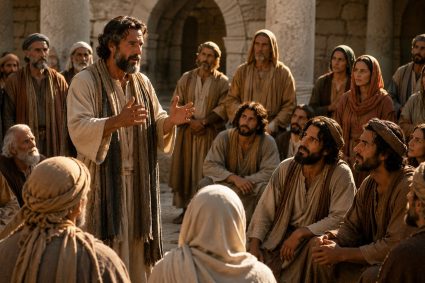
Paul first spoke in the synagogue. This corresponded to his usual missionary strategy. He first turned to the Jews and God-fearing people who were already familiar with the Holy Scriptures. But he did not remain only in the religious space. He also went to the marketplace, that is, to the place where public life took place.
This is theologically significant. The gospel belongs not only in the synagogue or in the church, but also in people’s everyday life. Christ should not be proclaimed only in worship services, but also where people work, discuss, search, and live.
At the Areopagus, Paul encountered the thinkers of Athens. He did not begin with attacks, but with a point of contact from their own religious world. He spoke about the “unknown God” and led his listeners step by step to the Creator, to judgment, and to the resurrection of Jesus. Paul adapted his method to his listeners, but not his message.
This is an important principle: the form of proclamation may change, but the content remains Christ. Paul was culturally sensitive, but spiritually clear. He understood the worldview of his listeners, yet he did not lead them to human philosophy, but to the living God.
When Paul later came to Corinth, his message remained the same. The environment there was different, but the spiritual need was just as great. Corinth was a commercial city, marked by diversity, moral problems, and religious confusion. There too Paul proclaimed that Jesus is the Christ.
This is summarized especially powerfully in 1 Corinthians 2:2:
“For I determined not to know any thing among you, save Jesus Christ, and him crucified.”
This does not mean that Paul knew or said nothing else. It means that Christ was the center of his proclamation. Everything else was understood from the perspective of the cross. For Paul, the gospel was not one message among many, but the power of God for salvation.
Paul also worked in Corinth as a tentmaker. Through this we see that mission is not always dependent on external support. Paul combined work and proclamation. His everyday life became part of his ministry. There is also an important lesson in this: God can use our profession, our abilities, and our contacts to carry his gospel forward.
🌟 6. Spiritual Deepening
Paul’s journey from Athens to Corinth speaks strongly into our personal lives. Often we experience situations that we did not plan. Doors close, people reject us, paths change. Yet in Paul we see that a difficult detour can become a divine assignment.
In Athens, Paul was actually only waiting for his coworkers. But his waiting did not become wasted time. He saw the city, recognized its spiritual need, and began to act. Many people miss spiritual opportunities because they are waiting for “better circumstances.” Paul shows us that God can also work while we are waiting.
The question is not only: Where would I like to serve? The question is also: Whom does God place before my eyes today? Which people do I encounter in everyday life? Which conversations open up? What need do I see that I should not pass by indifferently?
Paul could not stop speaking about Jesus because Christ filled his heart. This does not mean that he was pushy or disrespectful. But it does mean that Jesus was not a secondary matter for him. Whoever is inwardly moved by Christ seeks ways to share him naturally and honestly.
We too live in a kind of modern Athens. People have many convictions, opinions, and “idols.” Some trust in science, some in money, some in success, some in self-fulfillment, some in spirituality without Christ. This diversity can intimidate us. But Paul shows that the gospel can also be spoken in an intellectual and pluralistic environment.
At the same time, we also live in a kind of modern Corinth. Our cities are marked by busyness, moral confusion, consumption, distraction, and spiritual indifference. Many people are busy, but inwardly empty. Precisely there, Christians are needed who make Christ visible.
Paul teaches us that mission requires perseverance. Not everyone in Athens listened positively. Some mocked, others wanted to hear more later, and some believed. Today too, reactions will be different. Our task is not to force results, but to bear witness faithfully.
It is also important that Paul made his message understandable. He spoke to Jews differently than to Greek philosophers, but he always remained faithful to the gospel. From this we learn that we must understand the people we want to serve. Love listens before it speaks. But true love does not hide Christ.
In Corinth, Paul focused entirely on the proclamation of the Word. This shows that spiritual work requires concentration. Many things can distract us, even in the church. But the center remains the message of Jesus Christ, the crucified and risen One.
This lesson calls us to open our eyes. Perhaps there are people around us who are interested in religion, but without knowledge of God. Perhaps there are people who appear strong outwardly, but inwardly are searching for hope. Perhaps there are places we consider too difficult, even though God wants to work precisely there.
Paul reminds us: the gospel is not bound to ideal conditions. It can be heard in Athens, in the marketplace, before philosophers, in Corinth, in a workshop, in a synagogue, and in a simple conversation. What matters is a heart that loves Christ and is ready to use the opportunity.
🔧 7. Application in Everyday Life
Practical steps:
- Ask God to show you open doors for conversations about Jesus.
- Use even unplanned situations as opportunities for witness.
- Learn to understand people better in their world of life.
- Speak about your faith in a clear, loving, and respectful way.
- Keep Christ at the center and do not lose yourself in secondary issues.
- Do not be discouraged by rejection.
- Connect your everyday life, your work, and your relationships with your service to God.
- Pray for your city or community and ask God where he wants to use you.
❓ 8. Reflection Question
What opportunity for proclamation or personal witness has God perhaps already given me that I have overlooked until now?
🌟 9. Final Thought
Paul’s journey from Athens to Corinth shows that God can also use detours, waiting times, and difficult places for his work. Paul did not allow opposition, foreign culture, or spiritual confusion to stop him. He saw the people, recognized their need, and proclaimed Jesus Christ to them. His message remained clear: Christ is at the center, especially Christ as the crucified One. We too are invited to see our surroundings with spiritual eyes and to use every opportunity to pass on hope. Where Christ fills our heart, our everyday life becomes a place of witness.
“For I determined not to know any thing among you, save Jesus Christ, and him crucified.” 1 Corinthians 2:2 ✨🔥🚶♂️✝️