


Series: ✉️ FIRST AND SECOND CORINTHIANS with Pastor Mark Finley
Introduction:
In the 3rd quarter of 2026, we will study the letters to the Corinthians, two important letters written by the apostle Paul to a church full of challenges, questions, and spiritual struggles. Corinth was a wealthy and influential city, but it was also marked by idolatry, moral confusion, and conflicts that even affected the church. Paul did not write merely to correct problems, but to lead the believers back to the heart of the Christian life: Jesus Christ, and Him crucified. His message shows that the gospel is the foundation for unity, love, spiritual growth, service, and mission. Therefore, the letters to the Corinthians speak not only to the church of that time, but also to us today, because many of their challenges are very similar to those of our churches. These lessons invite us to place Christ once again at the center and to view our life, our church, and our service in the light of the cross.
Series: ✉️ FIRST AND SECOND CORINTHIANS with Pastor Mark Finley
🏛️ Lesson 1: Paul’s Ministry in Corinth
✝️ With Christ at the center: called, challenged, and sustained by God
Introduction:
In Lesson 1, we become acquainted with Paul’s ministry in Corinth, an important but spiritually challenging city. Paul did not come in his own strength or with his own message, but as an apostle of Jesus Christ called by God. His journey from Athens to Corinth shows that he used every opportunity to share the gospel. In Corinth he encountered opposition, moral problems, and religious confusion, yet God encouraged him to keep speaking and not to be silent. This lesson invites us to reflect on our own calling and to place Christ at the center of our life and service. It also shows that God has people even in difficult places whom He wants to reach.
Content:
📣 1.1 Paul, a God-called Apostle of Jesus
🙏 Called by God and fully centered on Christ
Paul does not understand his ministry as his own decision or as a human appointment, but as a calling through the will of God. His apostleship is firmly rooted in his encounter with the risen Christ and shapes his entire identity. That is why Paul repeatedly places Jesus at the center of his thinking, speaking, and actions. He sees himself as a servant, messenger, preacher, and teacher of Christ, whose task is to pass on the gospel. This calling also reminds us to ask God about our own place and mission in His service.
🚶♂️1.2 From Athens to Corinth
🔥 Paul uses every opportunity to proclaim the message
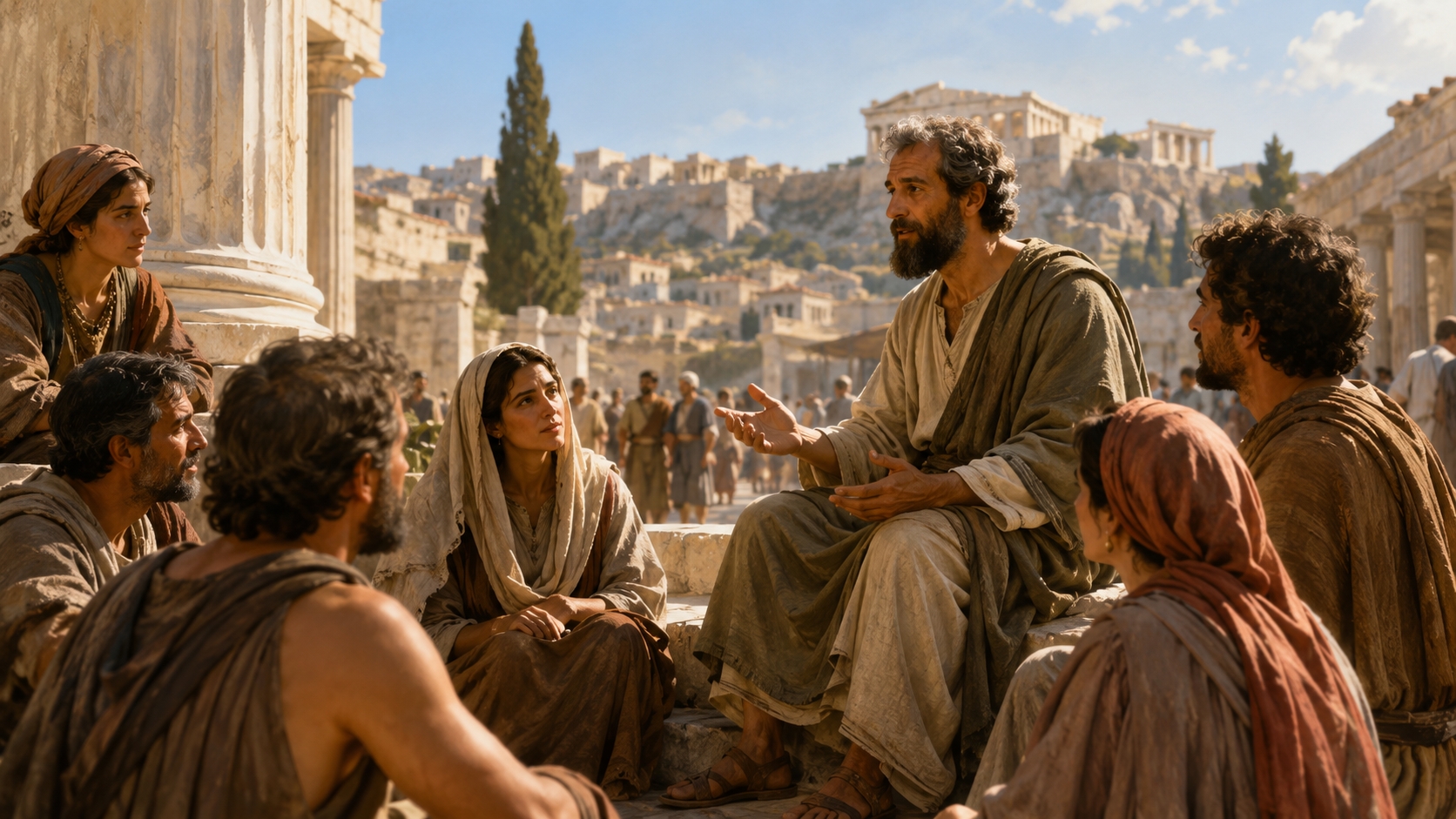
Before Paul came to Corinth, he was in Athens, where, despite a foreign culture and spiritual challenges, he courageously spoke about Jesus. He proclaimed the gospel in the synagogue, in the marketplace, and even before the thinkers on the Areopagus. In Corinth as well, his message remained clear: Jesus is the Christ and the Crucified One. Paul did not allow opposition or difficult circumstances to stop him, but remained faithful to his mission. His example shows that mission requires perseverance, clarity, and courage, especially in places where people think differently or reject the gospel. Today, too, we are invited to use every opportunity to share Christ in a clear and loving way.
🌆 1.3 The city of Corinth
💡 The gospel in the midst of a challenging city
Corinth was a wealthy, influential, and strategically important city where trade, culture, and religion were closely connected. For that very reason, Paul saw there a great opportunity to make the gospel known far beyond the city. At the same time, Corinth was marked by religious pluralism, idolatry, and moral looseness, which made the proclamation especially challenging. Yet Paul was not frightened away by the sin and confusion of the city; instead, he brought Christ precisely where people needed Him most. This shows us that God still wants to send His message today into difficult, secular, and morally confused environments. Our cities are often not so different from Corinth, and therefore we need the same courage, the same clarity, and the same love as Paul.
🙌 1.4 “Many in this city!”
👀 God sees people whom we do not yet see
In Corinth, Paul experienced opposition, slander, and rejection, especially from some of the Jews in the synagogue. Nevertheless, his work was not without fruit, for Crispus and many other Corinthians came to faith and were baptized. In his fear and weakness, Christ met Paul and encouraged him with the words: “Do not be afraid, but speak and do not be silent.” This promise showed Paul that God Himself stood behind his ministry and already knew people in that city who were open to the gospel. We too may trust that God is at work in difficult situations, even when we do not yet see the results. His presence gives us courage to keep going and to faithfully bear witness to Christ.
📝 1.5 Paul’s letters to the Corinthians
❤️ Letters born out of concern, love, and spiritual responsibility
Paul wrote to the Corinthians because their church was marked by many serious problems, including conflict, immorality, pride, and wrong thinking about matters of faith. His letters were not only correction, but also an expression of deep love and responsibility for the people God had entrusted to him. Paul did not want to shame the church, but to lead it back to Christ and help them see life through the lens of the gospel. In doing so, he showed that true spiritual leadership needs both truth and love. The problems in Corinth remind us that churches today also need renewal, humility, and Christ-centeredness again and again. Paul’s tears and concern show how deeply the spiritual well-being of his brothers and sisters mattered to him.
📌 1.6 Summary
🧭 Paul’s ministry in Corinth: called, challenged, and sustained by God
Lesson 1 shows that Paul did not understand his ministry as a human task, but as a calling through the will of God. On his way from Athens to Corinth, he used every opportunity to proclaim Jesus Christ. Corinth was a wealthy and influential city, but also morally and religiously challenging, where the gospel was especially needed. Despite opposition, fear, and weakness, God encouraged Paul with the promise that He had many people in that city. The letters to the Corinthians show how deeply Paul cared for the church and how much he wanted to lead it into a life fully centered on Christ. Today, this lesson also reminds us to accept God’s calling, to bear witness with courage, and to view our churches through the lens of the gospel.