
🟦 Introduction
In Lesson 2, the message of the cross is at the center. Paul shows that the gospel is not based on human wisdom, eloquence, or outward strength, but on Jesus Christ, the Crucified One. For many people, the cross appears to be foolishness or weakness, but for believers it is God’s power for salvation. At the cross, God reveals His love, His grace, and His wisdom in a way that surpasses human expectations. This lesson invites us to place our trust not in our own abilities or human logic, but in Christ alone. Whoever rightly understands the cross recognizes in it the core of Christian life and proclamation.
✉️
✉️ FIRST AND SECOND CORINTHIANS
✝️ Lesson 2: The Message of the Cross
📖 2.1 The Gospel of the Cross
⚡ The Cross as God’s Power and Wisdom
📖 1. Introduction
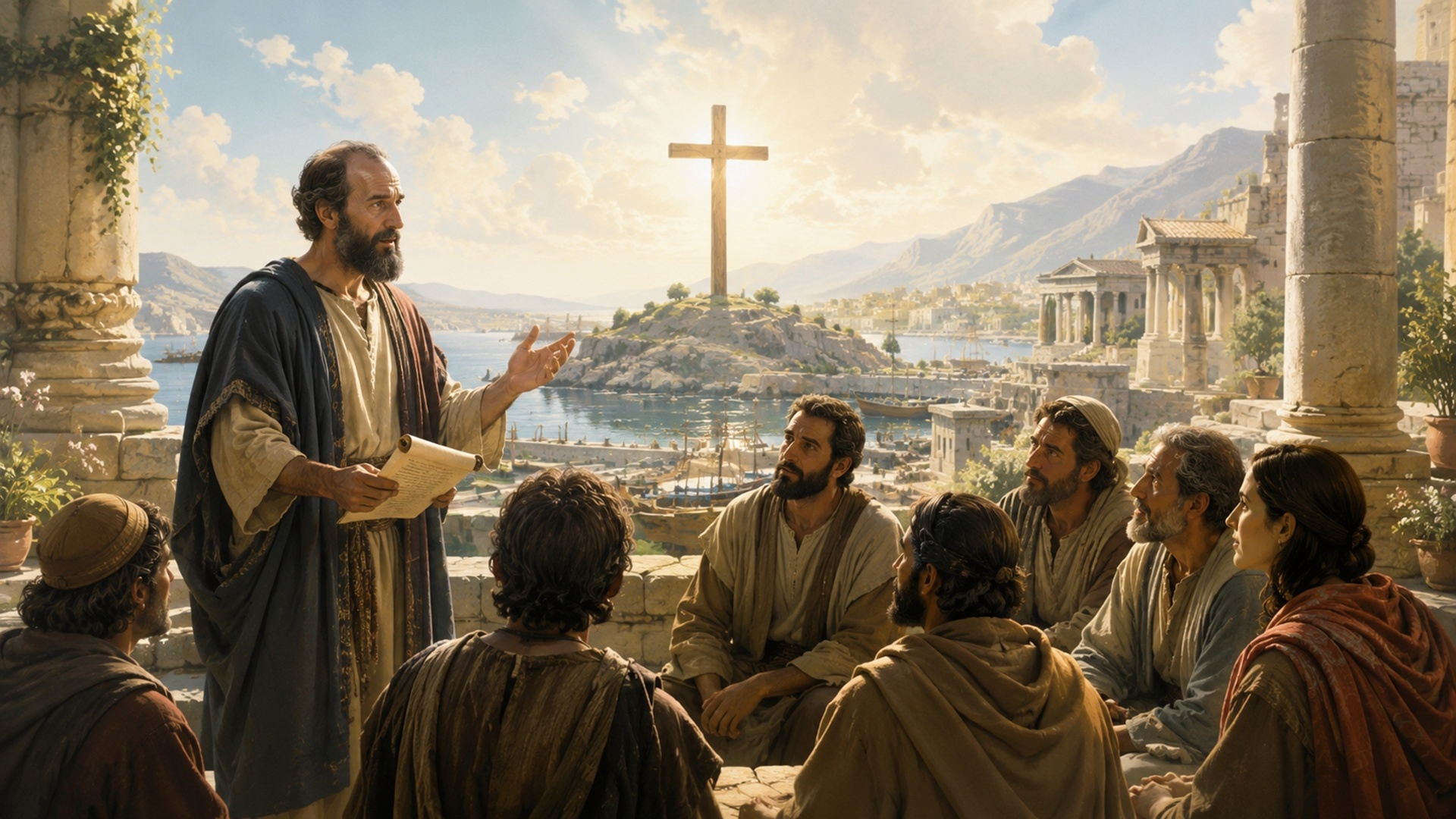
In Lesson 2, Paul begins with the center of his proclamation: the cross of Jesus Christ. For him, the gospel was not first of all a beautiful idea, a philosophy, or a moral teaching, but the message of Jesus Christ, the Crucified One. In Corinth, a city full of human wisdom, eloquence, and self-confidence, Paul deliberately chose not to appear with impressive rhetoric. He knew that the power of the gospel does not lie in human persuasion, but in the cross itself. The cross shows how serious sin is and how great God’s love is for us human beings. Whoever understands the cross recognizes the core of the Christian faith.
📜 2. The Biblical Foundation
Paul writes:
“For Christ did not send me to baptize, but to preach the gospel—not with wise words, lest the cross of Christ be emptied of its power.”
1 Corinthians 1:17
He continues:
“For the word of the cross is foolishness to those who are perishing, but to us who are being saved it is the power of God.”
1 Corinthians 1:18
And later Paul summarizes his proclamation in Corinth:
“For I determined to know nothing among you except Jesus Christ and Him crucified.”
1 Corinthians 2:2
These verses clearly show: For Paul, the cross is not on the margins, but at the center of the gospel.
🌍 3. Connection to Today
Today, too, we live in a world often shaped by achievement, knowledge, success, self-presentation, and human strength. Many people expect convincing arguments, emotional experiences, or visible evidence before they are willing to believe. To some, the message of the cross seems too simple, too weak, or too old-fashioned. Yet this is precisely where its power lies: the cross does not show what human beings can accomplish, but what God has done for humanity. Churches, too, are in danger of relying more on programs, methods, personality, or outward success than on the power of the gospel. Paul reminds us that nothing must replace the cross of Christ.
💡 4. Central Message of the Lesson
👉 The gospel of the cross is not human wisdom, but God’s power for salvation; therefore Jesus Christ, the Crucified One, must stand at the center of every proclamation and every Christian life.
✝️ 5. Theological Focus
The most important thought in this section is that Paul understands the cross as the center of the gospel. He does not say that other topics are unimportant, but he makes it clear that everything must be understood from the perspective of the cross. Without the cross, there is no forgiveness, no reconciliation, no redemption, and no true hope.
In 1 Corinthians 1:17, Paul says that Christ sent him to preach the gospel. This means that the proclamation of the cross was not his own idea, but his divine commission. Paul understood himself as a messenger of Christ, and his task was to pass on the saving message clearly.
At the same time, Paul emphasizes that he did not want to preach with “wise words.” By this he does not reject education, thinking, or understandable language. He himself was an educated man and could argue logically. But he knew that human eloquence can become dangerous when it covers over the message of the cross.
The problem is not wisdom itself, but a wisdom that exalts itself above God. When people think they can replace God with their own cleverness or judge the gospel by human standards, the cross becomes incomprehensible to them. The cross breaks human pride because it shows: human beings cannot save themselves.
Paul did not want the Corinthians to be impressed by the preacher, but by Christ. In a culture that admired skilled speakers, Paul could have tried to gain attention through brilliant rhetoric. But he knew: if people are impressed only by words but do not recognize the cross, their faith remains superficial.
That is why Paul says that the cross of Christ must not be emptied of its power. This is a serious thought. One can speak about the gospel and still cover it over with human pride, showmanship, manipulation, or self-presentation. The cross does not need human decoration in order to be powerful. It must be proclaimed clearly, faithfully, and with Christ at the center.
The cross reveals both God’s justice and God’s love. God’s justice becomes visible because sin is not simply ignored. God’s love becomes visible because Christ Himself bears our guilt. At the cross, judgment and grace meet.
For Paul, the cross was not only an event of the past, but the foundation of the entire Christian life. Whoever believes in Christ lives from the power of what Jesus accomplished on the cross. Christian faith does not begin with human improvement, but with God’s saving act.
The cross is also God’s answer to the problem of sin. Human wisdom can analyze, explain, and discuss, but it cannot redeem the heart. Philosophy can ask questions, but it cannot remove guilt. Science can discover many things, but it cannot reconcile human beings with God. Only Christ, the Crucified One, can save.
Therefore, the cross is God’s power. This power is not first shown in outward might, but in forgiveness, reconciliation, transformation, and new life. Where the cross is accepted, people are freed from guilt, hearts are renewed, and relationships with God are restored.
🌟 6. Spiritual Deepening
The message of the cross challenges us personally. It asks us: What do I really trust in? Do I trust in my own piety, my knowledge, my experience, my church membership, or my good works? Or do I trust completely in Christ and in what He did for me on the cross?
The cross removes every basis for pride. Before the cross, all people stand equal: sinners who need grace. No one can say: I am saved by my own wisdom or strength. No one can boast before God. Everything is a gift.
At the same time, the cross gives deep assurance. If my salvation is based on Christ and not on my performance, then I may have peace. My hope does not depend on whether I am strong enough, but on the fact that Christ is fully sufficient. The cross shows me: God has done everything necessary for my salvation.
Paul knew that the Corinthians were strongly shaped by their culture. They valued wisdom, eloquence, status, and human recognition. But the cross turned these values upside down. God revealed His power not through human brilliance, but through a crucified Savior.
We too must examine which values shape our thinking. Do we sometimes seek more impression than truth in the church? More style than substance? More human recognition than God’s presence? More success than faithfulness? The cross calls us back to the simplicity and depth of the gospel.
This does not mean that we should speak poorly, teach without preparation, or switch off our minds. Paul was not against thinking. But he was against human wisdom taking control over the gospel. Our thinking should serve the cross, not replace it.
Spiritually speaking, the cross is the place where our old self is exposed. There we see how destructive sin is. If sin were harmless, Christ would not have had to die. The cross shows the true price of redemption.
But the cross is also the place where God’s love shines most brightly. Christ did not die for perfect people, but for sinners. He gave Himself for people who could not save themselves. Therefore, the cross is the greatest revelation of divine grace.
For proclamation, this means: We must never grow tired of proclaiming Christ crucified. People do not first need religious entertainment, moral improvement, or philosophical explanations. They need Jesus. They need forgiveness. They need reconciliation with God.
In our personal life of faith, too, we must return again and again to the cross. When we become guilty, we find forgiveness there. When we become proud, we learn humility there. When we are discouraged, we see God’s love there. When we feel weak, we recognize God’s power there.
The cross also changes the way we treat other people. Whoever lives by grace will become more gracious toward others. Whoever knows that Christ died for sinners will not give up on people too quickly. Whoever recognizes God’s love at the cross is invited to pass that love on.
The message of the cross is simple, but not superficial. It is plain enough for every person to understand, and deep enough that we will never exhaust it. Paul made it the center because he knew: Without the cross, everything Christian loses its power.
🔧 7. Application in Daily Life
Practical steps:
- Consciously place Jesus Christ and His cross at the center of your faith.
- Examine whether you trust more in human strength or in God’s power.
- Regularly read Bible passages about Jesus’ suffering, death, and resurrection.
- Thank God daily for the redemption Christ accomplished on the cross.
- Speak about the gospel simply, clearly, and with Christ at the center.
- Make sure that methods, programs, or eloquence do not cover over the message.
- Learn not to boast in your achievements, but in the Lord.
- Return again and again to the cross when you face guilt, pride, or discouragement.
❓ 8. Reflection Question
Where do I still rely too much on human wisdom, impression, or my own strength instead of on the power of the cross of Christ?
🌟 9. Closing Thought
Paul knew that the message of the cross would seem incomprehensible or weak to many people. Nevertheless, he made it the center of his proclamation because only in the cross does God’s saving power become visible. The cross reveals the depth of human sin and, at the same time, the greatness of divine love. It removes every human boast and gives a hope that rests on Christ alone. Even today, nothing must displace or cover over the message of Jesus Christ, the Crucified One. Where the cross stands at the center, God’s power works for salvation, transformation, and renewal.
“For the word of the cross is foolishness to those who are perishing; but to us who are being saved it is the power of God.”
1 Corinthians 1:18 ✨📖⚡✝️