🍞 5.Give us today our daily bread
“Give us today our daily bread.”
Matthew 6:11
🕊️ A story – the manna in the morning
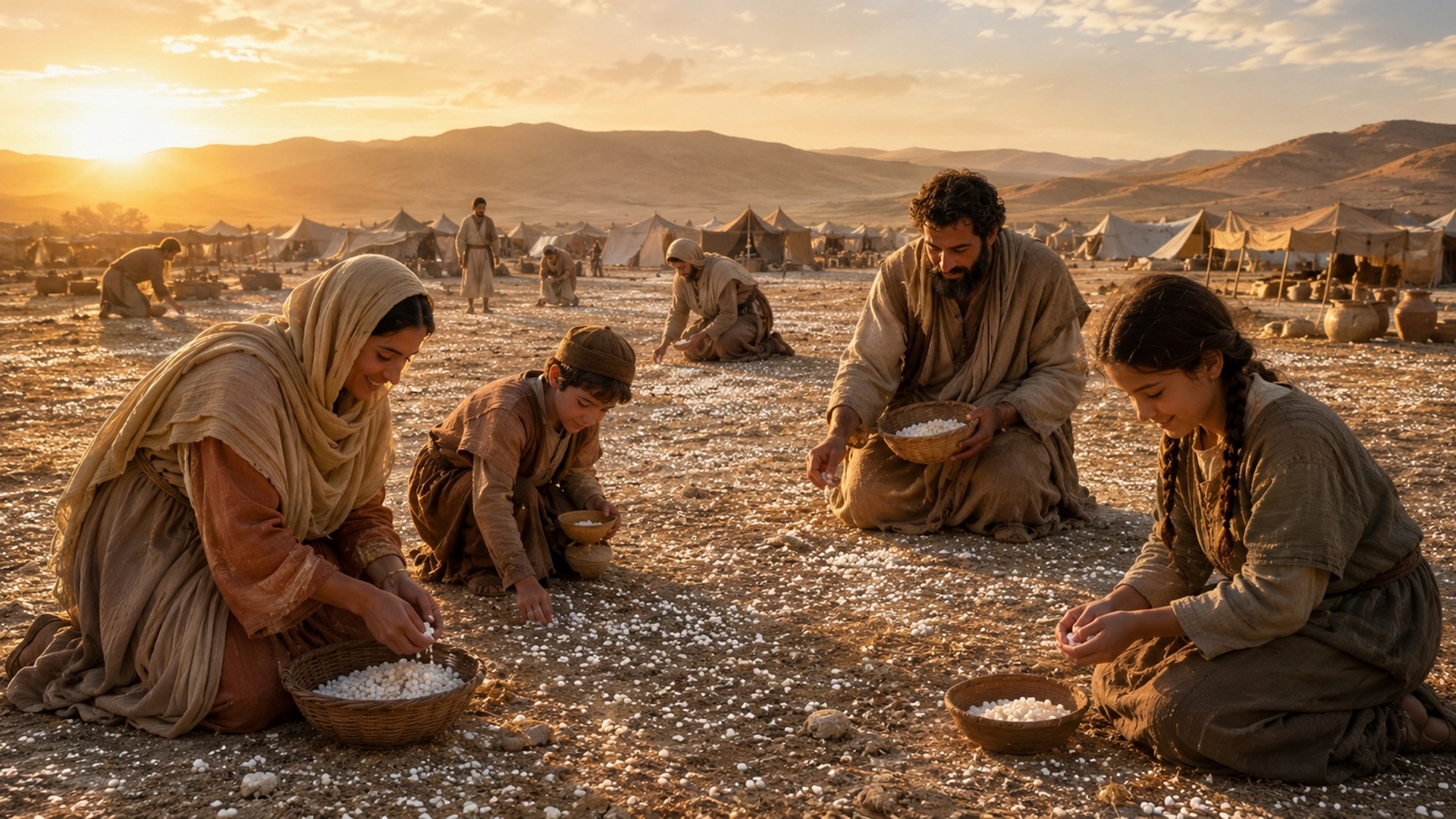
The wilderness was vast and barren. No field, no market, no supplies that could be planned or secured. The people of Israel were on their way, step by step, day by day – dependent on what was not in their own hands.
In the morning, something happened that they did not understand at first.
When the dew lifted, something lay on the ground. Fine, white, unfamiliar. They did not know what it was and asked, “Man hu?” – “What is this?” From this came its name: manna.
There was enough. For everyone. For every day.
But there was an instruction: they were not to gather more than they needed for the day. Whoever tried to store more discovered that it spoiled. It could not be secured.
The next morning, it was there again.
And again.
And again.
Thus began a journey on which the people had to learn something that is not self-evident: trust. Not for weeks in advance. Not for an entire life all at once. But for today.
🌿 What does “our daily bread” mean?
With this request, the prayer becomes very concrete. After the great thoughts – God’s name, His kingdom, His will – Jesus brings us back into everyday life.
“Our daily bread” stands for everything we need in order to live. Not only food, but also strength, guidance, and whatever carries us through the day.
And yet the emphasis rests on one word: today.
This request does not direct our eyes toward what we want to control, but toward what we are allowed to receive.
Ellen G. White describes it this way:
“In the request for daily bread, we acknowledge our dependence on God. We are reminded that everything we have comes from Him and that we may trust Him daily.”
(Ellen G. White, Thoughts from the Mount of Blessing, chapter “The Lord’s Prayer”)
And she further writes:
“God does not always give in advance for many days, but He invites us to trust Him step by step. This daily trust leads to a living relationship with Him.”
(Thoughts from the Mount of Blessing, chapter “The Lord’s Prayer”)
🔥 The need for security
It is not easy for us to live this way. We plan, we secure things, we think ahead. That is not wrong – but it can lead us to rely on what we ourselves can control.
The request for daily bread presents another perspective: I am provided for, but I am not independent. I have what I need, but it does not come from myself.
This way of thinking changes our outlook. It removes the pressure of having to carry everything ourselves and opens space for trust.
🌙 Provided for – even in the hidden places
It is interesting that the manna was often unobtrusive. Not a spectacular miracle in the sense of a grand display, but a quiet, daily provision.
Many things in our own lives happen in this way as well. Not always visible, not always consciously noticed, but nevertheless real.
Ellen G. White writes:
“Many do not recognize how often God provides for them because they have grown accustomed to His gifts. But whoever becomes attentive discovers that God works in the small things of everyday life.”
(Thoughts from the Mount of Blessing, chapter “The Lord’s Prayer”)
🌾 The Sabbath as a reminder of God’s provision
The Sabbath reminds us every week that, ultimately, we do not live by our own strength, but by God’s care. In a world that highly values performance, productivity, and self-sufficiency, the Sabbath gives a different sign. It invites us to pause for one day and recognize anew: God is the true giver of every good gift.
The request “Give us today our daily bread” takes on special meaning on the Sabbath. While on the other days we work, plan, and carry responsibility, on the Sabbath we are reminded that even our ability to work is a gift from God. Our life is not sustained by our efforts alone, but by His daily grace.
Israel had already learned this truth in the wilderness. The manna fell from heaven every day, but on the sixth day God gave a double portion. On the Sabbath, no one had to gather. No one had to provide for themselves. God had already provided.
Precisely here lies an important spiritual lesson. The Sabbath invites us to lay down, for a moment, the burden of self-provision. It reminds us that our heavenly Father already knows what we need before we ask Him.
Ellen G. White writes:
“The Sabbath was meant to strengthen human trust in God. It reminds us that the same God who created the world is also able to care for His children.”
How often are our thoughts filled with worries? How often do we ask ourselves whether we will have enough, whether the future is secure, or whether our strength will be sufficient? The Sabbath interrupts this cycle of worry. It turns our eyes away from our limited possibilities and toward God’s unlimited faithfulness.
On this holy day, we may consciously look back and recognize how God has led us. Many blessings seem ordinary in everyday life. Health, food, family, friends, protection, open doors, and new strength – much of this we often notice only when we come to rest. The Sabbath creates space for gratitude and opens our eyes to God’s daily provision.
But the Sabbath reminds us not only of bread for the body. It also points to nourishment for the soul. Jesus said: “I am the bread of life” (John 6:35). Just as our body needs food, our heart also needs fellowship with Christ. The Sabbath gives us time to receive this spiritual bread consciously – through His Word, through prayer, through fellowship, and through quiet encounter with Him.
Perhaps one of the most beautiful messages of the Sabbath lies in this: we do not have to earn God’s love. We do not have to work for it. Just as the manna was a gift, so His grace is also a gift. We may receive before we perform.
Therefore, the Sabbath becomes a weekly reminder of Jesus’ words: “Give us today our daily bread.” It invites us not to live in fear of tomorrow, but in trust in the God who provided yesterday, provides today, and will also care for His children tomorrow.
Thus, the Sabbath becomes a day of trust, gratitude, and assurance that we are safe in the hands of a faithful Father.
🤲 Invitation
Take a moment today and ask yourself: What do I truly live from? What really carries me through the day?
Speak these words consciously: “Give us today our daily bread.” And let them become an expression of your trust.
✨ Prayer
Father,
You know what I need – often better than I do myself.
I tend to rely on what
I can see and plan.
But I ask You:
teach me to trust You.
Help me to recognize
that You provide for me every day.
Give me what I need –
not only outwardly, but also inwardly.
And give me a heart
that is grateful for what You give.
Amen.