



🌿 Traces of Creation – Discoveries from Nature
🐟 3rd Series: Life in the Hidden Realm – The World of Fish
🎨 Episode 5 – Protection Without Armor – Camouflage, Color and Form
👁️ Introduction: To Be Visible Means to Be Vulnerable
In water, there is hardly any cover.
No walls.
No trees.
No fixed hiding places.
Whoever is seen
can be pursued.
Whoever stands out
becomes prey.
And yet fish live in open spaces,
often without hard shells,
without spines,
without armor.
Their protection does not lie in strength,
but in something far more subtle:
form, color and deception of perception.
🌫️ 1. Camouflage Is Not Coincidence
Camouflage is not “disappearing”,
but a deliberate not standing out.
Many fish are:
- dark on top
- light underneath
This principle is called countershading.
Viewed from above,
the dark back blends
with the depths.
Viewed from below,
the light belly matches
the light at the surface.
The fish is not invisible –
but it is hard to recognize.
🌈 2. Color as Adaptation to the Habitat
Fish colors do not arise at random.
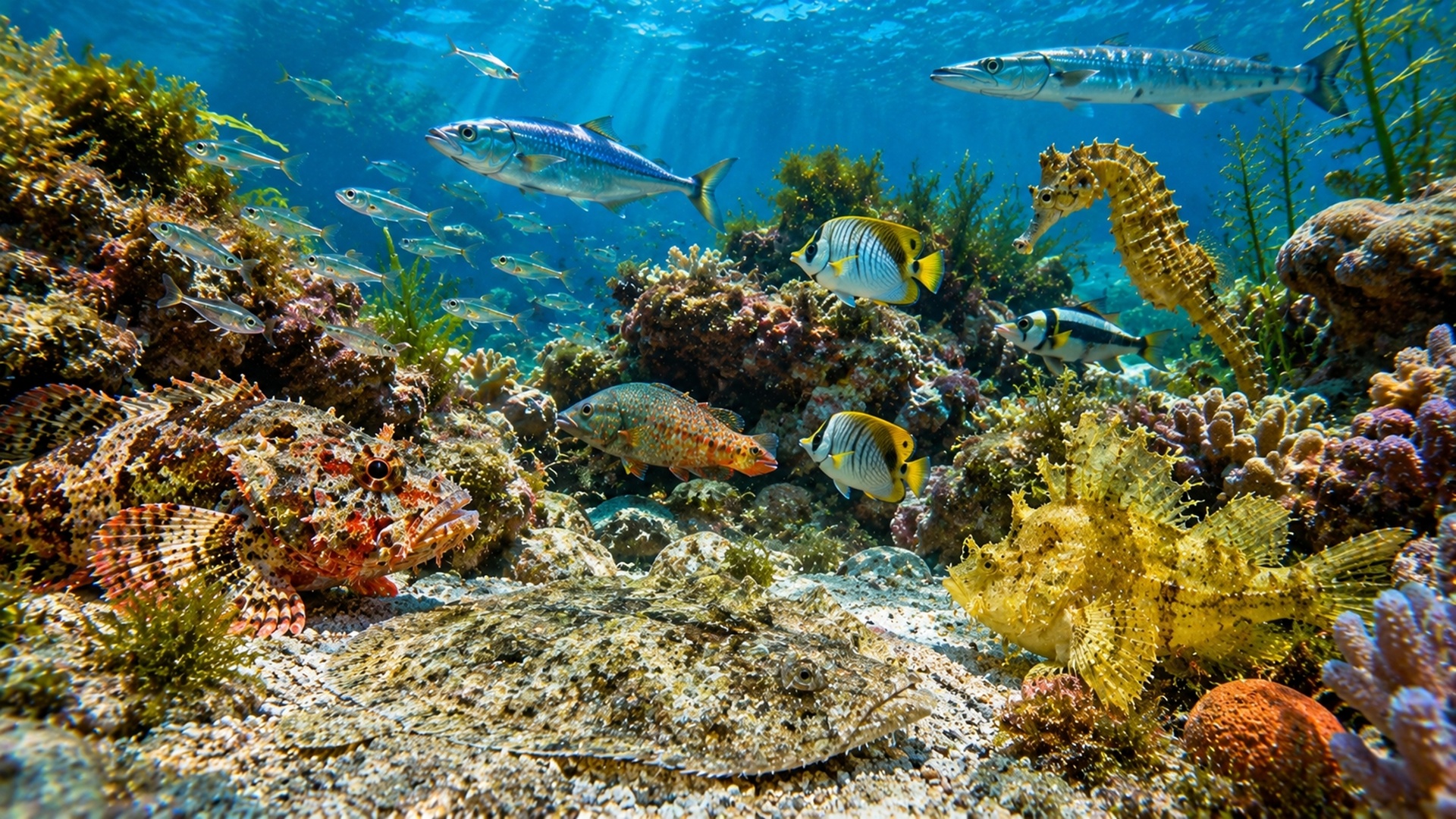
Reef fish often display:
- colorful patterns
- clear contrasts
Why?
Because coral reefs themselves are colorful, structured and full of movement.
In the open sea, however, the dominant colors are:
- silver
- gray
- blue
These colors reflect light
and distort the outlines of the body.
Color adapts to the optical environment –
not to aesthetic taste.
🐠 3. Form as Camouflage
Not only color,
but also body shape protects.
Flatfish:
- lie on the seabed
- are asymmetrical
- blend with sand or mud
Seahorses:
- resemble plants
- move slowly
- break up their own silhouette
Form deceives expectations.
A predator looks for “fish” –
but finds “background”.
〰️ 4. Patterns That Dissolve Movement
Some fish have stripes, spots or irregular patterns.
These do not serve as decoration,
but for disorientation.
During movement:
- outlines blur
- direction becomes difficult to estimate
- the predator loses focus
A clearly outlined body
is easier to follow
than a visually “broken” one.
Here, order protects through confusion –
not through chaos.
🦎 5. Color Change – Adaptation in Real Time
Some fish can actively change their color.
Not permanently,
but depending on the situation.
They adapt to:
- the substrate
- lighting conditions
- mood or stress
This color change is:
- fast
- controlled
- reversible
It requires:
- sensory perception
- neural control
- precise pigment movement
Here, protection arises through active response,
not through rigid structure.
🧠 6. Protection Without Consciousness
A fish does not think about camouflage.
It does not analyze.
It does not plan.
And yet its behavior is:
- appropriate to the situation
- reliable
- effective
This shows:
Protective mechanisms are integrated,
not reflected upon.
They function
because they must function.
🐣 7. Effective from the Very First Moment
A young fish is especially vulnerable.
It is:
- small
- slow
- barely protected
For this very reason, camouflage must work
from the first day of life.
A pattern that only works “later”
would be worthless.
Protection is not a learned skill,
but initial equipment.
🛡️ 8. A Rational View of Defense
In technical systems, the following applies:
The best protection is the one
that costs no energy.
Camouflage:
- requires no force
- causes no resistance
- draws no attention to itself
It is one of the most efficient forms of defense.
That nature uses this principle so consistently
is functionally logical –
not accidental.
✝️ 9. The Christian Perspective: Protection Through Measure
The Christian perspective emphasizes
that protection does not always come through strength.
Not everything is armored.
Not everything is armed.
Some things are preserved
by being embedded.
Fish are part of their habitat –
not foreign bodies within it.
This form of protection
is quiet,
but effective.
💡 10. What Camouflage and Form Teach Us
They teach us:
- protection does not have to be visible
- adaptation can preserve
- strength also shows itself in the unobtrusive
Perhaps they also remind us
that not every kind of security
arises from separation.
🌌 Final Thought
A fish glides through the water,
visible –
and yet hidden.
Not because it hides,
but because it belongs.
Whoever takes this quiet form of protection seriously
discovers even in color and form
traces of Creation.
