📘 Lesson 3 – Images From Marriage
3.6 Summary
God’s Love in His Covenant with His People
🟦 Introduction – A Love Story with Eternal Value
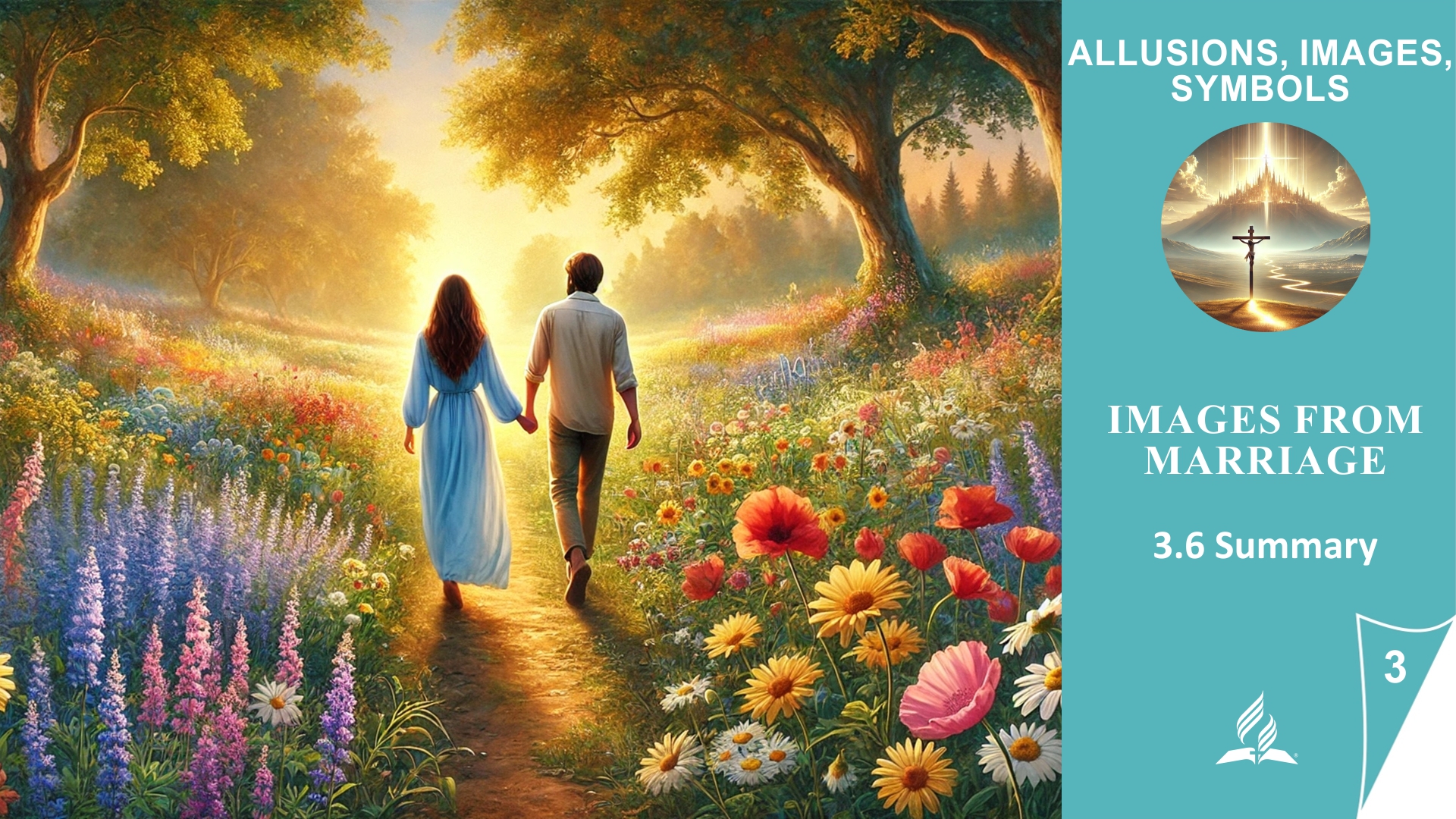
The Bible begins with a marriage—and it ends with one. From Genesis to Revelation a red thread runs through all of Scripture: the language of love, faithfulness, and covenant. Marriage is not merely a social construct or a romantic ideal but a prophetic symbol. It tells—sometimes in fragments, sometimes in radiant clarity—of God’s relationship with His people.
As we’ve walked through this lesson, we’ve discovered not only what God intends for human marriage but something far greater: that the Creator Himself is the Bridegroom—and we are His Bride.
📖 In-Depth Bible Study – Marriage as Divine Parable
-
3.1 One Flesh (Genesis 2:23–25; Ephesians 5:29–32)
Marriage begins with intimacy and unity. Adam recognizes Eve as “bone of my bone.” Paul sees in this a picture of Christ and His church—a union of love, devotion, and sacrifice. In marriage, God’s character should be visible: forgiveness, acceptance, self-giving.
-
3.2 The Beautiful Bride (Ezekiel 16:4–14)
God doesn’t look at us by our origins but by His love. Israel was abandoned and cast off—yet God raised her up as a queen. Her beauty was His work, not her merit. This truth guards us against spiritual pride: all that is good in us is grace.
-
3.3 Hosea’s Harlot Wife (Hosea 1:2; 3:1; Revelation 17–18)
God loves an unfaithful people. He even calls His prophet to marry a prostitute to show His heartache. But the message is not only judgment but restoration: God calls out of Babylon because He still loves.
-
3.4 Isaac and Rebekah (Genesis 24)
Rebekah comes from far away—like us, separated from heaven by sin. Yet she chooses freely for Isaac, as we choose for Christ. The Bride is fetched and guided by the servant—a picture of the Holy Spirit.
-
3.5 The Harlot Is Judged (Revelation 19; 21:1–4)
In the end comes final separation: Babylon falls—the Bride is sanctified. Judgment and wedding converge. The world God rejected is judged, but those who love Him celebrate an eternal wedding feast.
✨ Spiritual Principles
-
Marriage is a divine mirror—not perfect, but prophetic.
-
Love is not a feeling but a choice.
-
Unfaithfulness wounds—but God’s love endures.
-
The Bridegroom comes—and He comes to stay.
🧭 Practical Application
-
Live marriage as the Gospel: Forgive as Christ does. Love unconditionally. Serve with devotion.
-
Nurture your relationship with God daily: Say “Yes” to Him—not once, but continually. Read His Word. Talk with Him. Remain faithful.
-
See the church as the Bride: She’s not perfect, but she’s loved. Be patient with her. Be part of her. And rejoice with her on the day she is adorned like a Bride for her Husband.
✅ Conclusion – Beloved Bride of God
God sees us not as we are but as we can be in Christ. Marriage reveals a mystery: that heaven does not stay distant but binds itself—not to a concept, but to people.
Therefore the church is not a religious association but the betrothed of heaven. And you—if you confess Christ—are part of that Bride.
💬 Thought of the Day
You are loved—not because you are perfect, but because your Bridegroom loved you enough to give Himself for you.
✍️ Illustration – The Invitation to the Wedding
Hamburg. Early summer. A gray, drizzly Tuesday morning.
Mara stood in the kitchen of her small old-style apartment, staring at the courtyard where a lone chestnut tree sprinkled wet cobblestones with blossoms. The stale smell of her coffee mingled with the fresh air from the cracked window.
Her life felt like the day—gray, dampened by the rain of recent years. After her divorce she’d moved back into her late grandmother’s house. Her marriage—once full of dreams—had failed under estrangement, pain, and unspoken pride. Since then, “connection” felt more like a novel’s idea than reality.
In the mail—among junk and official letters—she noticed a plain envelope. Thick paper, hand-addressed: “To Mara.” No sender. No logo. No date. She hesitated, then opened it.
Inside was only a card—simple yet elegant. In gold letters:
“You are invited. The marriage feast of the Lamb draws near.”
Below:
📖 “And His Bride has made herself ready.” – Revelation 19:7
Mara frowned. What was this? A Christian cult? Poetic marketing? Yet something about it wouldn’t let her go. The words sounded oddly personal— as if someone not only invited her, but recognized her.
That evening she googled the verse. She found a Christian website explaining the parable of the Lamb’s wedding feast— a heavenly marriage. Christ as Bridegroom. The church as His Bride.
“I’m not church,” she thought. “I’m not even religious.”
But the theme lingered. The next Sunday she ventured into a small free church she’d always dismissed in passing: “Not for me,” she’d thought.
She sat in the back, silent, observing. The room was plain. No incense. No icons. Just people. And a message that struck her like warm light in cold fog:
“God did not fall in love with the perfect woman, but with the broken one. With you. With me. The church is not beautiful because she deserves it, but because she is loved.”
Mara felt tears. Not because of religion—but because of hope.
After the service she spoke with the pastor. “What if you don’t believe you’re lovable?”
He smiled. “Then you are exactly the Bride Jesus invited.”
In the following weeks she kept coming. Not because she understood—but because she felt understood. She read the Bible—not as a rulebook, but as a love letter. Especially the stories of the Bride, the adulterous wife still embraced. She saw herself in Gomer. In Rebekah. In the nameless woman whose tears Jesus wiped away.
One evening at a Bible study, she spoke up for the first time:
“I think… I want to say Yes. Not to a religion. To the One who invited me. Who said, ‘You are my Bride.’”
Silence. Then smiles. Then prayer.
Two years later.
Mara stands in a white dress—not at a human wedding but at her baptism. The sun shines. The river sparkles. Birds sing.
She steps into the water—not to escape, but to declare:
“I am the one who was invited. And I say Yes.”