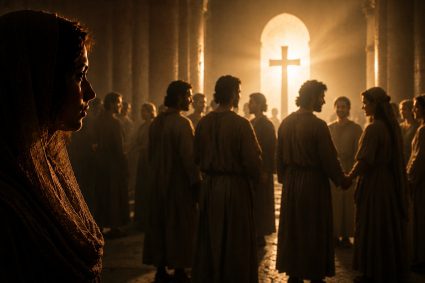
How do you live faithfully when you are persecuted?
How do you build a church while in chains?
How does the gospel grow when the apostle is absent?
These questions are at the heart of the letters to the Philippians and Colossians. Paul, himself a prisoner, writes to churches under pressure—both from outside and within. And yet every line shines with this truth: God continues to work—through devotion, order, and spiritual perseverance.
This week’s lesson teaches us that God’s church is not sustained by circumstances, but by Christ. Persecution may be real, but abandonment is impossible when Christ stands at the center.
………………..✉️………………..
📖 Bible Study
🔹 1. Paul – a prisoner, but not imprisoned
Philippians 1:13:
“…so that it has become known throughout the whole praetorian guard and to everyone else that my imprisonment is for Christ.”
Paul does not describe his imprisonment as defeat, but as a platform for the gospel. His “chains in Christ” became a testimony—even in “Caesar’s household” (Phil 4:22). Circumstances did not define his calling; they served it.
────────────────────────
🔹 2. Suffering as a calling—not as punishment
Acts 9:16:
“For I will show him how much he must suffer for my name.”
Paul knew that suffering was not an accident, but part of his mission. This helped him not only endure trials, but interpret them spiritually. His prison letters—including Philippians, Colossians, Ephesians, and Philemon—are today foundational texts of our faith.
────────────────────────
🔹 3. Spiritual steadfastness—in chains, but not broken
2 Corinthians 4:7–12:
“…hard pressed on every side, but not crushed; perplexed, but not in despair…”
Paul encourages us: Christ lives in fragile vessels. His power is revealed precisely when human resources fail. Paul trusts spiritual resources—truth, holiness, grace—rather than outward strength.
────────────────────────
🔹 4. Church planting without personal presence
Colossians 1:7:
“…as you learned it from Epaphras, our beloved fellow servant…”
Paul had never visited Colossae. Yet through faithful coworkers like Epaphras, a vibrant church grew there. This shows that the mission did not depend on Paul—but on reproduction and discipleship.
────────────────────────
🔹 5. Order in the church—not control, but a structure of service
Philippians 1:1: “…with the overseers and deacons”
Colossians 1:2: “…to the holy and faithful brothers…”
From early on, the church had responsible, spiritually guided structures. Paul knew: without leadership, the body of Christ scatters. With leadership, it grows.
………………..✉️………………..
💎 Spiritual Principles
-
God is not dependent on circumstances—only on faithful hearts.
-
Suffering is often part of the mission—not its failure.
-
The church thrives through spiritual order, not chaos.
-
The gospel grows through multiplication, not centralization.
-
The true power of the gospel is revealed in weakness.
………………..✉️………………..
🛠️ Everyday Application
• Do you feel trapped by illness, pressure, or fear? → Remember: Paul wrote world-changing letters in chains.
• Do you see no progress? → Paul worked through others, not only through himself.
• Do you doubt your church? → Order is not the enemy of the Spirit—it is its foundation.
• Do you feel “small”? → Colossae was small—but God did great things through faithful believers.
………………..✉️………………..
✅ Conclusion
God uses our weakness, our wounds—even our chains—when we place them in His hands. Paul shows us:
The prisoner of Christ is the freest person in the world.
And churches built on spiritual identity and healthy structure bear fruit—for generations.
………………..✉️………………..
💭 Thought of the Day
“A person in chains can accomplish more than a hundred people in freedom—if Christ lives in him.”
………………..✉️………………..
✍️ Illustration
“Letters from the Quarantine Zone”
A story of church, calling, and faithfulness in the 21st century
Part I – The City Behind the Fence
The city was called San Martín del Sur.
A mid-sized metropolis somewhere between sea and mountains in South America. Once known for trade, music, and open squares. Now it was known for checkpoints, drones, and digital surveillance.
Religion was not forbidden—but strictly regulated. Public proclamation was considered “socially destabilizing.” Churches were allowed to exist as long as they remained invisible.
Andrés Ferreira, 47 years old, was a church leader in San Martín. Not a salaried pastor, but a history teacher. Father of three. Quiet, analytical, faithful to Scripture.
One morning, after a house service with twelve people, there was a knock at the door.
“Mr. Ferreira, you are temporarily detained.
Suspicion: unauthorized religious gathering.”
No shouting. No violence. Just handcuffs.
Part II – The Windowless Room
The room was small. Concrete. No window. A camera in the corner.
Andrés sat on a metal chair. He was given paper. No phone. No internet.
An officer said, “You may write. It calms people.”
Andrés smiled faintly.
He thought of Paul.
“Perhaps this is my pulpit,” he thought.
He began to write—not accusations, not demands.
He wrote letters to the church.
Part III – The First Letter
“To the saints in Christ in San Martín—
not to the brave, but to the called.
Not to the strong, but to the faithful.”
He reminded them:
• that the church is not a building,
• that order is not an enemy of the Spirit,
• that Christ reigns even behind walls.
“I am not a prisoner of the state.
I am a prisoner of Christ.”
The officer read along. Said nothing.
But he carried the letter out.
Part IV – The Churches Without Names
The church did not fall apart. It multiplied.
As in Colossae, where Paul had never been, new groups emerged—without Andrés.
• Lucía, a nurse, led a house group.
• Mateo, a student, took over Sabbath School.
• Rosa, a widow, cared for the needy.
They did not call themselves “church.”
They called themselves “the fellowship.”
They had elders.
They had deacons.
They had clear responsibilities.
Not out of compulsion—but out of love.
Part V – The Second Letter: Order
Andrés wrote again:
“Freedom without order becomes chaos.
Order without love becomes tyranny.
Christ calls us to both.”
He reminded them of Acts 6, Philippians 1, Colossians 1.
“Appoint elders.
Care for one another.
Let no one fight alone.”
The letters were copied.
Passed on.
Memorized.
Just like with Paul.
Part VI – The Guard
His name was Javier Molina.
38 years old. Two children. No religion.
He brought Andrés food every day.
He heard him pray.
Not loudly—but consistently.
One day he asked, “Why are you so calm?”
Andrés replied, “Because I am not alone.”
Javier laughed at first.
Later, he asked for a Bible.
Part VII – The Third Letter: Suffering
“When we suffer, we are not forgotten.
When we are persecuted, we are not abandoned.
Christ was here first.”
“Afflicted, but not crushed.
Persecuted, but not abandoned.”
The letter went viral—anonymously.
People shared it in secret.
Part VIII – The Guard’s Decision
One night, Javier stayed longer.
“My wife is sick.
I don’t know what to believe.”
Andrés said, “I only know whom I belong to.”
They prayed.
Silently. Without words.
Javier began to pass on the letters intentionally.
Part IX – The Release
After six months, Andrés was released.
No apology. No trial.
He came home—and found not an empty church, but a grown one.
New leaders.
New groups.
New baptisms.
He wept.
Part X – The Final Letter
On Sabbath, Andrés did not step into the pulpit.
He sat in the last row.
Lucía preached.
Mateo led the singing.
Rosa organized the service.
Andrés understood:
“The church has learned to live without me.
That is exactly what God wanted.”
He wrote his final letter:
“It is not the apostle who carries the church—
Christ does.”
………………..✉️………………..
📌 Final Reflections on the Story
This story shows, in modern language, what Paul lived:
• The church grows under pressure.
• Order protects spiritual life.
• Persecution can lead to multiplication.
• The prisoner of Christ is never abandoned.