

✉️ FIRST AND SECOND CORINTHIANS
🤝 Lesson 3: Unity in Christ
🎯 3.2 Focused on Jesus
🕊️ Unity arises when Christ is at the center
📖 1. Introduction
Paul calls the church in Corinth to be united “in the same mind and in the same judgment.” By this, he does not mean that all believers must think alike, speak alike, or possess the same gifts. Rather, everyone should submit their thoughts, opinions, and relationships to Christ. The church was in danger of gathering around human leaders and personal preferences instead of looking together to Jesus. Paul reminds them that Christ is not divided and that He alone was crucified for the church. True unity therefore does not arise through humanly imposed uniformity, but through a shared focus on Jesus Christ.
📜 2. The Biblical Foundation
Paul writes:
“Now I appeal to you, brothers and sisters, in the name of our Lord Jesus Christ, that all of you speak the same thing and that there be no divisions among you, but that you be perfectly joined together in the same mind and in the same judgment.” 1 Corinthians 1:10
Then he asks the decisive question:
“Is Christ divided? Was Paul crucified for you? Or were you baptized in the name of Paul?” 1 Corinthians 1:13
Later, Paul describes the church as the body of Christ:
“Now you are the body of Christ, and each one of you is a member of it.” 1 Corinthians 12:27
These verses show that the church consists of many members, but it has only one Head and one center: Jesus Christ.
🌍 3. Connection to Our Time
Churches today can also be burdened by differing opinions, preferences, personalities, or group divisions. Some prefer certain preachers, while others prefer particular music, traditions, programs, or styles of leadership. Diversity is not a problem in itself, as long as Christ stands above everything. It becomes dangerous when personal preferences become more important than unity in Jesus. Our age strongly emphasizes individuality and freedom of opinion, but the church is called to be more than a collection of personal interests. It is the body of Christ, and every part should serve the whole body.
💡 4. Central Message of the Lesson
👉 Unity in the church does not arise because everyone is the same, but because everyone is focused together on Jesus Christ and submits their thoughts, opinions, and relationships to Him.
✝️ 5. Theological Focus
The central idea of this lesson is the lordship of Jesus over His church. Paul reminds the Corinthians that they were called “into fellowship with His Son, Jesus Christ our Lord.” The church, therefore, is not primarily a human organization, but a community that belongs to Christ.
When Paul asks, “Is Christ divided?” he shows how absurd divisions within the church are. Christ is one. His body cannot be split into competing parties without damaging the very nature of the church. Every division that places people above Christ contradicts the gospel.
Paul also asks, “Was Paul crucified for you?” With this question, he leads the church back to the cross. No human leader has redeemed the church. No preacher, teacher, or apostle carried its guilt. Christ alone was crucified for it. Therefore, the church’s loyalty belongs first and completely to Him.
Baptism also points to this truth. Believers were not baptized in the name of Paul, but in the name of God. Baptism means belonging to Christ, not belonging to a human party. A baptized person does not primarily bear the mark of a group, but the mark of Christ’s lordship.
When Paul speaks of being united “in the same mind and in the same judgment,” he does not mean uniformity. The church should not consist of people who all have the same personality, the same task, or the same manner of expression. In 1 Corinthians 12, Paul shows that the body has many members. Diversity is part of God’s plan.
Yet this diversity needs a common center. A body can function only when all its members are connected to the head. In the same way, the church can be healthy only when all believers live under the leadership of Christ. Different gifts become a blessing when they serve Christ.
Unity therefore does not mean erasing differences, but ordering those differences in Christ. One person serves through teaching, another through encouragement, another through practical help, another through leadership or prayer. Yet all serve the same Lord.
The term Paul uses for “perfectly joined together” points to restoration. Something that has been damaged or fallen out of order is to be brought back into its proper place. In Corinth, relationships, thinking, and spiritual priorities needed to be refocused on Christ.
The theological core is therefore this: Christ is the Head, the cross is the foundation, and the Spirit is the power of unity. Where Christ reigns, human pride loses its power. Where the cross stands at the center, party spirit and selfishness are exposed. Where the Spirit works, genuine fellowship grows.
🌟 6. Spiritual Deepening
This lesson confronts each of us personally with the question of what our thinking is focused on. It is possible to belong to the church and yet inwardly be strongly guided by personal preferences, sensitivities, or human opinions. Paul calls us to submit our thoughts to Christ.
To be focused on Jesus means that I do not first ask: What do I like? Who supports my opinion? Which group agrees with me? Instead, I ask: What honors Christ? What builds up the church? What serves peace and truth?
This is not always easy. Our ego often wants to be seen, affirmed, and defended. When our opinion is questioned, we quickly feel hurt. When our preferences are not taken into account, we withdraw or seek out like-minded people. This is precisely where Christ must become the center.
Unity does not begin primarily in meetings, programs, or structures, but in the heart. If Christ is my Lord, I must not make my ego my lord. If Christ was crucified for me, I cannot live as though my opinion were the center of the church.
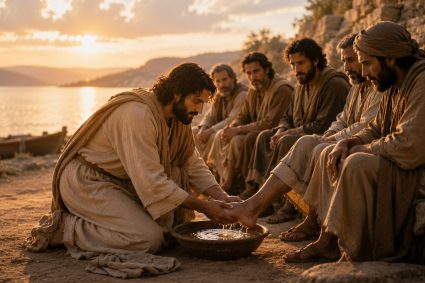
The cross teaches us humility. Jesus gave up His rights, humbled Himself, and gave Himself for us. Those who are focused on Him will not constantly seek their own recognition. They will be willing to listen, forgive, serve, and put themselves aside.
At the same time, unity does not mean abandoning truth. Paul did not seek superficial harmony in which problems were ignored. He addressed the divisions openly. True unity does not arise by suppressing problems, but through a shared return to Christ and His Word.
Small groups can also be very helpful in this regard. A small group is healthy when it leads people closer to Jesus, to the Word of God, to prayer, and to the whole church. It becomes dangerous when it isolates itself, speaks negatively about others, develops its own interests, or considers itself spiritually superior.
The difference between a healthy small group and a clique lies in its center. A small group asks: How can we follow Christ more faithfully and serve the church? A clique asks: How can we strengthen our opinion, our circle, or our influence?
Therefore, small groups need openness, humility, and connection to the whole church. They should not be little islands, but living cells within the body of Christ. They should promote unity, not separation.
Being focused on Jesus also changes the way we view leaders. We may appreciate leaders, learn from them, and pray for them. But we must not make them the center of our spiritual identity. Every human leader is only a servant of Christ.
When Christ is at the center, different leaders and gifts can work side by side without creating rivalry. Paul, Apollos, and Cephas were not to be set against one another. They all served the same Lord. In the same way, different ministries today should work together rather than compete with one another.
The church needs to renew this spiritual focus again and again because division often develops gradually. An unresolved conversation, wounded pride, a favorite opinion, or a group of like-minded people can slowly grow into separation. Therefore, we must continually return to Christ.
Unity is not merely an organizational goal, but a spiritual witness. Jesus said that the love among His disciples should be a sign to the world. When people see that Christians remain united in Christ despite their differences, the gospel becomes visible.
We cannot create this unity by our own strength. We need the Holy Spirit. He directs our hearts toward Christ, gives us humility, and reminds us that we are all members of one body.
🔧 7. Application in Daily Life
Practical steps:
- When disagreements arise, first ask what honors Christ.
- Pray for unity in your church and in your small group.
- Listen humbly to others, even when they think differently from you.
- Avoid turning people against one another.
- Appreciate leaders, but do not make any human being the center of your spiritual identity.
- Examine whether your group or circle of friends unites the church or divides it.
- Submit personal preferences to the well-being of the body of Christ.
- Ask the Holy Spirit to focus your thoughts and actions on Jesus.
❓ 8. Reflection Question
What opinion, preference, or human relationship may have become more important in my heart than unity in Christ?
🌟 9. Closing Thought
Paul calls the church to be united in the same mind and in the same judgment because Christ Himself is not divided. The church does not belong to human leaders, groups, or preferences, but to Jesus Christ, who was crucified for it. Unity does not mean uniformity, but a shared focus on the Lord. Where Christ is at the center, different gifts, personalities, and tasks can work together in harmony. Therefore, we must continually submit our ego, our opinions, and our relationships to the cross. A church becomes strong when it does not revolve around people, but when everyone looks together to Jesus.
“Is Christ divided?” 1 Corinthians 1:13 ✨🎯🕊️✝️