



🤩 Bible Stories to Marvel At
Where God’s miracles become great – for little and big children
⚡ Job Chapter 18 – Bildad Speaks Harshly Again
🔥 When warnings sound like thunder
🌅 Introduction
In the previous chapter, Job had spoken very darkly. His strength was almost gone, his eyes were tired from weeping, and his hope felt small and fragile. He had said that his days were coming to an end and that the grave seemed near.
Yet even in this deep sadness, Job had not stopped speaking. He had not hidden his despair. He had brought his questions and weariness into the light. His words were heavy, but they were honest.
His friends could have become silent. They could have realized that Job did not need any more pressure. Perhaps a gentle word would have helped. Perhaps one of his friends could have said, “Job, we do not understand everything, but we will stay with you.”
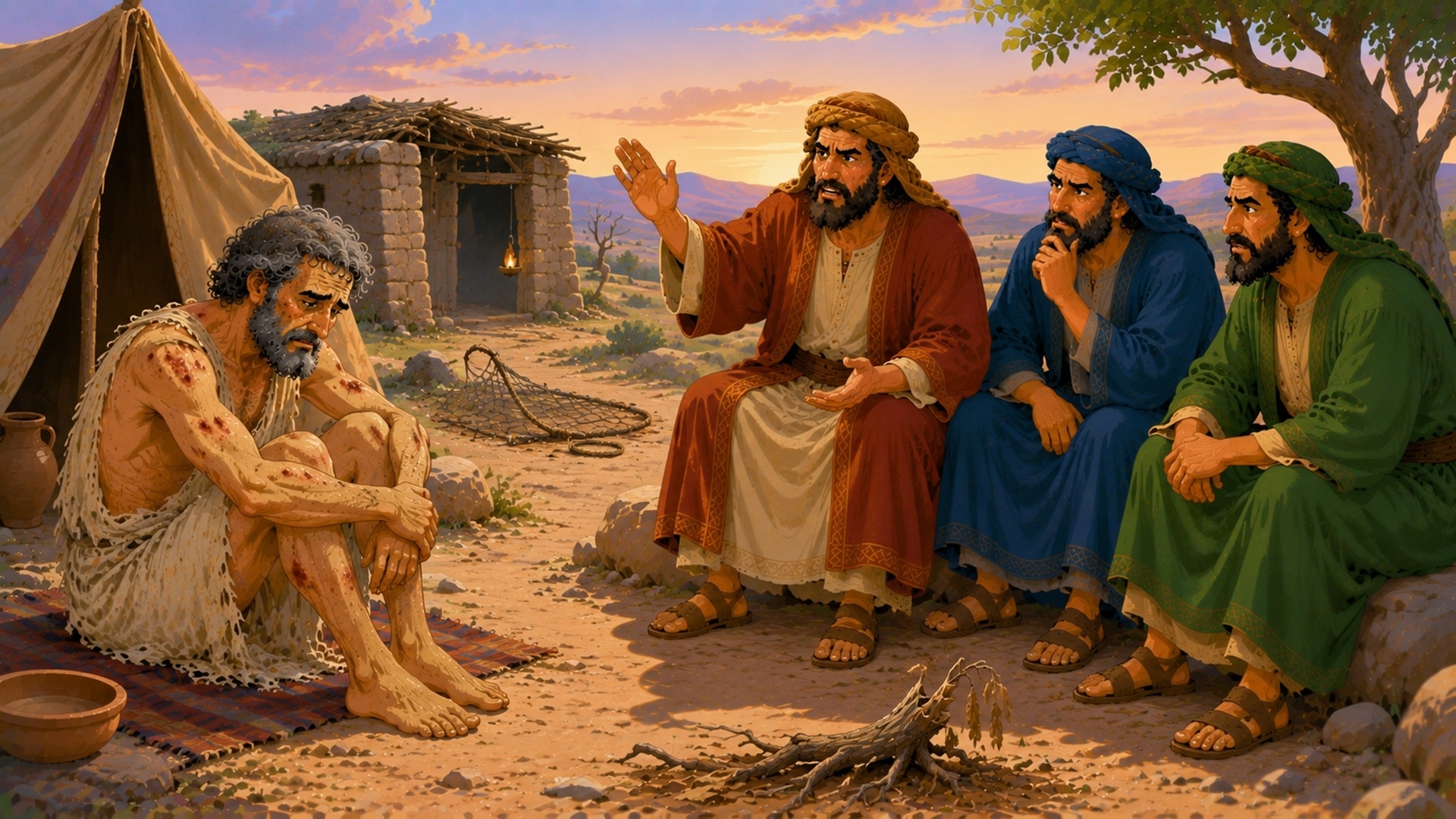
But that is not what happens. Bildad now answers again. He hears Job’s lament, but his heart does not soften. Instead, he speaks harshly and impatiently. He believes that Job talks too much and treats his friends as though they were foolish.
This chapter tells of a speech that sounds like thunder. Bildad uses powerful images to describe how the light of the wicked goes out, how traps wait for them, and how their security collapses. But because he directs these warnings toward Job, they do not help. Job needs comfort, but Bildad brings him fear and accusations once again.
📖 The Biblical Story
🗣️ Bildad Becomes Impatient
Bildad began his answer in anger. He asked when Job would finally stop speaking that way. To Bildad, Job’s words did not sound like the lament of a suffering person, but like rebellious speeches that needed to be corrected.
He felt attacked by Job. Job had accused his friends of not understanding him and of offering no genuine comfort. Bildad did not recognize this as a cry for help, but as an insult. He believed that Job treated them as though they had no understanding.
But Bildad did not see what lay behind Job’s words. Job did not speak that way because he wanted to despise his friends. He spoke that way because their words repeatedly wounded him. He was trying to show them that they were interpreting his suffering incorrectly.
Here we see how quickly conversations can become difficult when people no longer truly listen to one another. Job spoke out of pain. Bildad heard only contradiction. Thus, the conversation brought no comfort, but became another argument.
🌪️ Bildad Thinks Job Is Tearing Himself Apart
Bildad accused Job of tearing himself apart in his anger. By this he meant, “Job, your anger is only making everything worse.” To Bildad, Job’s lament was a sign that Job was not in a right relationship with God.
Bildad then asked, in effect, whether the whole world should be changed because of Job. Should the earth be abandoned simply because Job was suffering? Should a rock be moved from its place merely so that Job’s viewpoint could remain right?
These words sound harsh. Bildad wanted to make Job feel small and show him that he could not expect everything to be judged according to his pain. But in doing so, he overlooked something important: Job was not demanding that the world revolve around him. He wanted his suffering to be taken seriously.
When someone is crying, they do not need another person to say, “The world does not revolve around you.” They need someone who recognizes that their pain is real. Bildad did not understand this.
🕯️ Bildad Speaks of the Fading Light
Then Bildad began to speak about the wicked person. He said that the wicked person’s light would go out. The flame of his fire would no longer shine, and the lamp above him would grow dark.
The image is powerful. Light represents life, joy, security, and hope. When a house has light at night, people feel safer. When a lamp goes out, everything becomes dark and frightening.
Bildad meant that whoever lives without God will eventually lose their light. Their joy will not last. Their security will collapse. Their path will become dark.
This warning is serious. But Bildad’s mistake is that he speaks as though it applies to Job. The person sitting before him is not a wicked enemy of God, but a suffering man struggling with God. Job’s light has not gone out because he despised God. Job is suffering and does not understand God’s ways.
🪤 Traps on Every Path
Bildad continued speaking and described how the wicked person falls into traps. His own steps lead him into a net. A snare lies in his path. A trap catches him by the heel.
Children can imagine this as a dark forest with hidden traps everywhere. Whoever walks carelessly steps into one and cannot escape. Bildad wanted to show that a life lived against God is not safe, even if it appears safe for a while.
He meant that the wicked person may believe he can determine his own path. But in the end, he becomes entangled in what he has done. His own ways become dangerous to him.
Here too, we can recognize something true. Evil paths lead people into trouble. Lies, violence, and pride can become like nets in which people become trapped. But Bildad speaks this truth without compassion in the middle of Job’s pain. As a result, it does not become a help, but another blow.
😨 Terror on Every Side
Bildad painted an even darker picture. He said that terrors surround the wicked person on every side. Fear pursues him, and his steps are driven onward. He finds no rest because he lives without a firm foundation.
We can imagine someone hearing noises in the night and not knowing where to run. Danger seems to be everywhere. Every path appears unsafe. Fear becomes greater than courage.
Bildad wanted to show that a person without God cannot find true rest. When someone builds their life on wrongdoing, they cannot have genuine peace deep within. This is a serious warning.
But to Job, this speech must have sounded terrible. Job was actually experiencing fear, darkness, and uncertainty. When Bildad said, “This is what happens to the wicked,” it sounded as though he was placing Job directly in that group. This wounded Job once again.
🏚️ Security Collapses
Bildad also spoke about the wicked person’s tent. In those days, a tent was a home, a place for family, protection, and rest. But Bildad said that security would be torn away from that tent.
He described how the wicked person would be dragged away from the place where he felt safe. Everything he had trusted would fail. His home would no longer remain a place of peace. Instead, it would become a place inhabited by terror.
This image was especially painful for Job. Job had lost his home. His family had been shattered. His life was like a tent that had been torn down by a storm.
Bildad may have thought that he was speaking generally about the wicked. But to Job, these words must have sounded like arrows. They touched the very wounds that were still open.
🌱 No Root and No Branch
Then Bildad said that the roots of the wicked would dry up and their branches would be cut off. A tree lives when its roots receive water and its branches grow. But when both root and branch die, no future remains.
This image means that the wicked person has no lasting life, no secure future, and no strong support. What he has built will not continue to flourish.
For Job, this image was also painful. He had lost his children. His future felt cut off. His family, which had been like branches on a tree, was no longer with him.
That is why Bildad’s speech was so painful. He used images of loss, darkness, and ending. But Job was living in the middle of exactly that kind of loss. Instead of treating him gently, Bildad spoke as though Job’s suffering were evidence against him.
📛 His Name Will Be Forgotten
Bildad also said that the name of the wicked person would disappear from the earth. No one would remember him with honor. He would be driven from light into darkness and expelled from the world.
In the Bible, a person’s name is important. It represents remembrance, honor, and what remains after a person’s life. When someone’s name is forgotten, it seems as though their life has left no good trace behind.
Bildad wanted to show that a wicked life ultimately becomes empty. What is built without God will not endure with honor.
But once again, this truth was not the medicine Job needed. Job was not trying to defend evil ways. He was fighting against being falsely condemned. Bildad’s words made his loneliness even greater.
🌑 A Speech Without Comfort
At the end of his speech, Bildad summarized his thoughts. This, he believed, was the dwelling place of the wicked. This was what happened to the person who did not know God.
His message therefore stood clearly before them: darkness, traps, fear, shattered security, and a name that disappears. To Bildad, this was a warning. To Job, it was an accusation.
Bildad said nothing that brought healing to Job’s heart. He did not ask gentle questions. He did not sit beside Job and weep with him. He spoke about the end of the wicked while Job sat in his suffering and searched for understanding.
Thus, this chapter ends with deep tension. Bildad believes that he has spoken wisely. But we can sense that wisdom without compassion can sound like thunder to a suffering person—it causes fear but gives no light.
🌟 Job’s Answer Is Yet to Come
After Bildad’s speech, the question remains: What will Job say now? Will he silently accept these harsh words? Or will he explain once again that his friends do not truly understand him?
Job’s heart is already burdened enough. Now Bildad’s images of darkness, traps, and being forgotten are added to his pain. We can imagine how lonely Job must have felt.
But the story is not over yet. Job will continue to speak. And precisely after this harsh speech, one of the most hopeful declarations in the entire book will come from Job’s mouth.
This makes us curious: How can someone who hears so much about darkness still speak of hope? In the next chapter, we will see a bright statement shine in the middle of Job’s pain.
🌅 What This Chapter Shows
This chapter shows that Bildad describes the fate of the wicked using very powerful images. He speaks of fading light, hidden traps, fear, shattered security, and a name that is forgotten.
This chapter also shows how dangerous it is to use correct warnings in the wrong situation. Bildad speaks seriously about evil, but he directs his words against Job, who does not deserve despair but needs compassion.
🟣 Summary
Bildad answers Job for the second time and speaks very harshly. He accuses Job of talking too much and of looking down on his friends. Bildad then describes the end of the wicked using dark images: their light goes out, traps lie in their path, terror pursues them, their security is torn away, their roots dry up, and their name disappears. But Bildad makes the mistake of applying these warnings to Job. As a result, he does not comfort Job but wounds him even more.
💚 Message for Children Today
Words can be very powerful. They can help like light, but they can also frighten like thunder. When someone is sad, we should not attack them with harsh warnings. We should first listen and try to understand.
We also learn that suffering does not always mean that someone has done something wrong. Therefore, we should be careful before judging others. Compassion is often more important than a quick explanation.
💭 Questions for Reflection
🔸 Why did Bildad’s words sound like an accusation to Job?
🔸 What images did Bildad use to describe the end of the wicked?
🔸 How can we choose our words so that they comfort instead of hurt?
🧒 👧 👦
💌 Invitation to Job Chapter 19
🕊️ Job Knows: My Redeemer Lives
Bildad has spoken harshly and used dark images. He has spoken about fading light, traps, and shattered security. For Job, this was not comfort, but another burden.
But now Job will answer. He will speak about his deep loneliness, about the people who have abandoned him, and about a pain that hardly anyone understands.
Yet in the middle of this darkness, a wonderful statement will shine.
Come and discover the next chapter!
🔔 Preview of Job Chapter 19
✨ A Ray of Light in the Middle of Pain
Job feels abandoned and misunderstood. His friends are crushing him, and his family seems far away.
👉 Why does Job feel so lonely?
👉 What does he wish would happen to his words?
👉 And why does he say with hope, “I know that my Redeemer lives”?
✨ In the next chapter, we will hear one of the most beautiful expressions of hope in the entire book of Job—a light in the middle of the night.