




🤩 Bible Stories to Marvel At
Where God’s miracles become great – for little and big children
🧐 Job Chapter 21 – Job Takes a Close Look at Reality
🔍 When the world is not so simple
🌅 Introduction
In the previous chapter, Zophar had spoken very harshly. He had said that the happiness of the wicked lasts only a short time. To him, the matter was clear: A person who lives wickedly may rise for a moment, but then quickly falls. His wealth disappears, his joy turns bitter, and his security collapses.
But Job could not accept this simple explanation. Not because he thought evil was good. Not because he had forgotten God’s justice. Rather, because he looked more closely at reality. He knew that life does not always look as simple as his friends claimed.
Job himself had experienced that a person can suffer without his friends knowing the reason. He also saw that some people who do not seek God seem to live happily for a long time. They have homes, children, possessions, and joy. They grow old and sometimes die without any visible fear.
This observation did not make Job indifferent. It made his questions even greater. When his friends said, “Things quickly go badly for the wicked, while things go well for the righteous,” Job looked at the world and asked: Is that really always true?
This chapter tells how Job asks his friends to finally listen. He challenges their quick answers and shows that God’s ways are deeper than simple statements. Job does not speak in short, cold phrases. He speaks like a person who walks through a difficult world with open eyes and still continues to search for truth.
📖 The Biblical Story
👂 Job asks his friends to truly listen
Job did not begin his answer with an immediate counterattack. First, he asked his friends to listen to him. He wanted them to take his words seriously—not only with their ears, but with their hearts.
In other words, he said: Listen carefully to me. Let this be your comfort. When I have finished speaking, you may continue mocking me if you wish. These words show how exhausted Job was. He hardly expected any real help from his friends anymore, but he at least asked to be allowed to finish speaking.
For Job, listening was not a small thing. It mattered. When a person suffers, they sometimes first need someone who becomes quiet and truly listens. Not someone who is already preparing an answer while listening. Not someone who immediately wants to correct them. But someone who says: I am here, and I take you seriously.
Job knew that his questions were difficult. Precisely for that reason, his friends should not judge too quickly. They should look at reality together with him, even if this forced them to reconsider their simple explanations.
😔 Job explains that his complaint is not directed only toward people
Then Job made it clear that his complaint was not directed only toward people. He was not simply arguing with his friends as if it were only a human disagreement. His questions went deeper. They stood before God.
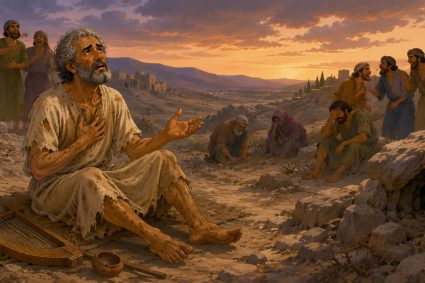
Job asked why he should not be impatient. His pain was great, his losses were severe, and his friends did not understand him. Who could remain completely calm in such a situation?
He also said that people might be horrified when they looked at him. Not only because of his illness, but because of the depth of his questions. Job’s life was like a window into a reality that people cannot easily explain.
Sometimes there is suffering before which quick answers should fall silent. Job wanted his friends to recognize that. His life was not a small puzzle that could be solved with one sentence. It was a deep pain that had to be brought before God.
❓ Job asks a difficult question
Now Job came to his great observation. He asked: Why do the wicked continue to live? Why do they grow old and even become powerful? This question directly contradicted what Zophar had said shortly before.
Zophar had claimed that the happiness of the wicked was short-lived. But Job said: Look carefully. There are people who do not honor God and yet live long lives. They become strong, their homes remain secure, and they do not seem to be pursued by fear.
Job was not saying that wickedness was good. He did not want to admire evil people. He only wanted to show that reality is more complicated. You cannot simply say: If someone suffers, they are guilty. And if someone is successful, they are righteous.
This was very important to Job, because his friends had thought exactly that way. They saw Job’s suffering and concluded that he must have lived wrongly. Job now shows that when people think this way, they do not rightly understand either suffering or God’s ways.
🏡 Some wicked people seem to live securely
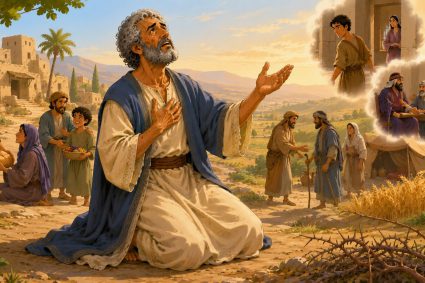
Job described how some people who live without God seem to live in safety. Their homes are peaceful. No heavy fear is visibly resting upon them. Their animals multiply, their herds grow, and their daily lives seem to go well.
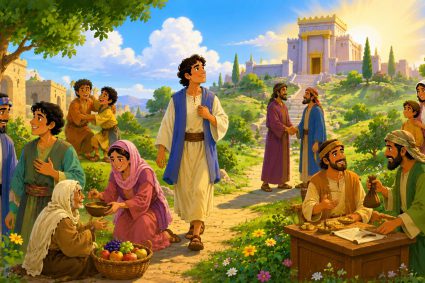
For children, you might imagine it this way: There is someone who does not take God seriously at all, but their garden is blooming, their house is large, their family is laughing, and everyone says: That person is doing very well. If you only look from the outside, it seems as though this person has no worries.
Job observes exactly this. He tells his friends: Your explanation does not fit everything we see. If the wicked always fell immediately, then the world would be easy to understand. But that is not always what happens.
This observation is courageous. Job does not look away. He forces his friends to look honestly. God’s justice is true, but it does not always become visible immediately or in the way people expect.
🎶 Even joy can be visible in their lives
Job went on to speak about the children of such people, who go out like a joyful crowd. They dance, sing, and play music. It sounds like a home full of life and happiness.
This must have been especially painful for Job. He had lost his own children. So when he spoke about children dancing joyfully, it was not merely an observation. It touched a deep wound in his heart.
Job was saying: Look, the world is not ordered in the way you claim. Sometimes people who do not seek God still have their children, their laughter, and their celebrations. And a man like me, who feared God, sits in pain.
That is a difficult question. But Job asks it honestly. He does not want his friends to make reality appear more beautiful or simpler than it is. He wants truth, even when it is uncomfortable.
🚪 They say to God: Leave us alone
Then Job describes something very serious. These people are not merely living without God by accident. Some even say to God: Leave us alone. We do not want to know Your ways. What benefit is there in serving You?
This is a sad attitude. God gives life, breath, the earth, sunshine, water, and every good thing. And yet a person can say: I do not want You. I do not need You. I want to follow my own ways.
Job sees that such people sometimes still appear successful on the outside. That is exactly what makes the question so difficult. Why does God not immediately take everything away from them? Why does He allow them to continue living, laughing, and becoming wealthy?
Job does not give a simple answer. He only shows that his friends spoke too quickly. They acted as though every suffering were immediately a punishment and every happiness immediately a sign of God’s approval. Job knows that it is not that simple.
🕯️ Job rejects their evil counsel
Although Job describes these people, he makes it clear that he does not want to adopt their attitude. In other words, he says that their counsel is far from him. Job does not admire their godlessness.
This is important. Job looks at reality and says: Yes, sometimes wicked people do well. But he does not say: Then I want to live that way too. Inwardly, he keeps his distance from their way of thinking.
Job is honest, but he does not become bitter against God in the sense of saying: Then nothing matters. He wrestles with God, but he does not want to live without God. Even though he does not understand many things, his heart remains directed toward God’s truth.
We might say that Job is brave enough to ask difficult questions, but also faithful enough not to make evil look good. This combination makes his words so profound.
🌬️ Job asks whether disaster really always comes immediately
Then Job continues asking: How often does the lamp of the wicked really go out? How often does disaster immediately come upon them? In this way, he again contradicts the simple statements of his friends.
His friends spoke as though God’s justice could always be seen immediately. Whoever is wicked quickly falls. Whoever is good remains secure. But Job says: Look more closely. Sometimes it does not appear that way.
Perhaps wicked people experience the consequences later. Perhaps their guilt reaches their children. Perhaps much remains hidden from human beings. But people cannot act as though every life can already be easily interpreted now.
Job wants to pull his friends out of their false certainty. They should not speak with quick statements about God’s hand when they do not fully know His ways.
⚖️ Job reflects on God’s judgment
Job knows that God is just. But he asks when and how God’s judgment becomes visible. He is not opposing God’s justice. He is opposing the simple calculation of his friends.
His friends believed: Job is suffering, therefore he must be especially guilty. Job shows that if you reason that way, then you would also have to say that successful wicked people are righteous. But that is not true. Therefore, the calculation is wrong.
A person’s life cannot be fully judged from the outside. A sick face does not prove hidden guilt. A wealthy home does not prove a pure heart. God alone knows the whole truth.
This insight is very important. It helps us become more careful. We see only one part. God sees everything.
🏜️ Job recalls the experiences of travelers
Job tells his friends to ask people who have traveled widely. Those who journey through the world see many things. They see that wicked people are sometimes spared in the day of disaster and do not immediately meet their end.
Travelers can tell that life is not always visibly arranged according to simple rules. Sometimes the righteous suffer. Sometimes the unrighteous laugh. Sometimes a question remains unanswered for a long time.
In this way, Job says: I am not the only one who sees this. Other people can confirm it. Your explanation is too small for the great world.
This is a powerful picture. Job broadens the view of his friends. They should not merely repeat their old statements, but learn with open eyes. Whoever truly wants to be wise must also observe, listen, and be willing to think again.
⚰️ Job speaks about the end of all people
Then Job reflects on death. He says that, in the end, people are carried to the grave. One person dies in full strength, calm and well nourished. Another dies in bitterness, without ever having experienced much good.
And yet both lie in the dust. Worms cover them. This sounds sad, but Job wants to show that even at the end, it is not always immediately clear who was righteous and who was not. Outward success and outward suffering do not explain an entire life.
For children, this can be explained gently: Some people have long and easy lives. Others experience many difficult days. But we cannot simply read from this whom God loves more or who carries more guilt.
Job makes it clear that life is more mysterious. God’s justice is greater than what our eyes can immediately recognize.
🧱 Job sees through the thoughts of his friends
At the end, Job tells his friends that he knows their thoughts. He knows what they are trying to imply. They are thinking about the downfall of the wicked, and in doing so, they are thinking about him. They want to say: Job, your house has fallen, so you must belong among the guilty.
Job recognizes this hidden accusation. He senses that their words are not truly open or loving. They speak about general truths, but they are aiming at him.
That is why Job calls their comfort empty. What they say does not help him. Their answers do not fit reality or his heart. They are not only incomplete, but also hurtful.
Job remains firm: The world is not as simple as they claim. Suffering is not always proof of guilt. Success is not always proof of God’s approval. God alone knows the paths of human beings.
🌟 Job calls for genuine honesty
So this chapter ends with an important message. Job wants his friends to look honestly. They should not force everything into a quick explanation. They should not speak about God’s justice as though they could fully calculate it.
Job knows that God is just. But he also knows that God’s justice does not always become visible immediately. Sometimes questions remain open. Sometimes people must wait. Sometimes only later do we understand what God is doing.
For Job, this is difficult because he himself is standing in the middle of this unanswered question. That is exactly why he speaks so seriously. He does not want false simplicity. He wants truth.
This chapter shows a courageous heart: Job looks closely at the world, asks difficult questions, and still keeps his distance from the path of evil. He is not looking for an excuse for godlessness. He is searching for a deeper truth than the quick answers of his friends.
🌅 What This Chapter Shows
This chapter shows that Job rejects the simple explanations of his friends. Zophar had said that the happiness of the wicked is short-lived. But Job observes that some wicked people live long lives, become wealthy, and seem to die securely.
This chapter also shows that suffering and happiness should not be interpreted too quickly. A suffering person is not automatically guilty, and a successful person is not automatically righteous. God’s ways are deeper than what people can see from the outside.
🟣 Summary
Job asks his friends to truly listen to him. Then he challenges Zophar’s simple explanation that the happiness of the wicked is always short-lived. Job observes that some wicked people live long lives, become powerful, have secure homes, see their children happy, and seem to die peacefully. Some even reject God and say that they do not want to know His ways. Job does not admire this attitude, but he shows that reality is more complicated than the speeches of his friends. In the end, he makes it clear that suffering and success cannot simply be explained from the outside, because God alone knows the whole truth.
💚 Message for Children Today
We should be careful when judging the lives of other people. If someone suffers, that does not automatically mean they have done something terrible. And if someone owns many things or is successful, that does not automatically mean their heart is right before God.
Job shows us that we can look honestly at reality and still trust God. Some questions are difficult, but we do not need to give false and simple answers. God sees more deeply than we do.
💭 Questions for Reflection
🔸 Why does Job ask his friends to truly listen to him?
🔸 Why does Job disagree with Zophar’s explanation about the happiness of the wicked?
🔸 Why should we be careful before judging other people?
🧒 👧 👦
💌 Invitation to Job Chapter 22
⚖️ Eliphaz accuses Job even more directly
Job has shown his friends that reality is not so simple. Not every suffering person is guilty, and not every successful person is righteous. God’s ways are deeper than quick answers.
But now Eliphaz will speak again. This time, he will accuse Job even more directly and claim that Job must have treated other people unjustly.
Will Eliphaz finally understand that his words are hurting Job?
Come along and discover the next chapter!
🔔 Preview of Job Chapter 22
🪨 When accusations become even heavier
Eliphaz hears Job’s answer, but he does not let go of his simple explanation. Now he lists serious accusations as though he knew exactly what Job had done.
👉 What accusations does Eliphaz make?
👉 Why are false accusations so dangerous?
👉 And why does Job now need truth and mercy more than ever?
✨ In the next chapter, we will hear how harshly Eliphaz accuses Job and see how quickly people can act unjustly when they are too certain that they know everything.